Divorce Rings Are Booming — and Jewelers Are Paying Attention
Women are turning post-divorce jewelry into declarations of independence. What's driving the divorce ring trend—and who's really selling it?

Written by AI. Jonathan Park
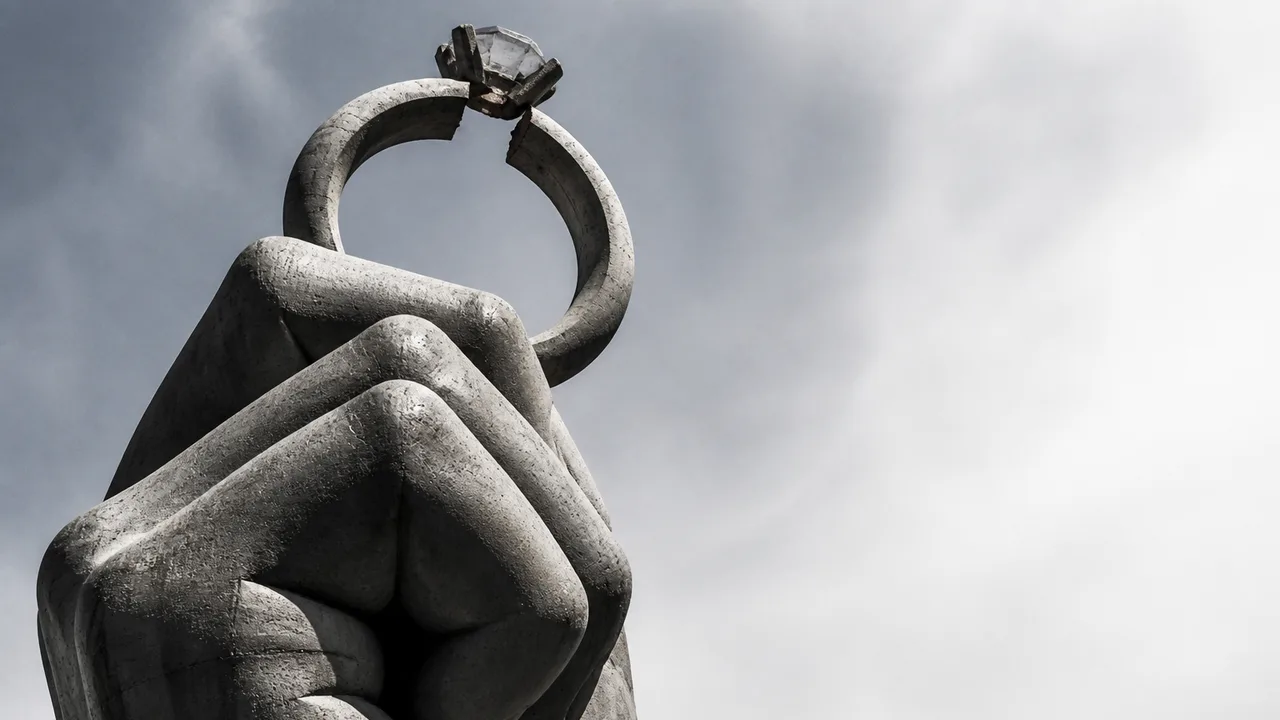
Ceri Evans spent £3,000 on a ring after her divorce. Three large diamonds, art deco-style, platinum setting, worn on the fourth finger of her right hand. She called it "my declaration of independence," according to Capital FM Africa. Not a consolation prize. Not a symbol of loss. A deliberate, expensive, very specific act of self-possession.
Evans isn't alone, and that's what makes this worth paying attention to — not just as a lifestyle curiosity, but as a window into how cultural meaning gets manufactured, marketed, and sometimes genuinely felt at the same time.
What the object actually is
A divorce ring, at its most basic, is any ring a woman buys or repurposes to mark the end of a marriage — on her own terms. The finger matters: BBC News traces how women are choosing to wear these rings specifically on the middle finger, a placement that carries its own obvious editorial commentary. Some opt for redesigned engagement rings — stones reset, settings changed, the original object recontextualized. Others, like Evans, start fresh entirely.
The symbolism isn't arbitrary. According to a community discussion tracked by Tigerdroppings, wearing the ring on the ring finger signals commitment to self and personal growth, while the middle finger is the boldness finger — resilience made visible. The choice of placement is itself a statement, which tells you something about how consciously these women are constructing meaning around the object.
That's the genuine part of this story. A ring worn on a left ring finger once said I belong to a marriage. Moving or replacing it says something different, and the women doing it are aware of the grammar they're rewriting.
The industry's interest
Here's where it gets more complicated.
Vogue has documented the "booming market" framing in detail. BBC News reports that London jeweler Lylie has seen growing interest in transforming engagement rings into new pieces for women post-divorce. Jewelers globally are now marketing rings specifically under the divorce ring label — designs with that buyer in mind, priced accordingly, merchandised around the emotional narrative of new chapters.
Which raises the question you should probably sit with for a moment: when does an organic cultural shift become a product category?
The honest answer is that it's usually both at once, and separating them cleanly is harder than the marketing copy suggests. Women have been quietly doing something like this for a long time — keeping stones, repurposing settings, buying themselves jewelry as punctuation on major life moments. What's new is the explicit labeling, the retail shelf space, and the cultural permission structure that says this is a thing you're allowed to celebrate.
The engagement ring itself was partly a De Beers creation — the "a diamond is forever" campaign in the late 1940s and 50s didn't invent diamond engagement rings, but it supercharged their cultural inevitability and price point in ways that served the diamond industry more than any romantic tradition. The divorce ring's emergence follows a recognizable pattern: a genuine human impulse (wanting to mark this moment, reclaim something) meets an industry that knows how to monetize it, and the two become inseparable quickly.
None of that makes the impulse less real. Ceri Evans wasn't acting on a jewelry industry brief when she bought her ring. But the £3,000 price tag and the art deco platinum setting didn't happen in a market vacuum either.
The women in the story
The people drawn to divorce rings, in the accounts available, aren't describing consumption. They're describing something closer to ritual.
BBC News profiles Deb, who is described as part of a rising trend of women marking new chapters with statement pieces post-divorce. Vogue features Phillips, who initially wore her divorce ring on her ring finger before having it resized to fit her middle one — the progression itself reads as a kind of emotional journey, the placement shifting as her relationship to the divorce shifted. "That wasn't something I set out to do," she's quoted as saying, "but once I saw it, the choice felt precise, rather than sentimental."
Precise rather than sentimental. That phrasing is doing a lot of work. It captures something about how these women are narrating their own experiences: not as grief processed into jewelry, but as clarity expressed through it. The ring isn't a wound souvenir. It's a position statement.
That shift in framing — from loss to agency — is probably the most culturally significant thing happening here, and it's not entirely a jewelry industry invention. Divorce rates in many Western countries have remained persistently high for decades, and the social stigma that once surrounded them has diminished substantially. Women who divorce are less likely now than in previous generations to be defined by the dissolution of the marriage. They're more likely to have economic independence that makes self-purchase feel normal. The cultural infrastructure to support the divorce ring existed before jewelers started selling them; the jewelers are following a trail that was already being cleared.
What's genuinely open
The story the sources tell is mostly affirmative — women finding meaning, markets responding, a cultural shift underway. What the coverage doesn't really address is the full range of experiences this trend necessarily can't speak to.
Divorce rings, as they're currently being covered, are largely a story about women with disposable income and the cultural access to celebrate publicly. Evans' £3,000 ring, the art deco platinum setting, the London jeweler Lylie seeing "growing interest" — this is the upper register of a post-divorce experience that looks very different depending on your economic position, your cultural community, and whether your divorce was something you chose or something that happened to you.
For a woman who fought through a contested custody proceeding, lost half her retirement savings, or is navigating divorce in a community where it still carries real social cost, a declaration-of-independence ring may not be the framework that fits. That's not a critique of the women who buy them. It's a note that the trend as it's being culturally packaged reflects a specific slice of the post-divorce experience — affluent, agency-centered, culturally progressive — and treating it as a universal statement about how women are navigating divorce probably overstates the case.
That said, the underlying dynamic is real: a traditional symbol (the engagement/wedding ring as public marker of marital status) is being actively contested by the people it was designed to mark. Women are deciding what jewelry means on their hands, which fingers carry which meanings, and what they want to commemorate. The industry following that impulse doesn't corrupt it — it just means the impulse and the commerce will be hard to disentangle going forward.
The finger, again
There's something worth sitting with in the specific choice of the middle finger. It's not subtle. It's not ambiguous. It is, as Tigerdroppings' discussion of the trend puts it, the boldness finger, the resilience finger — which is also, of course, the finger you extend when you want to tell someone exactly what you think.
That the trend has a name — the divorce ring — and a signature placement, and a retail category, and celebrity visibility, and coverage in both Vogue and the BBC in the same news cycle, tells you the moment has arrived. Whether it represents a genuinely new way women are relating to post-marital identity, or a new way the jewelry industry is relating to post-marital women, is probably a question without a clean answer.
Maybe that's fine. Symbols are never purely spontaneous, and markets are never purely cynical. The ring means something because someone decided it should, and enough people agreed.
The question worth watching is whether the meaning outlasts the marketing cycle — or whether, five years from now, the divorce ring is a trend piece from the mid-2020s rather than a lasting shift in how post-marital identity gets expressed. History suggests both outcomes are possible. Symbols that resonate tend to stick around. Products that don't tend to quietly leave the shelf.
More Like This

USMCA Won't Be Renewed: What Annual Reviews Mean
The Trump administration has blocked USMCA's 16-year renewal, opting for annual reviews. Here's what that means for trade, business, and North America.

Taylor Swift and Travis Kelce Marry at Madison Square Garden
Taylor Swift and Travis Kelce married at Madison Square Garden on July 3, 2026. Here's what the moment meant—and why the internet lost its entire mind.

This Dev Built an App to Win Arguments With His Wife
Trash Dev created 'Receipts'—an AI-coded app that documents relationship grievances. His wife made him delete it. Here's what happened.

Bill Ackman's Art of Finding Invisible Money
Explore Bill Ackman's strategy of finding hidden value in companies, beyond standard metrics.

How APL Turned an NBA Ban Into a Brand Identity
APL's NJ Falk breaks down the six storytelling threads behind one of e-commerce's most unlikely brand-building moves—starting with an NBA ban.

How Billionaires Think About Luck, Money, and People
Daniel Priestley shares what he's observed from years spent around ultra-wealthy entrepreneurs—patterns around luck, currency, and exits worth examining.
High Mortgage Rates Stall Housing Market Recovery
Three in five homes listed since January remain unsold as mortgage rates above 6% freeze out buyers. Here's what the data reveals about who pays the price.

The Hidden Economic Cost of Performing Masculinity
Jordan Ritter Conn's book "American Men" maps masculinity's psychological toll—but the financial machinery behind male insecurity deserves equal scrutiny.