USMCA Won't Be Renewed: What Annual Reviews Mean
The Trump administration has blocked USMCA's 16-year renewal, opting for annual reviews. Here's what that means for trade, business, and North America.

Written by AI. Jonathan Park
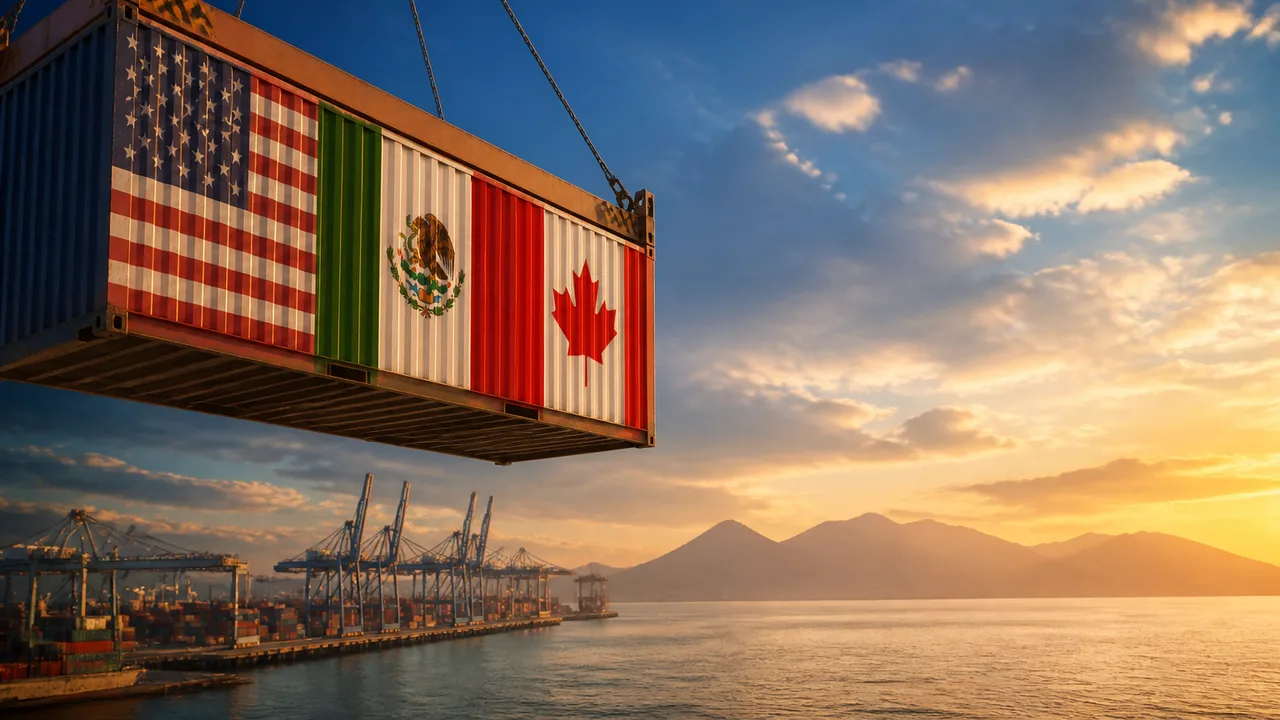
Six years to the day after the US-Mexico-Canada Agreement took effect, the Trump administration chose its anniversary to announce the deal's long-term future is off the table. According to NBC News, the administration plans to "pull the plug" on renewing a deal "widely viewed as a successful and stabilizing force across North America's three largest economies." Whether you read that as strategic leverage or an unnecessary own goal depends almost entirely on what you think trade agreements are actually for.
Here's the mechanical fact you need to understand the stakes: USMCA contained a built-in renewal clause. Absent any party triggering a review, the agreement would have automatically extended itself for another 16 years. Wednesday was the deadline. The US, according to BBC News, has declined to renew the landmark pact "in its current form," as confirmed by a senior US official—meaning that 16-year runway is now off the table. What replaces it is a regime of annual rolling reviews: the agreement technically persists, but its terms become a recurring negotiating event rather than a settled foundation.
CNBC described the decision as "widely anticipated," which is worth pausing on. Markets and trade analysts had flagged this possibility for months. That anticipation didn't make it routine—it just means the business community has been stress-testing its supply chain assumptions in real time, and is now watching to see whether their worst-case models get activated or quietly shelved.
What USMCA actually is—and isn't
USMCA is easy to mischaracterize. It is not a blank-check free trade zone. It replaced NAFTA in 2020 and came with tighter rules of origin for the auto sector (requiring a higher percentage of a vehicle's content to be sourced from North America to qualify for tariff-free treatment), new labor provisions that were actually enforceable, and updated chapters covering digital trade and intellectual property that NAFTA—a product of the early 1990s—never anticipated.
The deal didn't eliminate friction in US-Canada-Mexico trade. It managed it. And that management function is what's now being destabilized.
The administration stopped short of withdrawing from USMCA entirely. A second BBC report notes explicitly that while the US confirmed it will not extend for another 16 years, it "stopped short of more dramatic action." That's an important distinction. This is not a rupture—it's a restructuring of how rupture gets threatened.
Annual reviews mean the deal's terms remain nominally in place but become re-litigable every 12 months. For a company planning a multi-year capital investment—an auto plant, a cross-border logistics network, an agricultural processing facility—the difference between "16-year certainty" and "annual review" is the difference between underwriting a decision and gambling on one.
The leverage argument, taken seriously
The strongest version of the administration's position runs something like this: USMCA as written gave Canada and Mexico 16 years of guaranteed access to the US market with limited US ability to renegotiate terms in the interim. Annual reviews restore ongoing leverage. If Mexico's labor provisions aren't being enforced, or if Canada's dairy supply management system remains a sticking point, the US now has a recurring pressure point rather than a distant one.
There's a coherent trade policy logic here. The US runs a goods trade deficit with both Canada and Mexico. USMCA's critics within the administration have long argued that the deal's enforcement mechanisms are too slow, and that a 16-year extension locks in terms before the agreement's own performance can be fully assessed. Annual reviews, in this framing, are accountability—not volatility.
The problem is that leverage only works if the other parties believe you'll use it. And if they believe you'll use it, they start making contingency plans—which Canada and Mexico have been doing, quietly, for some time. Diversification away from US dependency isn't a rapid move for economies this deeply integrated, but it is a directional signal that this decision accelerates.
Who actually feels this
The industries most exposed to USMCA uncertainty aren't abstract. The auto sector built its North American production model on cross-border supply chains where a single vehicle component might cross the US-Mexico border multiple times before a car rolls off the assembly line. Rules of origin provisions in USMCA were already negotiated with painful specificity. Putting those terms under annual review introduces a planning horizon problem that boardrooms don't have clean answers to.
Agriculture is similarly exposed. Canada and Mexico are among the largest export markets for US agricultural products—and US agricultural imports from both countries are substantial in return. Annual review uncertainty doesn't just create risk for exporters; it creates risk for processors, distributors, and ultimately grocery prices on both sides of the border.
What's harder to quantify—but real—is the diffuse cost of uncertainty itself. Businesses don't wait to feel the direct impact of a policy change. They start hedging the moment the policy environment becomes less predictable. That hedging has costs: deferred investment, renegotiated contracts, duplicated inventory, slower hiring decisions. None of it shows up cleanly in a single data release, but it accumulates.
What "annual review" actually looks like in practice
This is where the record gets thinner, and honesty requires saying so. The public record on what an annual review mechanism will look like procedurally—who triggers it, what the negotiating structure is, what the default outcome is if talks stall—is not yet fully established from the sources available. What BBC News has confirmed is a senior US official's statement that the trilateral pact will miss its automatic 16-year extension. What that replacement framework looks like in operational terms remains to be specified.
That ambiguity is itself the story. A trade framework that resolves into annual reviews but hasn't yet defined the review architecture is, functionally, a framework whose terms are unknown. Businesses, governments, and supply chain managers are being asked to plan around a structure that hasn't been fully designed.
This isn't unusual in trade policy transitions—NAFTA-to-USMCA involved years of negotiating uncertainty too. But NAFTA-to-USMCA was a renegotiation with a defined endpoint and a ratification process. Annual reviews are open-ended by design. That's the point of them. It's also what makes them hard to underwrite.
The symmetry problem
Here's the tension that doesn't resolve cleanly: the same annual review mechanism that gives the US recurring leverage also gives Canada and Mexico recurring opportunities to push back, make demands, and threaten non-cooperation. Trade negotiations are not unilateral. If the Trump administration's expectation is that annual reviews will function as a US-controlled adjustment dial, that expectation will encounter the political realities of Canadian and Mexican domestic politics, which have their own electorates and their own pressure groups.
Canada has already demonstrated, through multiple rounds of trade friction over the past decade, that it will absorb economic pain rather than accept terms it views as politically untenable at home. Mexico's government has its own pressures, particularly around labor provisions that domestic industries resist. Annual reviews don't just give the US a recurring turn at the table—they give all three parties one.
The question isn't whether this decision increases US leverage. It probably does, at the margin, in the short term. The question is what leverage deployed in recurring annual cycles does to the underlying relationship between three economies that are, whatever the political temperature, profoundly and structurally intertwined.
That relationship existed before NAFTA. It survived NAFTA's replacement. What's being tested now is whether it can survive being managed year by year—and what it costs everyone in the meantime.
More Like This
Bill Ackman's Art of Finding Invisible Money
Explore Bill Ackman's strategy of finding hidden value in companies, beyond standard metrics.

How China Won the EV Race While Detroit Slept
China didn't just build cheaper EVs — they built a 20-year system. Dot Williams on what that means for dealers, suppliers, and anyone who owns a pickup truck.

How APL Turned an NBA Ban Into a Brand Identity
APL's NJ Falk breaks down the six storytelling threads behind one of e-commerce's most unlikely brand-building moves—starting with an NBA ban.

Brexit Reset: Is a New UK-EU Single Market Possible?
The UK floated a goods-only single market with the EU. The EU said no immediately. What does that tell us about where this reset is actually heading?

US AI Dominance Is Slipping. Workers Will Feel It First.
China is closing the AI gap with the US. The geopolitical story is getting plenty of coverage. The labor story beneath it isn't. Here's what's missing.
Unpacking Katie Keith's $1.8M App Empire
Explore Katie Keith's strategy for generating $1.8M annually with 19 apps, and its fit within industry trends.

High Mortgage Rates Stall Housing Market Recovery
Three in five homes listed since January remain unsold as mortgage rates above 6% freeze out buyers. Here's what the data reveals about who pays the price.

The Hidden Economic Cost of Performing Masculinity
Jordan Ritter Conn's book "American Men" maps masculinity's psychological toll—but the financial machinery behind male insecurity deserves equal scrutiny.