Email Isn't a Revenue Channel—It's an Ad Cost Problem
Sammy Tran argues e-commerce brands are measuring email all wrong. The real job? Making your paid ads cheaper. Here's what that actually looks like.

Written by AI. Jonathan Park
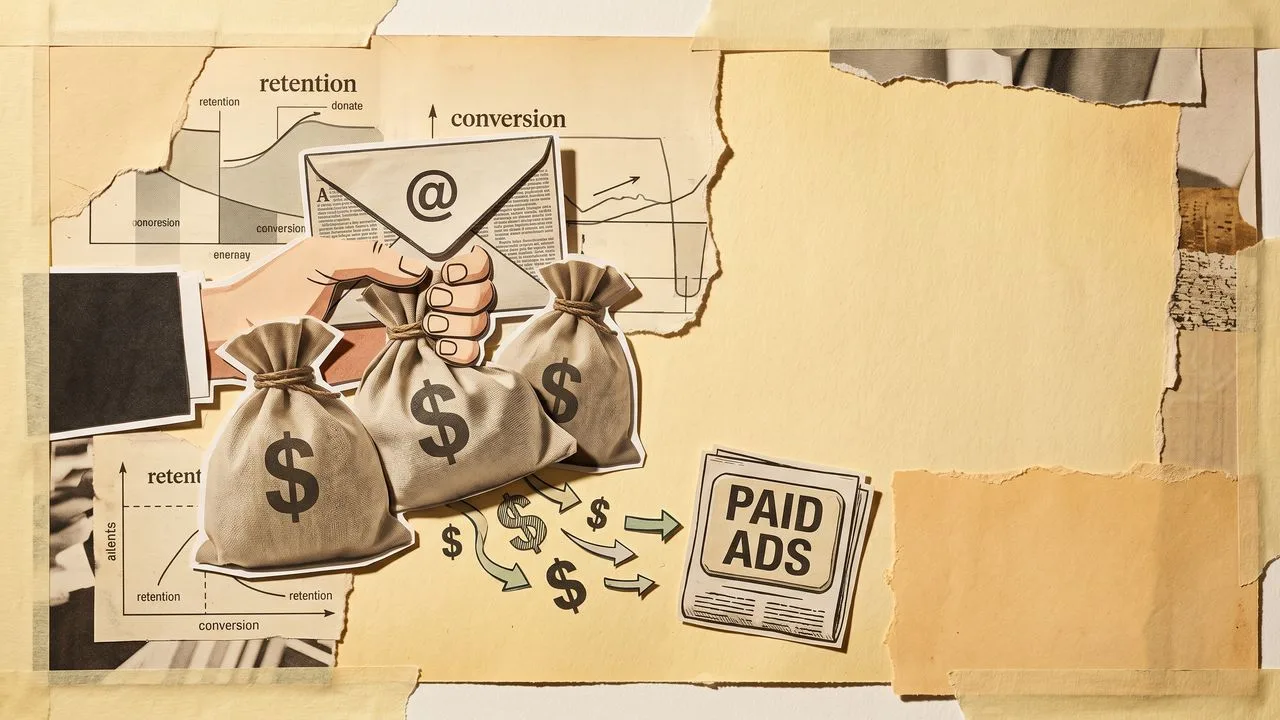
Photo: AI. Wren Sugimoto
There's a metric that lives on nearly every e-commerce marketing dashboard: email revenue. How much did email make this month? It feels like a sensible thing to track. It is, Sammy Tran argues, almost entirely the wrong question.
Tran—founder of a retention agency that's run email and SMS programs for e-commerce brands for over five years—made this case on a recent episode of The Checkout Podcast, and the framing is worth sitting with. His position isn't that email revenue doesn't matter. It's that brands obsessing over it are optimizing for the wrong output, and in doing so, leaving their most expensive problem—customer acquisition cost—completely unaddressed.
"More emphasis should go in email marketing journeys that support the acquisition funnel," Tran told host John Cole. "How can we use email as that support system and SMS to help lower cost per acquisition?"
The reframe is straightforward but meaningful: if your email program lowers your CPA, you can spend more on ads profitably. That compounds. Campaign revenue, measured in isolation, doesn't tell you that story.
The Ad-to-Popup Connection Most Brands Don't Make
The tactical centerpiece of Tran's argument involves pop-ups—which, I'll be honest, don't usually inspire much intellectual excitement. But the way he describes deploying them is genuinely more sophisticated than the standard "get 10% off, drop your email" implementation most brands are running.
The standard approach: one pop-up, shown to everyone after a three-second delay or 30% scroll. Tran's critique isn't that this is terrible—"something is better than nothing" is how Cole summarizes it, and Tran agrees—but that it ignores everything you already know about the person who just landed on your site.
Specifically, you often know which ad brought them there.
If someone clicked a Meta ad promoting 20% off a specific product and landed on that product page, showing them a generic "subscribe for 10% off" pop-up is a missed handshake. You can, instead, use UTM parameters from the ad to serve a pop-up that mirrors the offer, the imagery, and the product they already expressed interest in. Ten Meta campaigns running simultaneously means ten different pop-ups are possible. "You can create a pop-up per ad campaign," Tran explains, "and in doing so, you control that funnel post-ad-click onto the website with email."
The logical extension of this—pop-ups multiplied by ad campaigns, multiplied by product pages—can get unwieldy fast. Cole presses him on this, and Tran doesn't pretend it's simple. "It is a lot of work," he says. Then: "Do you want efficient ad spend?"
That's the real answer. The work isn't waste; it's the thing that turns ad spend into a scalable system rather than a leaky bucket.
The 80/20 Entry Point
For brands earlier in their growth—Tran and Cole use the example of a $3M annual revenue brand wondering whether to prioritize acquisition or retention—the prescription is more focused. Not a hundred pop-ups. Start with the top three landing pages and the top three-to-ten highest-spending ad campaigns. Look at those intersections and ask whether there's anything meaningfully different about each that warrants its own messaging.
Sometimes the answer is no—the same pop-up works across everything, and the testing focus should shift to the offer itself (percentage discount versus dollar amount, giveaway entry versus immediate discount). Tran's framework for offer testing is unit-economics-first: if bumping from 10% to 15% off costs you 5% margin but increases pop-up conversion rate by 20%, you run the math on actual contribution dollars, not the percentage change in isolation.
"There's no rule of thumb in particular," Tran says. "It's how you understand the unit economics behind the business."
This is either refreshingly honest or slightly frustrating, depending on your relationship with ambiguity. There's no universal ratio—no clean "sacrifice X margin for Y conversion lift and you win." What Tran is describing is a process of building toward understanding your specific business's numbers, not borrowing someone else's benchmark.
The Attribution Problem Hiding in Plain Sight
One of the more uncomfortable threads in the conversation involves how agencies—and Tran owns one, which earns him some credibility here—tend to report email performance. The default attribution window on most platforms is 30-day click. That means if someone received an email and then, at any point in the next 30 days, made a purchase, the email platform credits that sale to email.
The catch: the customer doesn't even have to open the email.
"They just didn't have to open it. They didn't have to see it," Cole notes. Tran confirms this is standard practice and that it's where agency incentives and honest measurement can diverge. Agencies want to show revenue lift; inflated attribution windows deliver that picture whether or not email actually drove the behavior.
Tran frames his agency as trying to do this differently—building toward incrementality measurement rather than defaulting to the widest attribution window that flatters the numbers. But he's also candid that this is harder to sell. Showing a client that your work generated $200K in "email revenue" is a cleaner pitch than explaining the methodological nuances of why that number is probably wrong.
This is worth naming for any brand working with a retention agency: ask what attribution model they're using. Ask what happens to the revenue number if you tighten the attribution window to seven-day click. The answer will tell you something.
Testing Discipline, or Lack Thereof
The conversation about split testing mechanics is, unexpectedly, one of the more honest moments in the episode. Cole and Tran disagree—productively—on how aggressively to test new pop-up offers.
Tran's position: when introducing a new offer format (say, switching from percentage discount to a giveaway), start by routing only 10-20% of traffic to the new variant. Protect the working version while you gather data.
Cole's counter: go 50/50 and get answers faster. His reasoning—working on a large brand with enough traffic to hit statistical significance in two days—is sound for his specific context. For a smaller brand that might take weeks to reach significance even at 50/50, Tran's conservative approach is the more appropriate one. And Cole acknowledges this.
What neither of them quite says explicitly, but what sits underneath the whole discussion: testing discipline is contextual. The "right" approach depends on your traffic volume, your risk tolerance, whether you work in-house or at an agency (agencies face stakeholder anxiety that brand-side operators don't), and how quickly you can iterate if something goes wrong.
There's also a buried observation about agency dynamics that's worth pulling out. Cole notes that marketing philosophies inside agencies often get shaped "almost as much on defensibility as on effectiveness." Tran, to his credit, doesn't deflect this. The incentive to run conservative tests isn't always pure caution—sometimes it's that a bad week of data generates client panic, and client panic generates account churn.
The structural argument Tran is making isn't especially radical once you hear it. Email should close the loop that paid advertising opens. The customer clicked an ad for a reason; the entire downstream experience—pop-up, welcome series, flows—should honor what that reason was and keep them moving toward a purchase. That's not retention in the traditional sense. It's acquisition with a longer memory.
The question worth sitting with for any brand running ads right now: if your email program disappeared tomorrow, would your cost-per-acquisition change? If the answer is no, Tran would say you've got the problem he's describing.
More Like This
Meta Pixel Misconfiguration Is Quietly Draining Ad Budgets
How a single tracking setup decision caused Ridge's travel ads to fund wallet sales instead. What it means for brands, consumers, and Meta's growing power over both.
Why Rushing Ads Can Sabotage Your Brand
Explore the pitfalls of early ad spending and the power of organic growth for brand success.
iGaming Retention: Loyalty in a Shifting Landscape
Explore how iGaming retention strategies adapt to shifting player behaviors and tighter regulations.
Unpacking Katie Keith's $1.8M App Empire
Explore Katie Keith's strategy for generating $1.8M annually with 19 apps, and its fit within industry trends.
OpenAI's Ad Strategy: Architecture of Trust or Just Talk?
OpenAI details its approach to ads in ChatGPT with technical separation between model and ads, data controls, and sensitivity filters. Will the principles hold?

How Brands Are Gaming ChatGPT's Recommendation Engine
Brian Dean from Backlinko reveals the off-site strategies companies use to get mentioned in AI answers. It's simpler than you think—and raises questions.

ENGO Raises €5.1M to Scale AR Sports Glasses
Grenoble startup ENGO has raised €5.1M to expand its lightweight AR glasses for athletes. Here's what the funding tells us about the wearable tech race.

China's Economy Grew 4.3% in Q2, Its Slowest Since 2022
China's Q2 2026 GDP grew just 4.3%, its weakest since the COVID lockdowns of late 2022. Here's what the numbers reveal about the structural cracks underneath.