The Bahia Emerald: A Geological Oddity and Legal Nightmare
The Bahia emerald weighs 340 kg and has at least 14 claimants. Its story spans geology, fraud, Hurricane Katrina, and a restraining order on the rock itself.

Written by AI. Olivia Meng
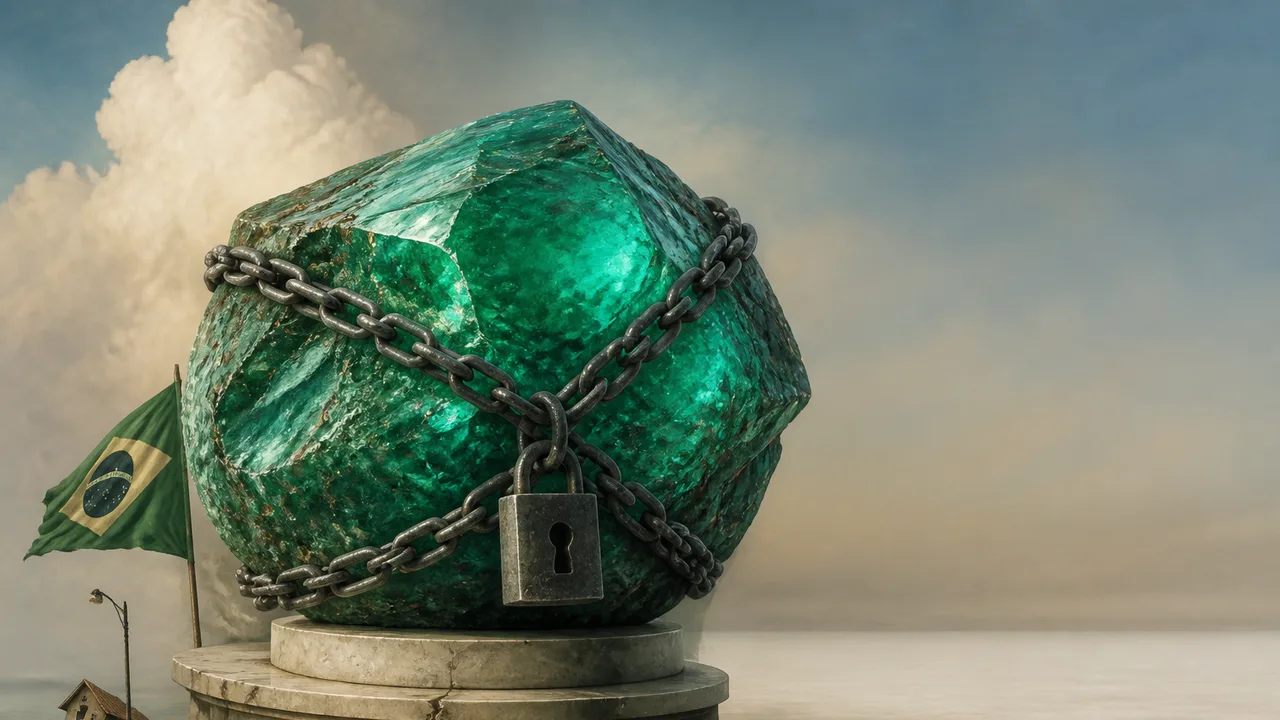
Photo: AI. Iolanthe Fenwick
There is a rock sitting in a high-security vault somewhere in Los Angeles — its precise location is not entirely certain — that has outlasted the legal ambitions of at least 14 private claimants, survived Hurricane Katrina, traveled cross-country via FedEx declared as an ordinary chunk of concrete, attracted a $127 million offer from Bernie Madoff, and received a formal restraining order from the U.S. Department of Justice. Not on any of the humans involved. On the rock.
The Bahia emerald is 340 kilograms of geological improbability, and its story is a useful lens for examining what we actually mean when we talk about ownership, value, and national heritage — because the stone challenges all three concepts simultaneously.
Something That Shouldn't Be Possible
Start with the geology, because it earns its place in this story.
Emeralds are a variety of the mineral beryl, colored green by trace amounts of chromium and vanadium. The geological problem is that beryllium — the element that makes beryl possible — is a creature of the upper crust. It's a small ion that gets pushed out of crystallizing minerals and ends up concentrated near the surface. Chromium and vanadium, by contrast, are mantle metals. Large, highly charged ions that lock into dense minerals early in the cooling process and stay deep. The vertical separation between these elements can run to hundreds of kilometers.
As SciShow host Reid Reimers puts it: "Getting the two together in a single crystal should basically never happen. And yet somehow it does."
In Bahia, northeastern Brazil, the mechanism that bridged this gap was contact metamorphism — a process where intruding magma heats adjacent host rock and, crucially, drives fluids across the boundary between them. The dark, ultramafic basement rock in the Carniba mountain range carried the chromium. A massive magmatic intrusion more than two billion years ago carried the beryllium. At the contact zone between them, superheated fluids carried both elements into a shared space, and emeralds crystallized in the narrow margin where geology's rules bent just enough to allow it.
The Bahia emerald formed in that margin. Several large, deep-green hexagonal prisms embedded in a matrix of dark host rock, roughly 90 centimeters across at its widest. The dark rock that surrounded the crystals — the part that looked, to a customs inspector, like ordinary concrete — is itself evidence of the geological event that made the emeralds possible. The "worthless" casing and the priceless interior are the same story.
The Chain of Custody That Wasn't
In 2001, two American businessmen, Tony Thomas and Ken Canedo, flew to Bahia on what appears to have been a speculative venture to acquire emeralds as collateral for a financing scheme. The shop they'd arranged to visit was, reportedly, a disappointment. The Brazilian dealers, attempting to salvage the deal, took them to a carport, pulled back a tarp, and revealed the Bahia emerald. Asking price: $60,000.
What followed is the kind of sequence that sounds fabricated precisely because no competent fraud would be this chaotic.
Thomas wired $60,000 to Brazil. Court documents recorded the payment as being for the smaller, original lot of emeralds — not the giant specimen. Thomas claimed the giant emerald went missing in transit, then didn't file a theft report. It arrived in San Jose, California in 2005 — shipped via FedEx, declared on customs forms as worth somewhere between $100 and literally zero dollars. Canedo collected it. Thomas's bill of sale, later requested by authorities, was said to have burned in a house fire. The fire was real; the document's presence inside it remains unverified by anyone who mattered.
From San Jose, the stone traveled to a storage facility in New Orleans, arriving in time to spend weeks submerged during Hurricane Katrina. Then through a Florida gem dealer who tried to use it as collateral in a diamond transaction, then — when the diamonds didn't materialize — it was forfeited to a buyer in Idaho. Then back to California. Then there was a middleman who reportedly claimed to have been kidnapped by Brazilian warlords. Then a SWAT team. Then an LA County Sheriff's helicopter.
The LA Superior Court ultimately made a tentative ruling in favor of the Florida and Idaho parties as the claimants who came closest to demonstrating legal title. The operative word is "closest" — which, given the chain of events described above, suggests the bar was not especially high.
The Problem of Value
Before Brazil's government entered the legal picture, the courts faced a more fundamental obstacle: what is this thing actually worth?
The honest answer is: it depends on who's asking and why.
Emerald valuation works differently from most gemstones. Because of their chaotic formation process, emeralds almost always contain what gemologists call jardin — networks of internal fractures, inclusions, and imperfections. These inclusions serve as a kind of fingerprint proving authenticity, but they also make the stones structurally vulnerable. A heavily included emerald is more likely to fracture when set in jewelry, which depresses its practical value. The result is that emerald pricing is, in Reimers's words, "really subjective. But ultimately an emerald is only worth what someone will pay for it."
In the Bahia emerald's case, the spread of "what someone will pay" ran from $60,000 (what was paid, originally, for a transaction whose terms are disputed) to $1.3 million (what one buyer paid for a stake in selling it) to $19 million minimum bid on eBay to $75 million buy-it-now on that same eBay listing to $127 million from Bernie Madoff, offered in a combination of cash, diamonds, and watches, and declined.
That range — from sixty thousand to one hundred and twenty-seven million — tells you something useful about gemstone markets that no simple price-per-carat formula can capture. Value here is less a property of the stone than a function of narrative, scarcity, and the willingness of any given buyer to believe in both.
What Belongs to Brazil
In 2024, a U.S. court ruled in favor of the Brazilian government, which had argued that the stone was extracted without valid mining rights, making the original transaction legally void from the outset. The U.S. government announced it would repatriate the emerald so it could be displayed in a Brazilian museum.
As of 2026, that repatriation has not occurred. No ceremony, no announcement, no confirmed transfer.
Brazil's position rests on a framework that applies to a lot of disputed cultural and natural property: that resources extracted from sovereign territory without legal authorization belong to the nation of origin, regardless of how many subsequent transactions occurred. It is the same argument applied to Elgin Marbles, looted antiquities, and colonial-era natural history collections. The logic is consistent. The enforcement is, historically, uneven.
The interesting tension here is not between Brazil and the private claimants — the court resolved that. It's between the legal resolution and the physical reality. The stone has been ruled Brazilian. It is sitting in Los Angeles. Those two facts have coexisted for over a year without resolution.
The Bahia emerald formed because two sets of incompatible elements were forced together under extraordinary conditions, producing something that neither set of conditions could have produced alone. Twenty-five years into its documented legal history, it remains suspended between two incompatible claims on its future — too geologically improbable to have formed, too legally complicated to move.
Whether it ends up behind museum glass in Brazil or remains in that vault is, at this point, a question of institutional will rather than law. The court made its decision. Someone still has to actually ship the rock.
More Like This
How the Asteroid Impact Ended the Dinosaur Era
Explore the catastrophic asteroid impact that ended the dinosaurs, its immediate aftermath, and the long-term environmental changes.

CIA's Ghost Murmur: Quantum Sensor or Spy Fiction?
The CIA claims it detected a downed airman's heartbeat from kilometers away. The physics says otherwise. Here's what the science actually tells us.

Why Everyone on Earth Commutes for 78 Minutes a Day
New research finds humans worldwide average 78 minutes of daily travel—regardless of wealth, distance, or transport mode. Here's what that means for energy and climate.
Ancient Amazon Civilizations Revealed by Archaeology
LiDAR mapping and new excavations are overturning the myth of a pristine, empty Amazon—revealing cities, roads, and millions of lost inhabitants.
Rommel's Gold: Nazi Plunder or Enduring Myth?
The story of Rommel's lost gold is part treasure hunt, part Holocaust history. What do we actually know—and what are we choosing to romanticize?

Understanding the Real Risk of Brain-Eating Amoebas
Explore the facts and myths surrounding brain-eating amoebas. How real is the threat, and can climate change affect its spread?

Solar Cycle 25 Was Twice as Strong as Predicted
Solar cycle 25 peaked at nearly double forecast levels. Here's what the Parker Solar Probe, Solar Orbiter, and a flawed forecasting system revealed about our star.

Anil Menon Reaches the ISS on His First Spaceflight
NASA astronaut Anil Menon launched to the ISS on July 14 aboard Soyuz MS-29. His eight-month mission raises questions about what space cooperation looks like next.