Japan's Deep-Sea Bet on Rare Earth Independence
Japan is spending half a billion dollars mining rare earths six kilometers underwater. The numbers don't work—and they're doing it anyway. Here's why that matters.

Written by AI. Dorothy "Dot" Williams
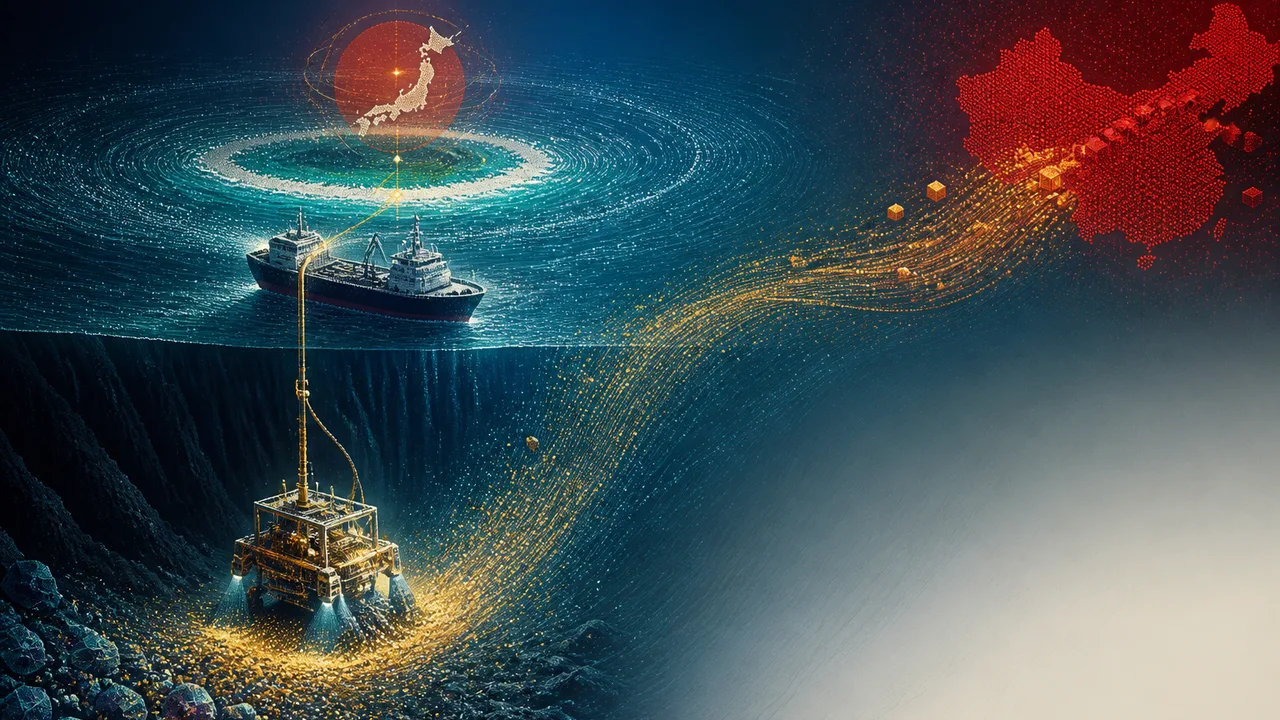
Photo: AI. Dexter Bloomfield
I want to tell you about a tiny coral atoll in the middle of the Pacific Ocean that, over the last century and a half, has been fought over for bird poop, fortified against a land invasion that never came, used to navigate ships before GPS existed, turned into a seabird sanctuary, and is now the centerpiece of a government industrial policy gamble that would make any banker in the room quietly excuse themselves.
The island is called Minamitorishima. It is less than a square mile, sits nine meters above the ocean, and hosts a small rotating crew from Japan's Self-Defense Force and a weather agency. What it also sits above — some 6,000 meters below the seafloor, which is itself about 10 meters below the surface of said seafloor — is a significant deposit of rare earth elements. Specifically, the heavy rare earths: yttrium, europium, terbium, dysprosium. The ones China has an effective stranglehold on globally, and the ones that go into the motors, magnets, and electronics that run modern manufacturing.
The Asianometry channel published a detailed breakdown of Japan's Minamitorishima project this week, and the piece that stuck with me is the part the headline writers always skip: the economics are genuinely bad. And Japan is doing this anyway. That combination tells you something important — not just about Japan, but about what happens to any business, any country, any operation that waits too long to diversify a critical supplier relationship.
How a supplier problem becomes a six-kilometer-deep engineering project
In 2010, China didn't formally declare an export ban on rare earths to Japan — what happened was more informal and harder to fight: customs processing slowed, shipments stopped moving, the tap got turned off without anyone putting it in writing. The trigger was a territorial dispute. The mechanism was administrative. The effect was the same as a ban for the companies downstream who needed the materials.
Anyone who has run a supply-dependent business knows this exact feeling. It's not always a blunt instrument. Sometimes your supplier just stops returning calls on the same timeline. Sometimes lead times quietly stretch from four weeks to twelve. By the time you've confirmed there's a problem, you've already missed production windows.
Japan's manufacturing sector — precision equipment, automotive, electronics — runs on rare earths the way a kitchen runs on salt. You don't need a lot, but nothing works without them. As Asianometry puts it: "like technology vitamins. We don't need a lot of them, but nothing works without them." After 2010, Japan went looking for alternative sources, signing supply deals with Australia and Brazil. But according to Asianometry, Japan still sources somewhere between 60 and 80 percent of its rare earths from China — a spread wide enough to warrant your own research before quoting it, but the directional reality is not seriously disputed. For all the diversification efforts, the dependency held.
So a research group led by Professor Yasuhiro Kato at the University of Tokyo started pulling sediment cores from the Pacific floor. Two thousand samples. Seventy-eight sites. What they found near Minamitorishima — concentrations of heavy rare earths at 2,000 to 7,000 parts per million, sitting in the mud because millennia of fish bones had done the slow geological work of accumulating them — was the kind of discovery that gets declared "semi-infinite" in press releases and then runs directly into the wall of reality.
The numbers, plain
Here is what the numbers actually say, translated out of the register of financial analysts and into something recognizable:
A 2021 economic analysis, cited by Asianometry but not attributed to a specific named study (which is worth flagging if you're tracking this closely), ran the project at 10-year average rare earth prices and got an IRR of 3.7 percent and a net present value of negative $525 million over a 15-year project life. That's not a deal with a funding gap. That's a deal where you do all the work, take all the risk, spend a decade and a half building out frontier technology at 6,000 meters underwater, and end up half a billion dollars behind where you started — assuming nothing goes wrong technically, which it will, because this has never been done before at scale.
No bank touches that. No private equity firm touches that. Your local SBA lender would not touch that. The only entity that touches that is a government that has looked at its alternative — not getting the rare earths at all — and decided the loss is worth it.
That is, genuinely, a defensible position. It is also a position that reveals just how badly the dependency got before anyone took it seriously enough to act.
What six kilometers of pipe looks like
The technology Japan settled on is called pulp lifting, or pipeline lift. You put a machine on the seafloor that turns the ore and mud into a slurry, and you suck it up through a pipe — 3,000 meters of pipe in the current configuration — using compressed air. The slurry comes up, gets separated and dewatered on the island itself, gets loaded onto a transport vessel, and goes to a processing facility where acid does the extraction work.
Asianometry walks through the alternatives they ruled out — drag buckets (too destructive, like "Disney villainy levels of stuff"), continuous loop bucket systems (tangling risk, spillage), French-developed shuttle vehicles (too complicated, too many failure points) — before arriving at the pipeline method as the least bad option. The environmental costs are real: immediate loss of seafloor marine life in the extraction zone, and silt plumes that can suffocate surrounding areas for weeks or months. Japan says its closed-mining apparatus will suppress the sediment plumes. How much, the video notes honestly, remains unclear.
Before the reported test extraction near Minamitorishima, the team ran a smaller integrated test in 2022 in 2,400-meter waters off Ibaraki Prefecture, successfully pumping up 70 tons of slurry per day. The scale-up target is 350 tons per day, with expanded trials scheduled for 2027.
One important note on timing: Asianometry states the first successful on-site test extraction occurred in February 2026. That date, depending on when you're reading this, may still be recent or may not yet be independently verified across multiple sources. The video presents it as confirmed, and I'm treating it as such — but if you're making procurement or policy decisions based on this, verify it yourself.
The jurisdictional piece, in plain terms
There is one advantage Minamitorishima has that has nothing to do with geology. The deposits fall entirely within Japan's 200-nautical-mile exclusive economic zone. That matters because the International Seabed Authority — the UN body that governs deep-sea mining in international waters — has not finished writing the rules for this kind of operation, despite years of missed deadlines. Mining inside your own EEZ means you answer to your own environmental regulations, not an international body still working out what it believes.
This is not a loophole. It's a legitimate jurisdictional fact. But it does mean the project moves faster and with less external oversight than it would if the deposits were a few miles further out to sea. Japan also holds an ISA exploration contract for international waters near Hawaii, and the engineering knowledge from Minamitorishima is meant to apply there too. China reportedly holds a contract in the same zone.
The real cost of waiting
Here's what I keep coming back to. The 2010 supply disruption was not a surprise. China had been consolidating rare earth production for years, had been signaling that these materials were strategic assets, and any manufacturer paying attention to their supply chain had years of warning. The warning was there. The dependency deepened anyway.
Small manufacturers in the U.S. who ran motors, made components, sourced materials that ran through Chinese processing — they know this story in a different register. Not as geopolitics, but as the slow-motion realization that the supplier you never bothered to qualify an alternative for has become the supplier you cannot replace. By the time you know you have a problem, the cost of fixing it is multiples of what it would have been to diversify earlier.
Japan is now spending roughly $500 million over 15 years — a project with no clear path to commercial profitability, at depths where the Titanic (which sits at around 3,800 meters) would be considered the shallow end — because the alternative is continued dependence on a supplier that has already shown it will use that dependence as a lever.
Asianometry puts it straight: "$500 million over 15 years seems like a fair price to pay, considering especially that the alternative would simply be not getting the rare earths."
That's not a ringing endorsement of the project economics. It's a description of what supplier lock-in actually costs when the lock gets turned.
The bird poop is long gone. The seabirds have the island to themselves again. What's left, buried under miles of cold dark water, is the consequence of a supply chain decision nobody made — which is its own kind of decision.
More Like This
Uganda Vanilla Could End the Price Chaos
Madagascar's vanilla monopoly has wrecked small business budgets for decades. Uganda's emerging industry might finally offer the stable supply chain Main Street needs.

Lloyd Blankfein's Risk Rules Work on Main Street Too
Lloyd Blankfein's frameworks on crisis management, contingency planning, and AI risk translate directly to small business — if you know where to look.
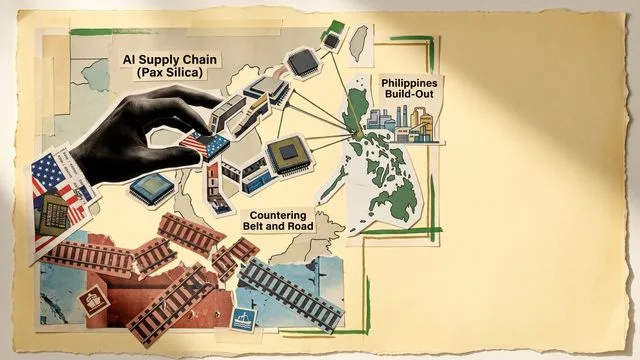
Pax Silica: America's Answer to Belt and Road
The Trump administration's 14-country AI supply chain coalition sounds ambitious. Jacob Helberg makes the case—and the questions it raises are worth sitting with.
Intel's 30 Years in Costa Rica: What Happened
Intel is closing its Costa Rica assembly plant after nearly 30 years. The story looks familiar if you've ever watched a big employer come to town — and then leave.

Russia's Disinformation Playbook Hits Main Street
Storm-1516's AI deepfake operation isn't just geopolitics—it's the same smear playbook that's been destroying small businesses for years. Here's what you need to know.

Ocean Currents, Arctic Strategy, and a Broken Thermostat
A retired colonel examines what ocean current science means for Arctic strategy, NATO stability, and the defense planners who keep nodding politely.

Texas Is Becoming the Hub of Commercial Space
From SpaceX's Starbase to Firefly's moon landing, Texas has become the center of commercial space. Here's what's driving the shift—and what it costs.

Spain's Immigration Boom: Real Gains, Real Costs
Spain's mass immigration wave is propping up its pension system — but stagnant wages and a housing crisis reveal what the government isn't building alongside it.