Ancient Sky Serpents and Dragons: What UAP Claims Get Right and Wrong
Fire-breathing dragons and metallic sky creatures are being reread as ancient UAP reports. We examine the evidence, the translation problem, and what history actually shows.

Written by AI. Sofia Ramirez
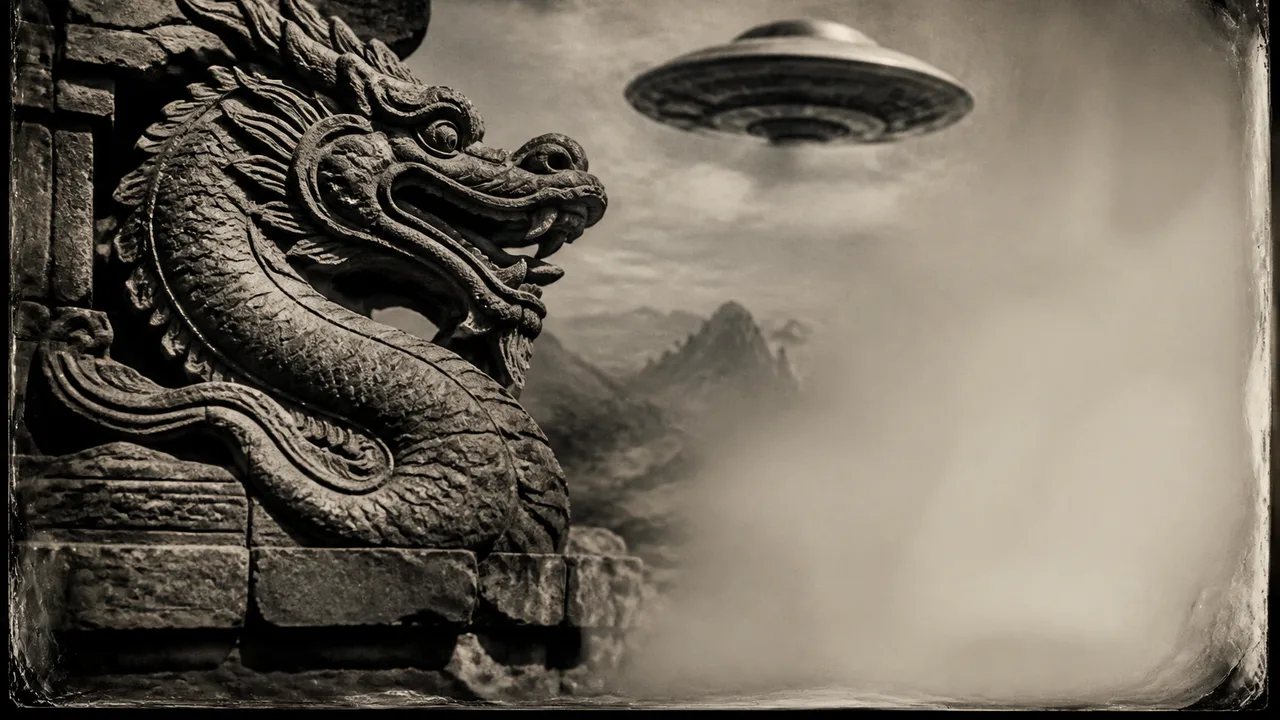
Ancient Pages published a piece this week asking whether fire-breathing dragons, metallic sky creatures, and iron serpents described by ancient cultures were records of unidentified aerial phenomena, encounters with technology observers could not explain (ancientpages.com). The question is old. Erich von Däniken was asking a version of it in 1968, and the History Channel has been monetizing it for two decades. What makes the current moment different is that UAP talk has moved from the fringe to congressional hearings and NASA reports, which gives recycled ancient-astronaut claims a fresh patina of respectability.
So it's a fair moment to ask the historian's question carefully: when an ancient writer describes a gleaming wheel in the sky or a serpent breathing fire, what are we actually looking at?
The Case Being Made
The strongest version of the argument runs like this. Ancient Origins frames it generously: long before cameras, ancient civilizations used written language, the most advanced recording technology available to them, to document extraordinary aerial encounters. Strip away the religious and cultural terminology of the era, the argument goes, and the physical descriptions underneath might refer to real objects in the sky.
There's a kernel of legitimacy here that skeptics sometimes skip over. Ancient sky watchers were careful observers. Chinese court astronomers logged sunspots and supernovae with enough precision that modern astrophysicists still use their records to date the Crab Nebula. Medieval chroniclers recorded comets, auroras, and eclipses that astronomers have since verified. Some fraction of strange sky reports are surely reports of strange sky phenomena: bolides, ball lightning, parhelia, auroral displays. The sky has always been weird, and people have always written down what they saw.
Cryptid Atlas, cataloguing the sky-serpent motif, notes the mythological reading: these are continuations of ancient dragon archetypes, later reinterpreted through modern sky events, with a skeptical explanation on offer in wind-swept cloud structures, airborne debris, and, in the modern case, digital compression artifacts (cryptidatlas.com). The site also notes the obvious cultural driver: the motif got its current fame from Ancient Aliens on the History Channel.
Why the Evidentiary Distance is Enormous
Here's where the historian's toolkit earns its keep, and where the UAP rereading falls apart under any real scrutiny.
First, the transmission problem. Almost nothing we read as an "ancient account" is an original document. Texts were copied by hand for centuries, each copy an opportunity for scribal error, embellishment, and harmonizing with convention. They were translated across languages that lacked vocabulary for the concepts involved. They were moralized, embedded in mythic systems that had their own logic about what a sky serpent was for. A vivid description may be several literary generations removed from anything anyone saw.
Second, the genre problem. Ancient writers did not operate under modern journalistic norms. A chronicler reporting prodigies in the sky was often making a political or theological argument; omens justified reigns, warned of usurpers, explained plagues. Anomalien.com, which is broadly sympathetic to the ancient-mystery frame, makes the concession itself: ancient writers treated these phenomena as signs of social unease and impending disaster. The sky story is doing work in the text's own world, and you can't peel the observation off the work like a label.
Third, the independent-witness problem. A real flying machine leaves a trail. Multiple unconnected sources in different regions would describe a similar object with consistent physical details: sound, speed, duration, effects on animals, shadow on the ground. What we mostly find instead is a motif. Sky serpents show up across cultures in forms that track local cosmology, not a shared engineering spec. When descriptions do converge, convergence often tracks trade routes and shared texts, which points to the story traveling rather than the object.
Fourth, the missing material record. If mechanical objects appeared in antiquity, we'd expect physical traces: metallurgy with no ancient analogue, altered crop residue, artifacts. In two centuries of systematic archaeology, none has surfaced that convinces mainstream science. Meanwhile, the official position has hardened rather than softened. Anomalien.com notes that a recent NASA report concluded there is no evidence suggesting UAPs are of extraterrestrial origin. That conclusion concerns modern cases with sensor data and trained witnesses; the evidentiary bar for ancient literary passages is vastly higher.
What Both the Believers and the Debunkers Miss
The ancient-astronaut reading fails as evidence, but the reflexive dismissal misses two things that matter.
One is what the anomaly does in the society that records it. Anomalien.com observes that modern reactions to UAPs resemble those of thousands of years ago, and the parallel holds up better than the technological claim does. Ancient people read sky anomalies as omens of disaster and social breakdown. We read them as signs of hidden government technology and cover-ups. Both readings convert an ambiguous sighting into a story about power: who knows, who hides, what's coming. The sky serpent and the crashed craft serve the same anxiety with different props.
Two is the labor question, which is where my own lens comes in. Who did the observing? The court astronomers and temple scribes who recorded prodigies were trained specialists, part of state machinery, producing records whose purpose was often to legitimize the state. Their anomalies are preserved because institutions preserved them. Ordinary people saw uncountable things in the sky and recorded none of them; they had no ink and no archive. Any rereading of ancient sky stories is a rereading of the official record, and the official record is a curated artifact. That doesn't make it false. It means we're looking at what power found useful to write down, then, exactly as now, when congressional UAP testimony competes with Pentagon reports over which official story wins.
The Honest Historical Task
Separating literary convention from observation is possible, and it has been done. Historians of science pull verified celestial events out of chronicles by cross-referencing independent sources, checking against astronomical retrocalculation, and weighing genre. A comet that appears in Chinese, Japanese, and European records in the same year is probably a comet. A flaming wheel that appears in one apocalyptic text, structured to mirror an earlier prophecy, is probably a literary inheritance.
The UAP rereading skips this work because the work is the product's enemy. Ambiguity is the asset. A description that could be anything can be claimed as anything, which is why the same passages serve ancient astronauts in one decade and interdimensional beings in the next. The question "did observers encounter technology they couldn't explain?" is answerable in principle, and the accumulated answer, across translation, genre criticism, and two centuries of archaeology, is that we have stories about the sky, not records of machinery.
The older stories will keep getting remade. Every generation projects its own machines upward: Victorian commentators found airships in scripture; the Cold War found saucers; our decade finds sensor-swallowing craft. The iron serpents of the ancient sky tell us about what a society fears is hidden above it right now. That's a history worth reading closely, and it's the history the disclosure narrative keeps rewriting in its own image.
More Like This

An 11,000-Year-Old Statue of a Man Riding a Leopard
Archaeologists unearthed an 11,000-year-old statue at Karahan Tepe, Turkey, showing a man riding a leopard. What does it tell us about Neolithic power?
The Bari Disaster: Mustard Gas, Secrecy, and 1943
On December 2, 1943, a German raid on Bari killed over a thousand people—and released mustard gas that officials spent decades trying to erase from history.
Rommel's Gold: Nazi Plunder or Enduring Myth?
The story of Rommel's lost gold is part treasure hunt, part Holocaust history. What do we actually know—and what are we choosing to romanticize?

A Physicist Calls UFO Disclosure a Distraction
Physicist Brian Keating tore through the latest government UFO release and found nothing. His argument: the timing alone makes it suspect.
Chile's Navy UFO Sighting and the Limits of Radar
A Chilean Navy helicopter filmed an unidentified object in 2014 that defied radar detection. Here's what investigators found—and what remains genuinely unsettled.

Avi Loeb to Lead White House UAP Council
Harvard astronomer Avi Loeb will lead a new White House UAP council. What the council's structure reveals about whether it's built for science or optics.

Roosevelt's 1936 Peace Promise: What He Really Meant
In 1936, FDR ran on "peace" — but he meant three different things by it. Unpacking that word reveals a political strategy still worth examining today.
The Anaconda Plan Was Right. People Paid for It.
Winfield Scott's Anaconda Plan was strategically vindicated — but the years it took to work were paid for in hunger, death, and bondage by ordinary people.