Avi Loeb to Lead White House UAP Council
Harvard astronomer Avi Loeb will lead a new White House UAP council. What the council's structure reveals about whether it's built for science or optics.

Written by AI. Olivia Meng
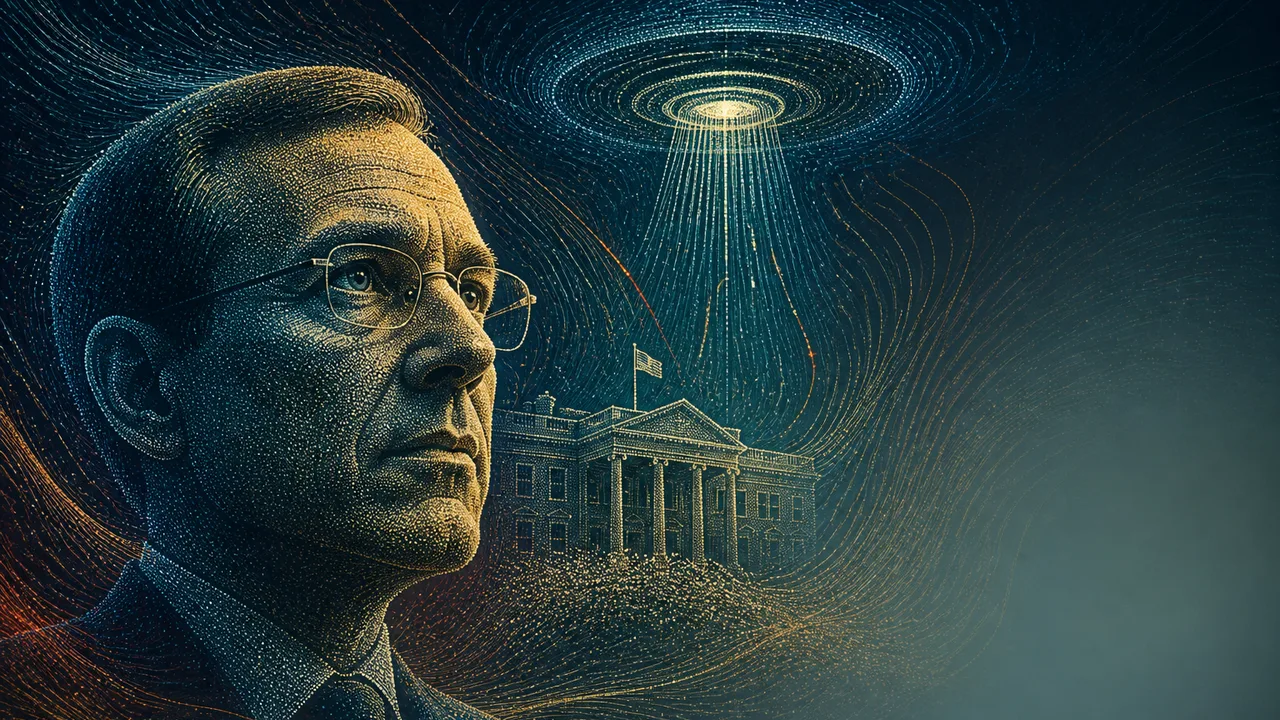
The word the press keeps reaching for is "polarizing." PBS NewsHour, The Hill, WBUR, CBS Boston — the same adjective, orbiting the same noun, in nearly every story about Avi Loeb's appointment to lead a new White House scientific advisory council on unidentified anomalous phenomena. I want to sit with that word for a moment before we move on, because on my beat, "polarizing" is a term of art. It means: this person's claims make the establishment uncomfortable, and we don't yet know if they're right.
I've watched that label applied to climate scientists for the better part of a decade. Scientists who said Arctic ice loss was accelerating faster than models predicted. Scientists who published findings on permafrost methane feedbacks that the prevailing consensus hadn't fully accounted for. "Alarmist," the coverage said. "Polarizing." Some of those findings became the new baseline. Some didn't. The point is that "polarizing" is a description of social friction, not a measurement of scientific accuracy — and a press corps that conflates the two is doing its readers a disservice.
That is not a defense of Loeb's specific claims. It is a demand for precision about what kind of challenge he actually represents.
Loeb holds the Frank B. Baird Jr. chair in science at Harvard and has had a conventional and distinguished career in theoretical astrophysics. He became a public figure — and a contested one — when he argued publicly that 'Oumuamua, the first interstellar object detected passing through our solar system, might be an artifact of alien technology rather than a natural formation. The mainstream scientific community was skeptical, and said so loudly. More recently, he has led expeditions to recover what he believes may be interstellar material from the ocean floor, work that has generated both scientific interest and pointed criticism about methodology.
The relevant question for this story isn't whether Loeb is right about any particular claim. It's what his appointment to a formal White House advisory body tells us about what that body is designed to do.
According to Space.com, Loeb will head a group studying unidentified anomalous phenomena — a term now used as a catch-all for objects and occurrences that might appear not just in the air but in space or underwater. CBS Boston reports that the council is framed, at least in press coverage, around studying national security risks posed by UFOs — though whether that language reflects the council's official charter or CBS's paraphrase of it is not made clear by the available sourcing. That ambiguity is itself informative.
Here is the structural question I keep coming back to, the one my beat has made it impossible to ignore: governments create formal scientific bodies for two distinct reasons. The first is to generate findings — to actually resolve an empirical question that has become too consequential to leave unexamined. The second is to absorb pressure — to demonstrate seriousness without committing to conclusions, to give political cover in the shape of a credential-laden committee.
On the climate side, I have watched both types operate. The Intergovernmental Panel on Climate Change was built with the first logic and has, imperfectly and sometimes frustratingly slowly, actually produced it. Other bodies — advisory panels convened under administrations that were ideologically hostile to the findings they were tasked with producing — functioned as delay mechanisms. The tell was never the roster. It was the mandate: how specific were the deliverables, how public would the data be, and did the body have any authority to compel disclosure from the agencies whose files were most relevant?
I don't yet know the answers to those questions for this council. Neither, based on the available reporting, does anyone else — at least not on the record. NewsCord aggregated thirteen sources covering this story, and the structural details of the council's mandate remain thin across all of them. What we know is: Loeb leads it, it is described as a team of "outside scientists," and it is framed around national security and UAP investigation. What we don't know is whether it has independent access to classified sensor data, whether its findings will be published, or whether it has a fixed reporting timeline. Those are not secondary details. They are the entire mechanism.
Loeb, whatever one thinks of his specific theories, is genuinely committed to treating UAP investigation as a scientific problem rather than a cultural one. That instinct is worth something. The field's credibility problem has long been that serious instrumented observation has been crowded out by eyewitness testimony and unfalsifiable claims — a dynamic that makes rigorous researchers reluctant to engage and leaves the space to people who aren't. A scientist willing to plant proper sensors, collect calibrated data, and publish methodology is doing something qualitatively different from the existing UAP discourse, even if some of his prior conclusions have outrun his evidence.
The word "polarizing," deployed reflexively, risks obscuring that distinction. And here is where the climate parallel becomes concrete, not rhetorical: when I covered early attributional climate science — the work of trying to establish the fingerprint of anthropogenic warming in specific weather events — mainstream outlets routinely described the researchers as "controversial" because their findings implicated fossil fuel interests. The controversy was real, but it was political, not scientific. Coverage that failed to make that distinction ended up, in retrospect, on the wrong side of a very large empirical question.
I am not suggesting UAP investigation is the equivalent of climate science in terms of the evidence base. It is not. What I am noting is that the word "polarizing" can perform the same rhetorical function in both cases: it signals that a claim is contested without specifying what kind of contest is happening and who is doing the contesting. Readers deserve that specificity.
So here is what I'll be watching, and what I'd suggest you watch too.
The council's credibility as a scientific enterprise — rather than a political one — will become visible at a specific and measurable moment: when, or whether, it releases its data collection protocols. Not its findings. Its methodology. A body that publishes instrumentation standards, sensor specifications, and data-sharing agreements with relevant defense and intelligence agencies before it publishes any conclusions is behaving like a scientific institution. A body that produces a summary report without that scaffolding is behaving like a communications operation. That's the test I know how to apply because I've applied it before — to emissions monitoring programs, to environmental impact review panels, to every government body that has ever been handed a politically inconvenient empirical question and told to study it.
If within the next six to twelve months the council has published a data governance framework and secured a formal data-sharing agreement with at least one defense agency, Loeb's appointment will have been the real thing. If the first output is a press conference with unverified images and no replicable methodology, we'll know what kind of body this was built to be.
More Like This
Rethinking Cosmic Acceleration: A Local Illusion?
Exploring the debate on whether the universe's acceleration is a local phenomenon, challenging the concept of dark energy.
How the Asteroid Impact Ended the Dinosaur Era
Explore the catastrophic asteroid impact that ended the dinosaurs, its immediate aftermath, and the long-term environmental changes.
Subcritical Reactors: Nuclear Power's Safety Fix?
A new generation of subcritical reactors promises to make nuclear meltdowns physically impossible. But can they deliver on cost, scale, and timeline?
Understanding the Real Risk of Brain-Eating Amoebas
Explore the facts and myths surrounding brain-eating amoebas. How real is the threat, and can climate change affect its spread?
Avi Loeb on Methane, Microbes, and Interstellar Objects
Avi Loeb tells Brian Keating that JWST methane data from 3I/ATLAS is puzzling enough to warrant a microbe hypothesis—and explains why a dark comet might be Soviet.
Ben Bernanke Joins Anthropic's AI Oversight Trust
Former Fed Chair Ben Bernanke joins Anthropic's Long-Term Benefit Trust. Here's what his economic expertise actually means for AI governance—and what it doesn't.

The Aurochs Is Gone. Should We Bring It Back?
The wild ancestor of cattle vanished in 1627. Now scientists are using back-breeding to resurrect it—and the ecological stakes extend across all of Europe.
Spain's 2026 Total Solar Eclipse: Best Cities to Watch
On August 12, 2026, a total solar eclipse crosses Spain. Here's which cities sit in the path of totality — and what it actually means to be there.