Avi Loeb on Methane, Microbes, and Interstellar Objects
Avi Loeb tells Brian Keating that JWST methane data from 3I/ATLAS is puzzling enough to warrant a microbe hypothesis—and explains why a dark comet might be Soviet.

Written by AI. Nadia Marchetti
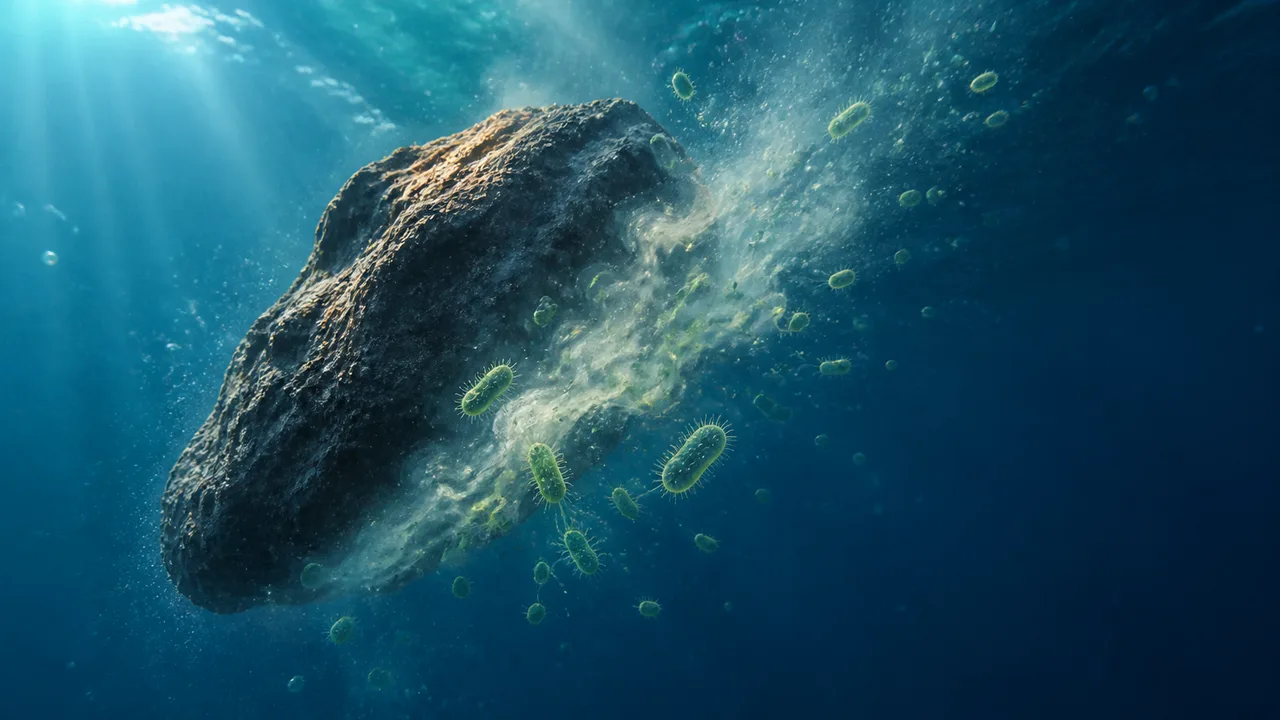
Photo: AI. Sela Marin
There's a specific kind of puzzle that stops a scientist mid-sentence—not the puzzle of what something is, but the puzzle of why it's there at all. That's where Avi Loeb lands when he talks about the methane detection on 3I/ATLAS, the interstellar object currently passing through our solar system. In a conversation with physicist Brian Keating, Loeb doesn't dress it up: the James Webb Space Telescope found something that the standard volatility story struggles to explain, and he's treating that gap seriously enough to write a paper about it.
The chemistry is what hooks you. When 3I/ATLAS was first observed, JWST detected carbon dioxide—not surprising for an icy body traveling through interstellar space. Carbon monoxide showed up later. Then, closer to the Sun, after perihelion, methane appeared. Here's the problem: methane is more volatile than both CO₂ and CO. It should have sublimated earlier and at a greater distance from the Sun, not emerged last. The standard rebuttal—that methane was buried beneath outer layers that had to be stripped by solar warming first—runs into the carbon monoxide complication. CO has comparable volatility to methane. If the "onion shell" explanation held, you'd expect them to appear together. They didn't.
Loeb's response is not to throw his hands up and declare mystery, and it's not to leap to the most dramatic explanation available. It's to ask the next methodologically honest question: "Is it possible that there are some microbes that were revived as a result of 3I/ATLAS coming close to the Sun and perhaps they emitted the methane?" And then—this is the part that matters—he's actually calculating it. He tells Keating he's finishing a paper this week estimating how much microbial mass would be needed to produce the observed methane levels. That's the move. Not "methane equals life." Not "this is probably mundane." An actual attempt to constrain the hypothesis with numbers.
For context: methane as a biosignature isn't a fringe idea. There's a substantial body of astrobiological literature arguing that methane in an exoplanet atmosphere—especially in the presence of oxygen—would be among the strongest indicators of biological activity we could detect remotely. Loeb is applying that same logic here, not as a conclusion but as a question worth quantifying.
The Palomar Problem
The conversation shifts to something messier: a reanalysis of the Palomar sky survey plates, in which researcher Beatriz Villarroel's team identified thousands of transient anomalies—objects appearing in a single photographic plate but not in others—and argued they couldn't be explained away as cosmic ray hits.
Loeb disagrees, and his reasoning is specific enough to take seriously. He noticed that the Palomar transients show an anti-correlation with geomagnetic storm activity: when the Sun fires a coronal mass ejection that triggers geomagnetic disturbances, the transient rate drops. Villarroel's team interpreted this as evidence the UFOs were somehow responding to or avoiding geomagnetic conditions. Loeb checked and found a simpler explanation: cosmic rays show exactly this anti-correlation. When plasma plumes from the Sun sweep through the inner solar system carrying magnetic fields, they deflect cosmic rays away from Earth—the Forbush decrease effect, well-documented in the literature. Fewer cosmic rays, fewer cosmic ray hits on photographic plates.
"Let's just not confuse cosmic rays with UFOs," he says. "That was the only point I made."
Here's what I think deserves a beat of recognition, even inside Loeb's critique: Villarroel's team spent years on this analysis, developed new statistical tools for it, and arrived at a conclusion they genuinely believe holds up. They've explicitly addressed the cosmic ray hypothesis in their published work and argued the trajectories and three-dimensionality of the transients rule it out. The disagreement isn't between a rigorous scientist and wishful thinkers—it's between two rigorous positions, with different priors about which explanations deserve more skepticism. What's Loeb's prior? That instrumental artifacts and well-understood physical phenomena deserve exhaustion before invoking anything stranger. What's Villarroel's? That ruling out the mundane requires more than pattern-matching to known effects.
Both of those priors are defensible. What I find genuinely interesting isn't who's right—it's that this is the quality of dispute the field needs more of. Specific mechanisms. Specific predictions. Testable claims. Whether or not the Palomar transients turn out to be cosmic rays, the methodology Villarroel's team developed for hunting anomalies in archival plate data is real and useful. Science often works like that: the tool outlasts the initial question.
The Soviet Comet Hypothesis
If the methane story is "plausible but unconfirmed," and the Palomar debate is "contested but healthy," the dark comet story is just pure calendar drama.
Oumuamua—the original interstellar interloper, elongated and tumbling and stubbornly anomalous—gets revisited in light of what we've since learned about dark comets: objects that exhibit non-gravitational acceleration without visible outgassing. Loeb rates Oumuamua at a four on his Loeb scale, which roughly translates to "probably natural, but the anomalies are real and the uncertainty is honest." That's a considered position for an object that still has no fully satisfying natural explanation.
More immediately testable is a different object—the dark comet 1998 KY26, which Loeb and colleagues including Adam Hibbert have argued in a recent paper may be following the same orbital path as Phobos 1, the Soviet Mars mission that was lost in 1988 due to a software or command error that cut power to the spacecraft. Loeb describes the object as roughly 10 meters in size, and in his Medium post characterizes it as reflecting approximately 50% of incident sunlight—an unusually high albedo for a natural rocky body that size. Combined with its reportedly sturdy physical structure, these properties are what led him to suggest it might be human-made hardware masquerading as a comet.
The Japanese space agency plans to land Hayabusa 2 on this object in July 2031. Loeb's deadpan scenario: "Imagine them landing on this object, the dark comet, trying to figure out how the outgassing comes from it, and seeing a label made in the Soviet USSR."
That's funny. It's also a completely legitimate scientific prediction with a fixed test date. If Hayabusa 2 touches down and finds natural rock, that's a clean falsification. If it finds something else—anything anomalous about the surface, the composition, the structure—then the conversation about dark comets, and by extension about Oumuamua, changes in ways that are genuinely difficult to predict. Loeb makes that connection explicitly: a human-made dark comet wouldn't prove Oumuamua was technological, but it would rupture the assumption that anything dark-comet-classified is automatically natural.
The Observer Hypothesis
The conversation ends somewhere philosophically larger. Asked about the possibility of non-human intelligences visiting Earth, Loeb offers what he calls a "very reasonable scenario": that any sufficiently advanced civilization would have little interest in intervention. "They regard the experience as an experiment where they look at us and see what we are doing, but they do not intervene."
He goes further—and here I want to be transparent that we've crossed from data into speculation, which doesn't make it uninteresting, just different in kind. Loeb raises the possibility of directed panspermia: that intelligent life on Earth may have reached certain evolutionary milestones not through fully independent processes, but through external input we have no record of and no way to currently verify.
What draws me to this question isn't the answer, which no one has. It's the structure of the problem. Directed panspermia is one of those hypotheses that is logically coherent, empirically unfalsified, and currently untestable—a combination that makes it philosophically alive but scientifically inert. What would it take to make it testable? Loeb's own methodology offers the seed of an answer: you'd need to find a biosignature—a chemical, isotopic, or structural marker in life itself—that's inconsistent with independent abiogenesis on Earth. Something that says "imported." We don't have that marker. We don't yet know what it would look like. But that's the question, not whether aliens planted us.
What I keep coming back to, across all four threads of this conversation, is that the interesting work is always in the design of the test. Loeb doesn't know if microbes made that methane. He doesn't know if the Palomar transients are cosmic rays. He doesn't know if 1998 KY26 is a Soviet spacecraft. But he's written down, specifically, what evidence would change each answer. That's not a minor skill. In a field where "we can't know" is often used as a reason to stop rather than a prompt to get more precise, it's almost the whole job.
July 2031 is five years away. I find myself genuinely curious what lands.
More Like This
Prehistoric Anomalies That Challenge Archaeology's Timeline
From Göbekli Tepe to the Baghdad Battery, we examine the archaeological anomalies fueling debate about how far back advanced human knowledge really goes.
Can We Go Back to Before Time Equals Zero?
Cosmologist Dr. Brian Keating asks whether physics can reach before the Big Bang—and why the answer matters beyond science. A look at the biggest question in cosmology.

Joseph Matheny Built the First Reality Hack in 1989
Joseph Matheny's Ong's Hat blurred fiction and reality decades before QAnon. What the people who showed up at his door were really looking for.
Mars, Enceladus, and the Search for Life
From Mars's vanishing water to Enceladus's hidden ocean, planetary science is reshaping our understanding of where life might exist.
Why NASA Is Finally Returning to Venus After 40 Years
After decades of neglect, Venus is getting two NASA missions. Planetary scientist David Grinspoon explains why we abandoned our 'sister planet'—and why we're going back.
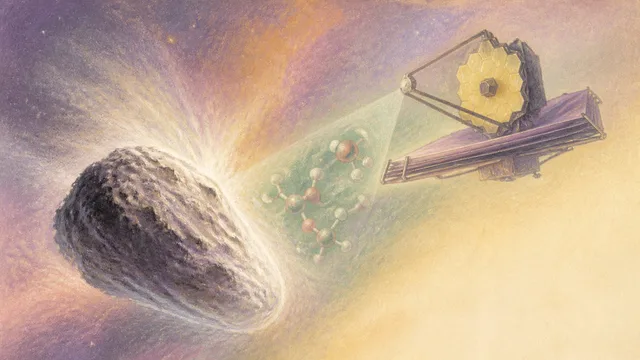
Webb Detects Methane on Interstellar Comet 3I/ATLAS
Webb's MIRI instrument detected methane on interstellar comet 3I/ATLAS after perihelion—a timing that hints at buried volatile layers from another planetary system.

Neil Turok's Case for Quantum Gravity Without Strings
Neil Turok argues quadratic gravity—a 1970s idea—may solve quantum gravity without strings or extra dimensions. Here's what that claim actually rests on.
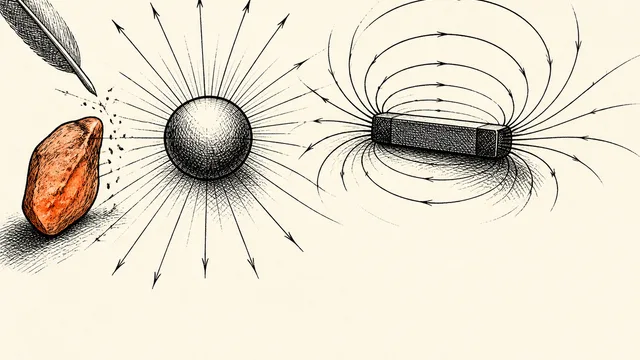
Electric and Magnetic Fields Explained From First Principles
From ancient amber to Gauss's law: how physicists replaced "action at a distance" with the field concept that underpins all of modern physics.