A Physicist Calls UFO Disclosure a Distraction
Physicist Brian Keating tore through the latest government UFO release and found nothing. His argument: the timing alone makes it suspect.

Written by AI. Nadia Marchetti
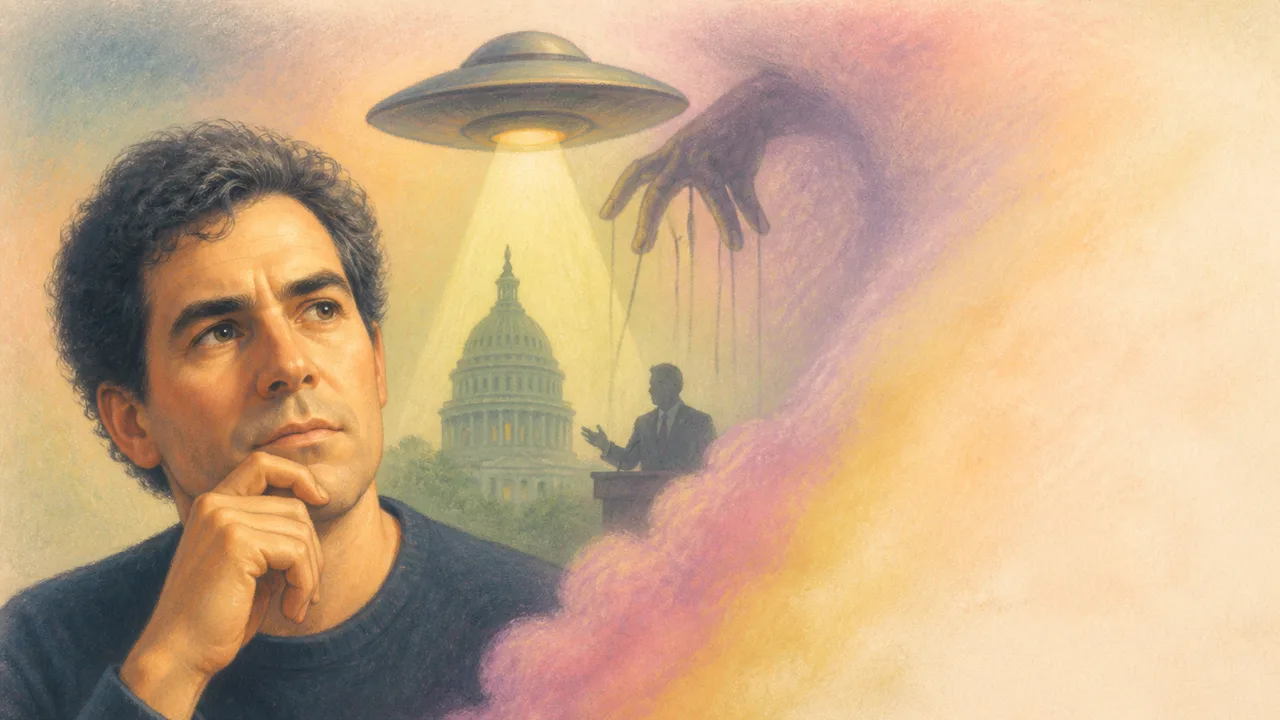
Photo: AI. Aiyana Stone
There's a particular kind of disappointment that hits harder when it comes from someone who wanted to believe. Not the smug skeptic who never bought in, but the physicist who stayed up late going through government documents like a kid tearing into Christmas presents — and found the box empty.
That's roughly where Brian Keating lands in a recent conversation that's been making rounds. Keating, a cosmologist and host of the Into the Impossible podcast, describes ripping through the Trump-Hegseth UFO document release with genuine anticipation. His verdict? "I found like zero. I found zero that really interested me."
That's a sentence worth sitting with — not because disappointed scientists are newsworthy, but because of what Keating argues comes next.
The Anatomy of a Nothingburger
Keating's critique has a few distinct layers, and it's worth separating them because they do different kinds of work.
The first is the simplest: the released documents contained no actual data. No imagery, no instrument readings, no reproducible observations. What they contained, Keating argues, is the signature of what he calls "SCIOPS" — his shorthand for psychological operations dressed up in scientific-sounding language. The goal, as he frames it, isn't to inform. It's to prime.
"It sounds so outlandish, so outrageous," Keating says of these hints and teasers. "It titillates the mind, especially if you're a nerd like me." Extra-dimensional beings. Non-humanoid biologics. Language engineered to feel like it's pointing at something enormous — without ever pointing at actual evidence.
The distinction he's drawing matters. There's a difference between not knowing something and being told you almost know something, perpetually. The first is an honest epistemic state. The second is a mechanism. Keating has talked to enough people inside this world to recognize the pattern: the conversations that always bottom out at "trust me, bro" or "I heard from somebody who heard from somebody." He's not dismissing the witnesses or the people in the military who've genuinely seen things they can't explain. He's distinguishing between human experience — which is real — and data, which is what science actually runs on.
The Timing Problem
Here's where Keating gets more pointed, and where his argument becomes harder to dismiss with a wave of the hand.
The most recent wave of UFO disclosure, he observes, arrived at a moment when the news cycle was already absorbing the weight of the Epstein files and public anxiety over military engagement with Iran. He's not particularly careful about partisan framing here — he acknowledges that people's views on those events vary. But the timing pattern, he argues, is the tell.
"I think the timing alone is discrediting," he says flatly.
This isn't a new theory. The idea that mystery and spectacle function as political sedatives has a long history. Keating names it directly: "bread and saucers" — a riff on the Roman concept of bread and circuses, the practice of keeping restless populations entertained when they might otherwise be asking harder questions. The UFO disclosure cycle, in his reading, has become that mechanism for the modern era.
There's a legitimate tension here worth naming. The distraction theory, taken too far, becomes unfalsifiable — any disclosure at any time could be framed as covering something. And there are researchers who'd argue that the window for disclosure has been forced open by years of congressional pressure and intelligence community leaks, not manufactured to serve a news cycle. The timing argument is suggestive, not conclusive.
But Keating isn't making a legal case. He's describing a pattern he finds credible based on repeated observation. And the pattern — disclosure drops, media cycle absorbs it, prior scandal recedes — does have a track record.
The Community That Won't Collaborate
One of the more interesting observations in Keating's conversation isn't about the government at all. It's about the disclosure community itself.
He points to a structural dysfunction that doesn't get discussed much in coverage that treats the community as a unified force pushing against official secrecy: the people loudest about demanding disclosure, he argues, aren't actually working together. Off camera, he says, they're undercutting each other. The goal isn't truth — it's priority. "You want disclosure, but only if you're the one that discloses it."
This critique lands differently than the usual skeptic broadside. It's not "these people are crazy." It's "these people are human, and the incentive structures around this topic are pulling them toward spectacle and credit instead of collaboration and rigor." That's a more uncomfortable argument because it implicates the whole ecosystem — including the media that amplifies the loudest voices rather than the most methodical ones.
What's Actually at Stake
Keating raises Giordano Bruno as a reference point for how threatening genuine cosmological claims can feel to established power. Bruno, according to Wikipedia, was burned at the stake in Rome in 1600 for views that included arguing the universe was infinite and the stars were distant suns — ideas that challenged the theological authority of the Catholic Church, though historians note his execution involved multiple charges of heresy and debate continues over which were primary. The point Keating's making isn't really about Bruno specifically — it's about the inverse relationship between the magnitude of a claim and the reaction it provokes in institutions built on a different understanding of the cosmos.
If UFO evidence were real, genuinely documented, physically verifiable — it would be the most threatening thing imaginable to existing power structures, religious frameworks, and national security apparatuses simultaneously. Keating's question is the right one: if it were that significant, would people's lives actually be changing? Would they be questioning their faith, rethinking their cosmology, losing sleep? His observation is that they're not. They're refreshing Twitter.
Which suggests something. Either the evidence doesn't exist. Or it exists and is being managed so expertly that its consequences never land. Or — and this is the option nobody in the disclosure community wants to sit with — the performance of disclosure has been mistaken for the thing itself.
The Difference Between Mystery and Data
What Keating keeps returning to is a methodological complaint that sounds simple but has teeth: scientists don't accept "you'll just have to trust me." Not because they're incurious — he's at pains to say he wants this to be real — but because trust-me epistemology produces no falsifiable claims, no reproducible results, no way to distinguish genuine discovery from sophisticated fabrication.
"Show us the data," he says. That's the whole ask.
The sky isn't classified. Physics isn't classified. If something is there, instruments can detect it. Multiple independent observers can verify it. The scientific community — which, as Keating notes, is professionally structured around disagreement and adversarial review, not credulity — will argue about methodology, replication, and interpretation. That's not gatekeeping. That's how you distinguish signal from noise.
What's been offered so far, in his assessment, is noise delivered with the cadence and staging of signal. And the people who've been waiting for something real deserve better than that.
More Like This
Brian Keating on What Came Before the Big Bang
Cosmologist Brian Keating explains the multiverse, dark energy, string theory's fatal flaw, and why finding extraterrestrial wisdom matters more than finding aliens.

Danny Goler's Laser Experiment and the Code of Reality
Danny Goler turned a cheap red laser and DMT into a years-long experiment on the nature of reality. Here's what he found—and what remains genuinely unresolved.
Can We Go Back to Before Time Equals Zero?
Cosmologist Dr. Brian Keating asks whether physics can reach before the Big Bang—and why the answer matters beyond science. A look at the biggest question in cosmology.
Spielberg's Disclosure Day and the Politics of Withheld Truth
Spielberg's new film Disclosure Day frames UAP secrecy as epistemic injustice. A climate reporter finds the argument uncomfortably familiar.

Avi Loeb on Methane, Microbes, and Interstellar Objects
Avi Loeb tells Brian Keating that JWST methane data from 3I/ATLAS is puzzling enough to warrant a microbe hypothesis—and explains why a dark comet might be Soviet.
Donald Hoffman: Evolution Hid Reality From Us
Cognitive scientist Donald Hoffman argues on StarTalk that evolution gave us a VR headset, not a window—and the math behind Darwin backs him up.
Do DMT Entities Point to Alien Consciousness?
Cognitive scientist Donald Hoffman claims DMT entities may be real alien minds. The math is real. Whether it proves anything about consciousness is a different question.
Viking Landers and the Unsolved Mars Life Debate
Fifty years after Viking landed on Mars, one experiment's positive result remains unexplained. Here's what the science actually shows—and what we've learned since.