Chile's Navy UFO Sighting and the Limits of Radar
A Chilean Navy helicopter filmed an unidentified object in 2014 that defied radar detection. Here's what investigators found—and what remains genuinely unsettled.

Written by AI. Priya Sharma
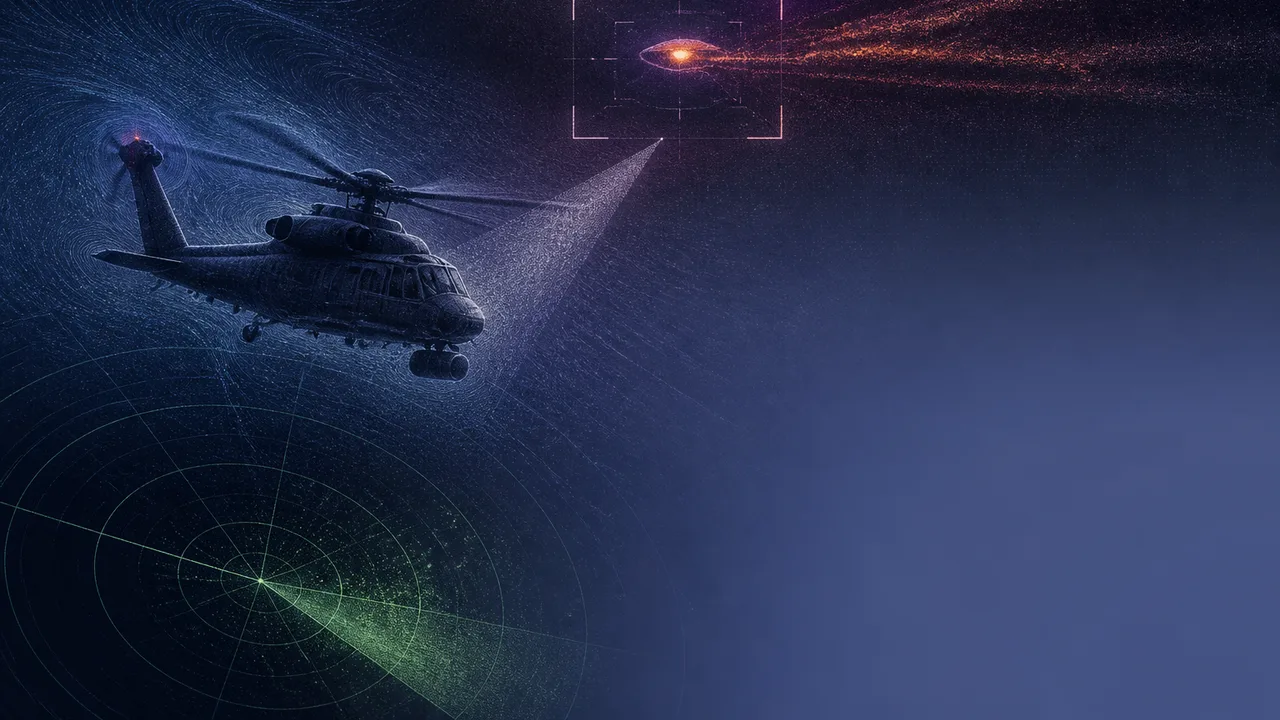
Photo: AI. Dexter Bloomfield
November 11, 2014. A Chilean Navy helicopter cruises at 4,500 feet over the Pacific coast near Santiago on what should be a forgettable daytime patrol. On board is a naval technician field-testing a new infrared camera system — the kind of equipment designed to find heat-emitting targets on the ground. At 1:52 p.m., the crew spots something in the open sky instead.
What followed was nine minutes of footage that would occupy Chilean government investigators for two years, generate a minor internet firestorm when the footage was released publicly, and ultimately land in that uncomfortable category of cases that resist clean resolution. Not because the evidence is thin, but because the evidence is genuinely complicated.
What the Camera Saw — and What Radar Didn't
The infrared footage shows a dark, oval-ish blob with what observers describe as a faint halo. Eight minutes into the encounter, the object emits a thick, heat-registered plume. The crew tries to hail the object by radio. No response. They check with air traffic control at Santiago Airport, 35 miles away. Nothing in that airspace, controllers say. The helicopter's own radar? Also blank.
The crew tracks the object until fuel forces them back to base.
That combination — strong infrared signature, no radar return, radio silence, no ATC contact — is what elevated this from routine oddity to a case file at CEFAA, Chile's official government body for investigating unidentified aerial phenomena. And after two years of analysis, CEFAA couldn't crack it. They released the footage online in 2017, and the inevitable happened: the theories multiplied.
"What is beyond dispute is that there is something flying in the air that is a different temperature than the air around it, and it seems to be expelling something into the air," as one analyst in the Science Channel's examination of the case puts it. That framing is precise and worth holding onto — it describes only what the data actually shows, without overreaching into what the data means.
The Stealth Theory Falls Apart Quickly
One early candidate explanation was a stealth aircraft. It's a tidy hypothesis at first glance: stealth platforms are engineered to defeat radar through geometry and radar-absorbent materials, which could explain why neither the helicopter's radar nor ATC spotted anything. The problem arrives immediately. Stealth aircraft are specifically designed to minimize their thermal and visual signatures precisely because infrared detection is the countermeasure to radar evasion. A platform that baffles radar while simultaneously projecting a bright heat signature and emitting a visible plume is not a coherent engineering concept — at least not one that matches any known stealth program. That theory doesn't survive contact with how stealth technology actually works.
A Passenger Plane, Seen Badly
The more durable hypothesis comes from Robert Fisher, an optical phenomena expert at Edinburgh University. Fisher's argument is that the "black blob" on the infrared footage is exactly what you'd expect a commercial jet to look like from a significant distance — specifically, one with four engines receding away from the camera.
Fisher constructed a demonstration using candles to represent the four heat sources of four jet engines, then backed away incrementally. At close range, four distinct heat points. At moderate distance, they merge into two. Further back, a single undifferentiated blob — visually indistinguishable from the Chilean footage. "The blob that you see in the video could really be just the heat signatures from the four jet engines of that airplane taken at quite a distance, and all merged down just like I've done right here," Fisher explains.
It's a simple, reproducible demonstration, and it's the right kind of scientific reasoning to apply here: if the sensor characteristics and physics of distance predict exactly this output, the extraordinary explanation doesn't do additional work.
But the trailing plume complicated Fisher's theory immediately. Contrails — the ice-crystal trails left by jet exhaust at altitude — are cold phenomena, well below freezing. The infrared footage, however, shows the trail registering as warm. "Normally contrails are below freezing, and yet this looks as though it's hot," Fisher acknowledged. "Um, that doesn't make any sense to me."
The Camera as Unreliable Narrator
Aviation analyst Mick West offers what is arguably the most technically rigorous contribution to the investigation, and it centers on understanding what the infrared camera is actually measuring versus what viewers assume it's measuring.
West's key observation: the camera establishes its thermal scale relative to the ambient temperature of the sky, which at altitude is extremely cold — well below the freezing point of water. In that reference frame, ice is "warm." Contrails, which are ice crystals, would therefore register as heat sources on the display, not cold ones. "Even things like ice, even things like contrails, actually show up as being hot," West explains. The apparent paradox of a freezing contrail appearing warm on infrared dissolves once you understand the camera's calibration baseline.
This matters enormously for how the footage should be interpreted. Every data point the infrared camera provides is filtered through a sensor system with specific, non-intuitive characteristics. The crew was testing new equipment — which is to say they were operating a system whose outputs they may not have been fully calibrated to interpret in real time. That's not a criticism of the crew; it's a structural feature of field-testing novel technology.
West also identified a candidate aircraft in commercial flight data: a four-engine plane that departed Santiago Airport at the precise time of the encounter, on a heading to Madrid, Spain, whose recorded flight path visually matched the object's trajectory. His analysis suggested that by the end of the nine-minute encounter, the object was approximately 200 miles from the helicopter — not the 35 to 40 miles the pilot had estimated.
The Altitude Problem, and Why It's Actually the Central Question
That distance estimate matters because of what it implies about altitude. The crew reported the object at roughly the same altitude as the helicopter — 4,500 feet. But contrail formation, even the aerodynamic variety that can occur at lower altitudes than the standard 30,000-foot threshold, requires conditions present somewhere between 15,000 and 25,000 feet. At 4,500 feet, no known contrail mechanism applies.
Fisher's response to this is candid about the limits of naked-eye distance estimation in open sky: "It's very difficult to work out by eye how far away something is just by looking at it. Even the most experienced crew can have some difficulties. You really need some kind of a reference point, but here we don't have anything. We just have open sky everywhere."
This is the hinge of the entire case. If the pilots correctly estimated the object's altitude and distance, the commercial aircraft theory struggles badly. If they underestimated the distance — which Fisher and West both argue is the more likely scenario given the absence of visual reference points — the aircraft theory becomes coherent. The infrared camera cannot independently establish distance or altitude. The radar, which might have, saw nothing. ATC, which might have cross-referenced, was looking in the wrong place.
The one remaining oddity that West's theory doesn't fully dissolve: the radio silence. A departing commercial aircraft crew, West argues, would have been in active communication with Santiago departure control on assigned frequencies — not monitoring the open frequency the helicopter used to hail them. Under that interpretation, the radio silence reflects proper protocol compliance, not evasion or absence.
Chile's CEFAA, with access to the original high-resolution footage and two years of institutional resources, still declined to formally endorse the commercial aircraft explanation. Whether that reflects genuine evidentiary uncertainty, institutional caution, or something about the footage that external analysts haven't seen isn't clear from the public record.
What "Unidentified" Actually Means
Cases like this one are useful precisely because they expose the gap between "we don't know what this is" and "this is therefore extraordinary." Those are not the same statement, and the conflation is where most UAP discourse goes wrong.
The Chilean footage offers a genuine ambiguity: a sensor system with non-obvious characteristics, operating conditions that compromise distance and altitude estimation, a plausible candidate explanation that requires assumptions about pilot error, and an official government investigation that reached no conclusion. The mundane explanation is plausible but requires several things to be true simultaneously. The extraordinary explanation requires abandoning established physics.
What the case actually demonstrates is that "unidentified" is a description of an investigation's outcome, not a property of the object. The two-year CEFAA investigation failed to identify the object — that's the factual record. Whether a better-equipped investigation with more complete flight data could close the gap is a different question, and one the public record doesn't yet answer.
More Like This

Crafting Supercars: The Science Behind Speed and Style
Explore how supercars like Alfa Romeo 4C and Aston Martin Vanquish are meticulously crafted using cutting-edge materials and precision engineering.

Mars, Enceladus, and the Search for Life
From Mars's vanishing water to Enceladus's hidden ocean, planetary science is reshaping our understanding of where life might exist.
A New Object in the Sky: The JetBlue Drone Strike
A JetBlue pilot reported hitting a drone on approach to JFK. What the incident reveals about airspace rules built before drones existed.

A Physicist Calls UFO Disclosure a Distraction
Physicist Brian Keating tore through the latest government UFO release and found nothing. His argument: the timing alone makes it suspect.

Colonel John Alexander's Life at the Edge of Official Reality
Colonel John Alexander commanded Green Berets, ran Pentagon psychic programs, and investigated UFOs. His 3-hour Why Files interview maps a career lived at the edge of official reality.

Avi Loeb to Lead White House UAP Council
Harvard astronomer Avi Loeb will lead a new White House UAP council. What the council's structure reveals about whether it's built for science or optics.

Quantum Field Theory, AI, and the Gravity Problem
Physicist Ross Jenkinson explains how quantum computing and AI could unlock the biggest unsolved problem in theoretical physics: reconciling quantum theory with gravity.

The Mountain Climbing Theorem Explained
Two climbers, one rule: stay at the same height. A deceptively simple constraint leads to a proof that hinges on graph theory and one critical word: finite.