A New Object in the Sky: The JetBlue Drone Strike
A JetBlue pilot reported hitting a drone on approach to JFK. What the incident reveals about airspace rules built before drones existed.

Written by AI. Priya Chandrasekaran
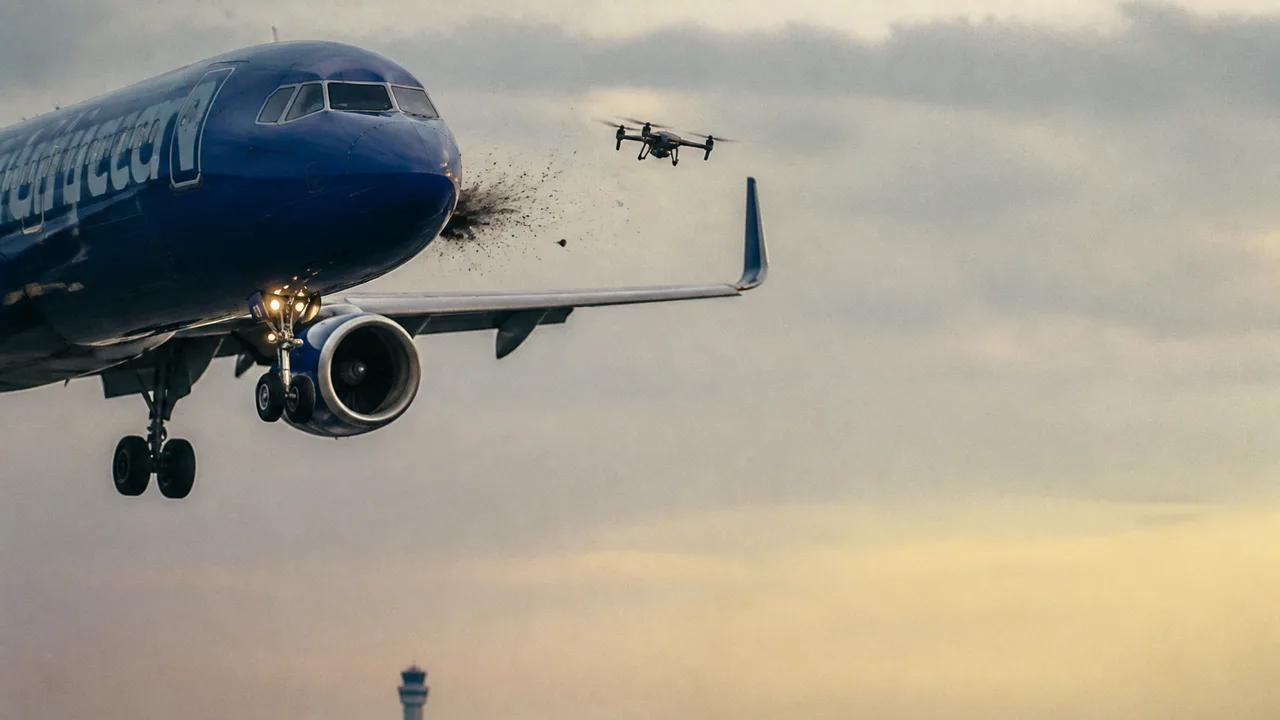
Modern aviation safety is, at its core, a long and expensive ledger of things that went wrong. Every regulation, every approach protocol, every altitude restriction exists because something broke — a wing, a fuselage, a chain of decisions — and the industry decided it could not afford to let that particular thing break again. The sky we fly through was built, incrementally and expensively, from crashes.
On the morning of June 29, a new kind of object appeared in that ledger.
A JetBlue Airbus A321, arriving from Las Vegas, was on approach to John F. Kennedy International Airport when the pilot got on the radio with a report that didn't fit the geometry of a normal landing. According to CNN, the aircraft was just north of the beach community of Sea Bright when the pilot reported striking a drone. The aircraft landed safely at 7:21 a.m. The pilot's words, captured in air traffic control communications, were compact and precise: "It hit us right above the cockpit."
The controller, according to The Hill, asked for confirmation. Think about what that moment is, for a person whose job is to hold the geometry of dozens of aircraft in their head simultaneously — to know, at all times, who is where, how fast, and how low. A drone strike is not a category that fits cleanly into that geometry. It is a report from a different world, arriving in the middle of a routine morning. The controller asked again. The pilot confirmed: "Yep, it hit us right, right above the cockpit."
AP News reports that after the aircraft landed, passengers deplaned normally, and the plane was removed from service for inspection. JetBlue said it "found no damage or evidence of a collision." Which raises its own questions — about the reliability of visual inspections, about what impact evidence actually looks like on an A321 fuselage, about whether "no visible damage" and "no collision" are the same sentence — but that is, for now, what the record shows.
NBC New York reported that the drone struck the plane at approximately 3,000 feet altitude. People noted that the incident came just three days after a similar close call at Newark. CNN reported that on the same day as the JetBlue strike, a helicopter reported a near-collision with a model plane in the same airspace. This is not a single anomalous event. It is a pattern making itself visible.
What the sky used to contain
The rules governing low-altitude airspace near airports were built in an era when the things flying in that airspace were, broadly, either licensed aircraft or birds. The FAA's wildlife strike database — which research by Richard A. Dolbeer, Michael J. Begier, and colleagues, published through the University of Nebraska's digital commons (digitalcommons.unl.edu), demonstrates is an extensive and scientifically foundational record — exists precisely because the aviation industry took the bird problem seriously enough to track it systematically. That database became the scientific basis for wildlife hazard management at airports across the country. It took decades and considerable institutional will to build.
Drones are a different problem. A Canada goose is a known quantity: its weight, its behavior, its seasonal patterns, its tendency to flock near water. A drone is a category, not a creature — and the category is vast. According to T-Drones (t-drones.com), a recreational quadcopter weighs a few pounds, while commercial delivery drones can weigh considerably more, depending on payload. The physics of a collision change significantly across that range. So does the question of where the debris goes.
An FAA rule implemented in 2019 prohibits recreational drone flights within a five-mile radius of airports without prior authorization. Commercial operators face a separate, more complex regulatory framework. But the enforcement mechanisms for these rules remain thin — drone registration is required but verification in the field is difficult, and the technology to identify and track rogue drones in real time is still catching up to the problem it needs to solve. What the JetBlue incident illustrates is not that no rules exist. It is that the rules exist in one world and the drones are operating in another.
The passengers
One Mile at a Time and Simple Flying both reported the incident with the clinical precision it deserves. What neither can fully capture — what no safety report can — is what the passengers on that flight experienced, which was: nothing. They landed. They got off. They went wherever they were going — to JFK's arrivals hall, to the taxi line, to the person waiting for them outside. They did not know. They may not know now.
I keep returning to that. I have sat in those seats on that approach more times than I can count — the belt of Atlantic water below, the Rockaways taking shape out of the morning haze, the city assembling itself on the horizon like a slow-developing photograph. It is one of the most ordinary extraordinary experiences in modern life: two hundred people suspended in aluminum at a thousand feet, trusting a system so complex and so well-drilled that its success looks, from the inside, exactly like nothing happening. You feel a bump and you think: turbulence. You don't think: debris. You don't think: the thing that just struck the aircraft above the cockpit could, under different circumstances, have done something other than leave no visible mark.
The measure of a safe flight, that morning, was that the passengers never had to know what the pilot knew. I am not sure whether that is a tribute to the system's resilience or an argument for its limits. It might be both. What I do know is that the people who walked off that plane carried, without their knowledge, a piece of a story that the rest of us are now trying to understand — because someone in the cockpit said something out loud.
What comes next is uncertain
The FAA is investigating, according to NBC News. What that investigation will yield, and on what timeline, is genuinely unclear. Aviation safety improvements have historically moved through a specific cycle: incident, investigation, finding, rule change, implementation. That cycle is measured in years, not weeks. The drone industry, by contrast, is moving in months.
There are technological proposals — remote ID requirements, geofencing systems, drone detection radar at airports — that have been in various stages of discussion and partial implementation for several years. Remote ID rules, which require most drones to broadcast their location and identification in real time, began phasing in through FAA mandate in 2023. Whether those systems would have identified the drone that struck the JetBlue A321, or enabled any meaningful intervention, is not something the current record can answer.
What the record can say is this: the sky above JFK on the morning of June 29 contained a commercial airliner, a drone whose operator has not been publicly identified, and a set of rules that were not, on that morning, sufficient to keep them apart. The airspace rules will eventually catch up — they always do, because the ledger demands it. The open question is what gets written into it first.
On approach to JFK, when the water gives way to the coastline and the city starts to resolve out of the haze, you are inside a system built by everyone who flew before you and everyone who survived, or didn't. You trust it not because you've read the regulations, but because you've learned, as a traveler, that the system's memory is longer than your anxiety. Now the system has a new entry in its memory. The passengers on that June 29 flight didn't know they were part of it. But they were.
More Like This
American Tourists in Europe: The Etiquette Gap
From date formats to tipping culture, the everyday customs that trip up American travelers in Europe—and what they reveal about deeper cultural differences.

Luxury Train Journey Across Australia: Worth the Cost?
Explore a luxurious 80-hour train journey across Australia and its opulent offerings.

Dulles Airport's Mobile Lounges Were Never Built for You
Dulles Airport's 1960s mobile lounges were designed for jet-age elites. When flying democratized, regular people inherited a system built for someone else.
Why Prepared Travelers Are Calmer at the Airport
Flight anxiety is common and real. Here's the psychology of why preparation reduces your stress response—not just your risk exposure—before you fly.
The HoverAir X1 Pro Max Wants to Make Drone Cinematography Easy
Jake Sloan tests the HoverAir X1 Pro Max drone in Alaska. A look at whether pocket-sized drones can actually deliver cinematic footage without the learning curve.
Drone Detectors From the Front Lines, Tested
A Ukrainian battlefield drone detector meets consumer-grade SIGINT tools. What happens when war tech goes civilian? More than you'd expect.

Lily Allen's West End Girl Tour and the Fourth Wall
Lily Allen is defending her West End Girl tour's fourth-wall staging. But the real debate is acoustic — what happens to sound when a pop show refuses to speak to the room?
Flock Cameras Track Far More Than License Plates
Flock Safety's AI-powered cameras are spreading fast across U.S. cities—and they're capturing far more than license plates. Here's what's at stake.