Dulles Airport's Mobile Lounges Were Never Built for You
Dulles Airport's 1960s mobile lounges were designed for jet-age elites. When flying democratized, regular people inherited a system built for someone else.

Written by AI. Sofia Ramirez
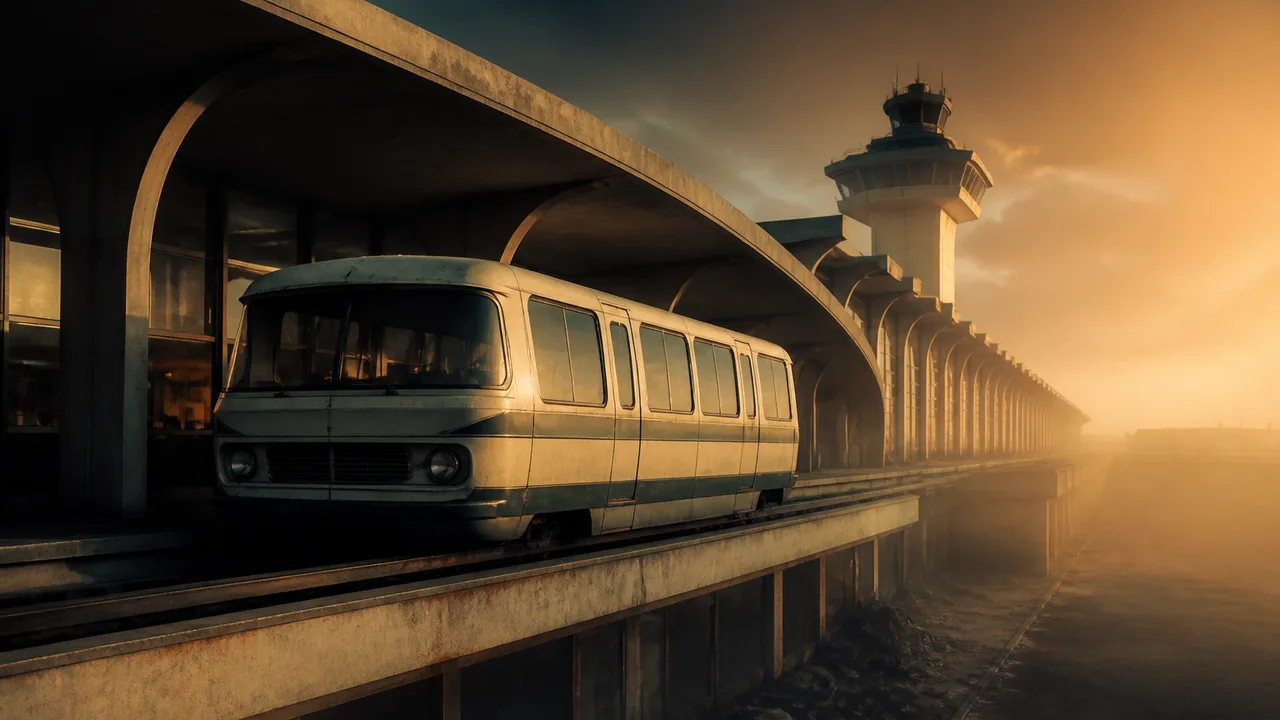
Photo: AI. Astrid Lehmann
Picture the person who actually rides one of Dulles Airport's mobile lounges in 2026. Not the YouTube creator making a video about them — the traveler who doesn't have the luxury of treating it as content. Maybe it's someone on a budget fare with a 45-minute connection window, dragging a carry-on through a diesel-smelling vehicle while 10 minutes evaporate waiting for it to fill up. Maybe it's a wheelchair user navigating a system that was designed before the Americans with Disabilities Act existed, before disability rights advocates forced airports to think about who "passenger" actually means. Maybe it's an international traveler arriving for the first time in the United States, stepping off a transatlantic flight into what a Fourth Place video recently described as feeling "a lot like an overcrowded waiting room in a dentist office with some stripper poles in the center of it."
These are the people the mobile lounge was never built for. And that's not a design flaw so much as a design truth.
A System Built for a Different Passenger
When Eero Saarinen — the Finnish-American architect behind the Gateway Arch competition win, the TWA Flight Center at JFK, and the Dulles terminal itself — invented the mobile lounge concept in the late 1950s, flying was still a class act. Literally. Domestic air travel in 1962 cost roughly the equivalent of $600-800 in today's dollars for a one-way ticket. The people boarding mobile lounges at the newly opened Dulles Airport were not regular people. They were executives, diplomats, and the comfortable professional class. The mobile lounge, with its air conditioning, piped-in music, and thick padded seats, wasn't a bus. It was a pre-boarding club car. A rolling anteroom for people who expected to be comfortable between the check-in desk and the aircraft door.
Saarinen's system was genuinely elegant on its own terms. Passengers walked a few feet from the ticketing counter into a dedicated lounge matched to their specific flight. The lounge then detached from the terminal, drove across the tarmac, and docked directly with the aircraft — extending a bridge that locked onto the plane. No walking across exposed tarmac. No gate fingers radiating from a fixed concourse. The entire airport was mobile, flexible, and designed around the experience of a relatively small number of travelers who expected to be treated well.
It worked. For a while, it worked spectacularly. In the early 1960s, when Dulles traffic was low and the terminal was still a novelty, people reportedly bought tickets just to ride the mobile lounges with no intention of flying anywhere. Saarinen's system was so futuristic it functioned as a tourist attraction.
Then flying got cheaper. Then flying got crowded. Then flying became something ordinary people did.
What Gets Left When a System Outlives Its Class
Saarinen died in September 1961, months before Dulles opened in November 1962. He never saw a passenger board one of his mobile lounges. He called Dulles "the greatest thing I have ever done" — and given that this is the man who designed the Gateway Arch (which, like Dulles, was completed after his death), that's not a small claim. There's something genuinely painful in that fact. The man spent years designing a system specifically around the human experience of travel, obsessed enough to study passenger flow at multiple airports and conclude that Americans were walking 900 feet too many, and he didn't live to see a single person use it.
What he also didn't live to see: the system he designed for a few hundred well-heeled passengers per day handling millions of ordinary ones per year.
By the 1980s, demand had blown past Dulles's capacity. The airport hastily threw up a midfield concourse — the CD concourse — originally intended as temporary infrastructure while planners figured out a real solution. It became permanent, the way "temporary" things do when institutions can't make decisions. And since the mobile lounge system had been designed for direct terminal-to-aircraft service, not terminal-to-concourse shuttling, the vehicles were now doing a job they were never engineered for. Luxury waiting rooms became cattle cars.
This is a pattern I recognize from housing history, from transit history, from public school history. Systems designed for the comfortable get handed to everyone else without upgrade. The gap between what was designed and who actually uses it becomes the space where ordinary people live, cope, wait, and miss their connections.
The $1.5 Billion System That Goes Nowhere
The story gets more specifically absurd in 2010, when Dulles spent $1.5 billion building the AeroTrain — an automated people mover that is, by all accounts, exactly what you'd want an airport transit system to be. Efficient, flowing, modern. The only problem: it connects the main terminal to the A and B gates and then skips entirely to a station beneath a future concourse that doesn't exist yet. Travelers connecting through the C and D gates — where the mobile lounges operate — can walk what's reportedly a substantial distance through a pedestrian tunnel to reach the AeroTrain's fourth station, or they can take a mobile lounge. That's the choice Dulles offers. A very long walk, or a 60-year-old diesel vehicle.
As the Fourth Place video puts it with appropriate exasperation: "That's right, $1.5 billion in 2010. And for some reason, Dulles Airport couldn't build a people mover that connected all of the concourses."
This isn't a design problem. Saarinen's original design, whatever its class assumptions, had internal logic. The problem is governance — specifically, decades of institutional paralysis that turned a series of small bad decisions into one enormous expensive mess. Each individual choice (build the CD concourse temporarily, repurpose the mobile lounges, build the AeroTrain before the master plan was complete) was made by someone trying to solve an immediate problem with insufficient resources and no long-term mandate. The mobile lounges in 2026 aren't a monument to bad design. They're a monument to what happens when no one is accountable for the whole system, only their piece of it.
What a Fix Actually Costs
A leading proposal developed by the Metropolitan Washington Airports Authority in conjunction with the Department of Transportation — reportedly unveiled in May 2026 — would complete the AeroTrain as a U-shaped two-way system connecting all concourses, with a reported price tag in the range of $22 billion and a potential completion date around 2034. Buzzrag has not independently verified these figures, and readers should treat them as preliminary until MWAA provides formal documentation. At that point, the mobile lounges — the vehicles that have been operating since 1962, substantially modernized in 2023 to buy another 15-20 years of service life — would finally be retired.
That last detail is worth sitting with. The 2023 modernization: money spent extending the life of vehicles everyone agrees should have been replaced decades ago. That's not irrational, exactly — you maintain what you have while you figure out what comes next. But it's a particular kind of dispiriting calculus. The people riding these things in 2023, 2024, 2025, 2026 are subsidizing a decision-making process that failed long before they showed up.
Dulles only got a Metro connection in November 2022 — the Silver Line Phase 2, which offers rail access to DC after decades of operating as a car-dependent island in suburban Virginia. For an airport that serves the nation's capital and handles significant international traffic, the timeline is stunning. International visitors arriving at Dulles today encounter a transit experience that most wealthy peer nations resolved twenty or thirty years ago.
A Last Thing About Saarinen
I keep coming back to him, maybe because the grief in this story is real even if it's easy to sentimentalize. He was 51 when he died. He had designed one of the most celebrated airport terminals in American history and a transportation system he genuinely believed would change how airports worked — and he didn't live to see any of it used, misused, repurposed, or run into the ground.
The mobile lounge wasn't a bad idea for what it was. It was a thoughtful solution to a specific problem for a specific kind of traveler at a specific moment in aviation history. The failure wasn't Saarinen's vision. The failure was everyone who came after him, inheriting a system they didn't fully understand, serving passengers it was never designed for, making short-term decisions in the absence of any long-term plan.
Saarinen designed an airport on the assumption that someone would keep thinking about it after he was gone.
They didn't. And now the person with the 45-minute connection and the roller bag is running.
More Like This

When Simple Beats Complex: Claude Projects vs. RAG Pipelines
A tech consultant tested Claude Projects against traditional RAG systems. The results raise uncomfortable questions about enterprise infrastructure.
Air New Zealand's Business Class Dilemma
Air New Zealand's new business class faces criticism for its lack of privacy and direct aisle access, raising questions about its competitive edge.
Inside Argentina's 7-Generation Working Estancia
Estancia La Tomasa near Buenos Aires has welcomed guests since 2023. Here's what a weekend on this 140-year-old working ranch actually looks like.

Driving Patagonia's Route 40: What Van Life Actually Looks Like
Kara and Nate drove 2,000 miles across Patagonia in 8 days. What they found reveals the gap between van life mythology and Patagonian reality.
Berlin's Tegel Airport: Built in 90 Days, Abandoned at Last
Berlin's Tegel Airport was built in 90 days during the Cold War. Now abandoned, its layered history—from airlift to hexagonal icon—raises urgent questions about memory and renewal.
Airport Secrets Frequent Flyers Already Know
From cleaner restrooms to cancellation rights, here's what airports and airlines quietly rely on you not knowing—until now.

The Spanish Civil War at 90: What the Coup Unleashed
On July 17, 1936, a military coup fractured Spain and drew the world in. What the Spanish Civil War's 90th anniversary still asks of us.

Medieval England: How Peasants and Guilds Shaped Society
A new documentary traces medieval England's social divide through two real families—one peasant, one guild merchant—and the starkly different worlds they inhabited.