Berlin's Tegel Airport: Built in 90 Days, Abandoned at Last
Berlin's Tegel Airport was built in 90 days during the Cold War. Now abandoned, its layered history—from airlift to hexagonal icon—raises urgent questions about memory and renewal.

Written by AI. Helen Papadopoulos
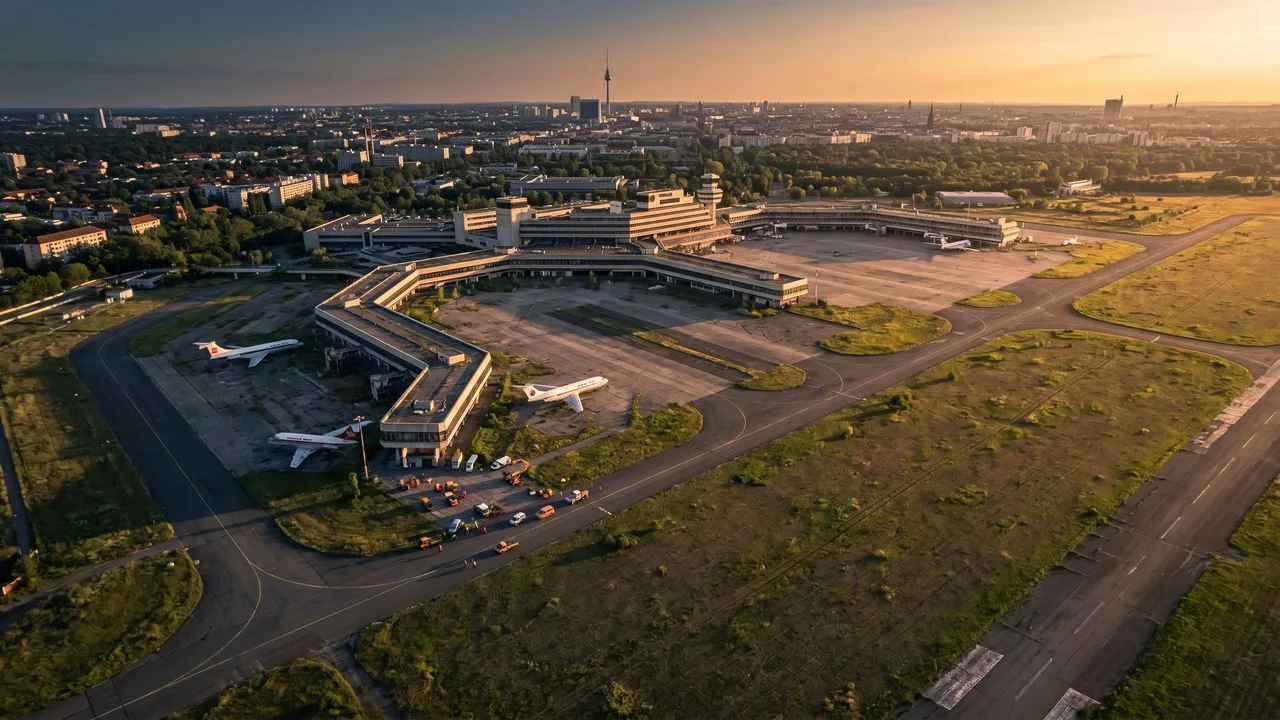
Photo: AI. Rio Sanchez
There is a particular quality of silence that belongs to places that were designed for noise. Train stations after the last service. Stadiums in January. Airports, always and especially airports, with their architecture calibrated for controlled human chaos—the bark of departure announcements, the rumble of wheeled luggage, the specific misery of the duty-free queue. When The B1M's construction channel recently sent a crew inside Berlin's abandoned Tegel Airport, the footage had that quality in abundance: vast 1970s interiors stripped of everything except the design itself, standing in the kind of stillness its architects almost certainly never imagined.
The building deserves more than a wistful tour, though. Tegel's story is dense with contingency—the kind of history where a geopolitical crisis, an artillery range, two architecture students, and a grenade from 1875 all end up in the same sentence. Understanding what the place was requires working backwards through several distinct lives.
Ninety Days and 19,000 Volunteers
The founding moment is almost implausibly dramatic. In June 1948, the Soviet Union blockaded West Berlin—all road, rail, and canal routes sealed, 2.5 million people cut off from food and fuel. The Allied response, the Berlin Airlift, became one of the largest humanitarian logistics operations in history: over 200,000 flights, 2.3 million tons of supplies, one aircraft landing every 90 seconds at Tempelhof and Gatow airports for eleven months.
It wasn't enough. Tempelhof's runways were too short for the larger Douglas C-54 Skymasters the Allies needed; Gatow could take the planes but not the volume. The solution was a former artillery firing range in the French-controlled northwest of the city—flat, open, and waiting. French military engineers ran the operation, but the labor was almost entirely German: more than 19,000 people, many of them volunteers, working rotating shifts around the clock. Civilians, students, local businesses. An airport from nothing in 90 days.
This founding fact has accumulated considerable symbolic weight over the decades, and it is worth sitting with rather than simply celebrating. The image of West Berliners building their own lifeline is genuinely stirring, but it also belongs to a particular Cold War narrative in which the city's population figures primarily as the grateful recipients of Allied protection. The workers who built Tegel's runway in 1948 were also the survivors of a war their country had started and lost catastrophically three years earlier. The airport was built by people living inside a divided city that was itself the direct consequence of that catastrophe. Both things are true simultaneously.
The Hexagon Problem
The terminal that most people associate with Tegel came later. By the 1960s, West Berlin was handling civilian flights under strict Cold War aviation rules—only airlines from the Allied powers could operate there—and needed a proper passenger building. The city held an architectural competition and awarded it to Meinhard von Gerken and Volkwin Marg, two architects who had not yet turned thirty and whose main relevant credential was an airport they had designed as a university thesis project. The confidence of this decision is either admirable or quietly alarming, depending on your disposition toward institutional risk-taking.
What they produced, opening in 1974, was genuinely strange and genuinely good. The terminal was built around a perfect hexagon, with each of the six sides functioning as a self-contained unit: its own check-in desks, its own security, its own boarding gates. The car was the organizing principle—passengers could drive directly to whichever segment served their flight, park, walk through glass doors, clear security, cross a short concourse, and board. Door to gate in fifteen minutes was reportedly achievable. The B1M's presenter, exploring the vacant terminal, noted the contrast with the modern airport experience: "The main thing you associate with airport is lots of distance, lots of walking. Sometimes you got to get in a train to get between terminals... Here you don't get any of that."
The hexagonal logic extended, with what seems to have been genuine obsession, into every corner of the building. Hexagonal columns. Hexagonal lift towers. Hexagonal floor plates. Ceiling panels made of triangles that resolve, at scale, into hexagons. The effect in the empty building is somewhere between coherent and oppressive—a total architectural grammar that leaves no surface uncommitted. Whether this represents inspired design unity or a rather aggressive imposition of one idea is a question on which reasonable people have disagreed.
What is less contested is that the design was functionally difficult to expand. A hexagon optimized around 1970s car culture does not scale gracefully. By 2019, Tegel was processing more than 24 million passengers per year against an intended capacity designed for a divided city of roughly half that population. The charm held, but the infrastructure strained. As one interviewee in the video put it with diplomatic precision: "One could say it was successful and it worked for an airport, but continued as an economically successful airport—it was maybe not the best."
What the Ground Remembers
The redevelopment story begins, in a sense, in 2004, when an excavation for Queen Elizabeth II's state visit uncovered a British aerial bomb on the site. This discovery initiated what has since become a systematic explosive ordnance disposal operation of considerable scope. The site's history as an artillery range predates its aviation career by roughly a century—the first military use dates to 1834—and the ground has been accumulating ordnance ever since.
EOD specialist Alexander Düring and his team have been working through the site in methodical layers, scanning each stratum before removing it. By May 2021, they had searched more than 22,000 square meters and recovered nearly 900 kilograms of live ordnance along with some 30,000 kilograms of munitions scrap. The inventory runs from Second World War incendiary bombs back to Imperial German grenades from the 1870s—"What we find is completely active," Düring confirmed, with the particular matter-of-factness that comes from handling explosive objects professionally. The target clearance date extends to the end of 2026.
There is something instructive about this process that goes beyond the immediate logistics. Berlin's redevelopment ambitions—the planned university, the Urban Tech Republic innovation park, the 5,000-unit residential neighborhood operating on sponge-city water management principles—all require first making the ground safe. The future, in this case, is literally conditional on a thorough accounting of the past. Whether that functions as metaphor depends on your taste for such things, but the material reality is concrete: you cannot build on ground you have not cleared.
The Question Tegel Poses
The last commercial flight from Tegel—Air France to Paris, November 8, 2020, a deliberate symmetry with Air France's inaugural service on January 2, 1960—was contested. Nearly a million Berliners had signed a petition to keep the airport open. The B1M's presenter, walking through the empty terminal, described finding the site "pretty saddening... it's sad to see a building that was so well optimized, so well engineered, and so essential to the life of this city."
That emotional response is real and worth acknowledging. It is also worth noting what it elides. The same human-scale efficiency that made Tegel beloved was structurally incompatible with the security requirements and commercial revenue model on which modern airport economics depend. "There was no duty-free," as one interviewee explained flatly. "That's what they always complained about." The airport that passengers loved was precisely the airport that its operators found unsustainable.
The redevelopment plans describe a future of innovation clusters and sustainable neighborhoods and preserved grassland habitats for rare species. These ambitions may be entirely genuine; they may also be the kind of language that development projects reliably produce. "Berlin TXL is definitely the most important economic and urban development project for Berlin for the next decade," according to one project representative. That level of confidence about a project still being cleared of live ammunition is either inspiring or premature, and probably some of both.
What Tegel actually becomes—whether the aspirational language survives contact with construction budgets and political cycles and the ordinary friction of turning a Cold War airport into a sponge-city innovation campus—is a question that Berlin will be answering for the next twenty years. The hexagonal terminal, currently silent and intact, is the most interesting artifact of the problem: a building that was genuinely excellent at doing one specific thing, in one specific historical moment, for one specific vision of how cities and airports should relate to each other. None of those conditions still obtain.
Whether that makes preservation an act of historical conscience or an expensive indulgence is exactly the kind of question that empty airports, with their particular quality of silence, tend to leave open.
More Like This
Air New Zealand's Business Class Dilemma
Air New Zealand's new business class faces criticism for its lack of privacy and direct aisle access, raising questions about its competitive edge.
Unveiling the Intricate Engineering of Runways
Explore the hidden complexities of runway design and how these choices impact safety and military operations.

Dubai's $22 Billion Sewage Crisis Runs Deeper Than Pipes
Dubai's sewage system is getting a $22B overhaul. But the workers who built the towers that broke it—and who'll dig the tunnels to fix it—are the story cities never tell.
Inside Argentina's 7-Generation Working Estancia
Estancia La Tomasa near Buenos Aires has welcomed guests since 2023. Here's what a weekend on this 140-year-old working ranch actually looks like.

Driving Patagonia's Route 40: What Van Life Actually Looks Like
Kara and Nate drove 2,000 miles across Patagonia in 8 days. What they found reveals the gap between van life mythology and Patagonian reality.
California's Forgotten Places and What They Cost
From a Nazi compound in the Pacific Palisades to a toxic mercury mine, California's abandoned places reveal what the state built, forgot, and left behind.

Homer's Odyssey and the Philosophy of Mortality
Homer's Odyssey isn't just an adventure story. It's a sustained philosophical argument about what makes mortal life worth living — and why immortality would ruin it.

Myth, Obsession, and the Men Who Dug for Troy
Arthur Evans and Heinrich Schliemann both found ancient civilizations while chasing myths. What does that tell us about archaeology—and obsession?