Dubai's $22 Billion Sewage Crisis Runs Deeper Than Pipes
Dubai's sewage system is getting a $22B overhaul. But the workers who built the towers that broke it—and who'll dig the tunnels to fix it—are the story cities never tell.

Written by AI. Sofia Ramirez
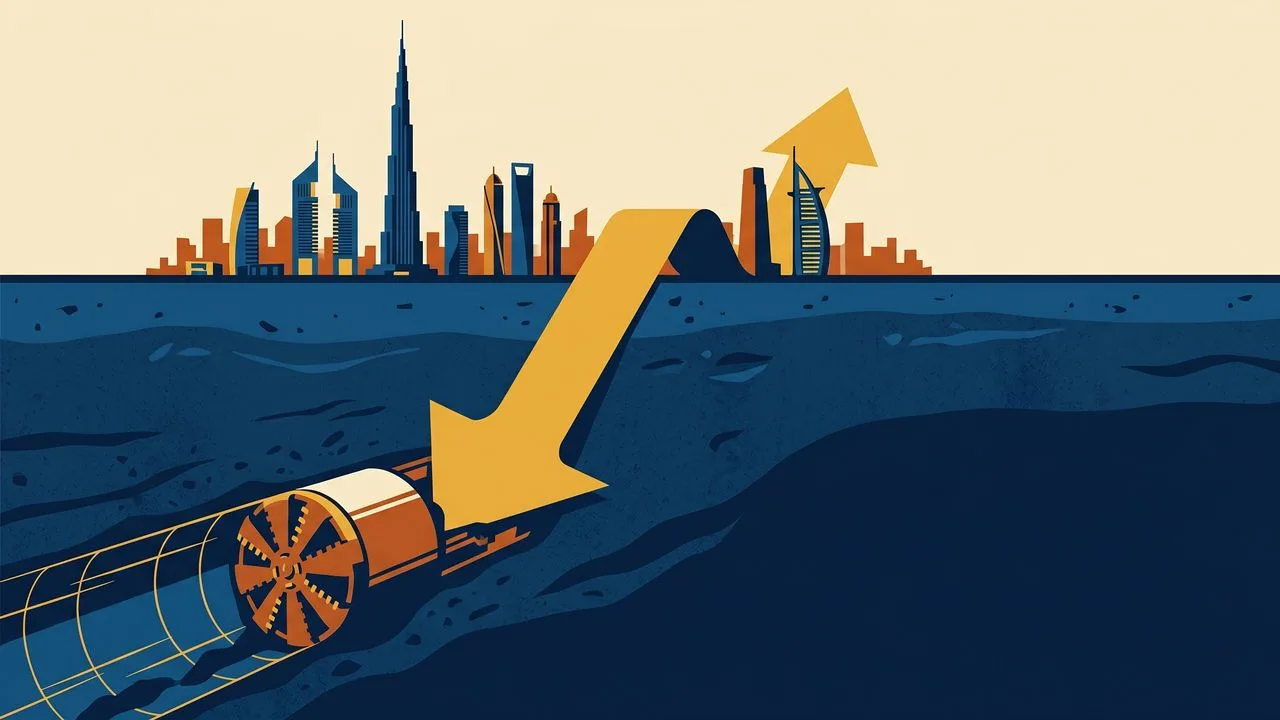
Photo: AI. Mika Sørensen
Picture a man sitting in a sewage tanker truck on a desert highway outside Dubai. It's somewhere past midnight. He's been in this queue for twenty hours. The treatment plant ahead is backed up — has been backed up for years, really — and the load in his tank needs to go somewhere. According to reporting from that period, some drivers, after that long wait, made a decision: find a patch of desert, dump it, drive away. "They told us that dumping is routine," one reporter noted at the time. "Nobody in those days."
Nobody watched. Nobody stopped it. And somewhere downstream, in someone's neighborhood, in someone's groundwater, that decision landed.
This is the story Dubai doesn't put on the billboard next to the Burj Khalifa.
The B1M's recent deep-dive into Dubai's sewage infrastructure is worth your time — it's genuinely good engineering journalism — and it's also, without quite meaning to be, a social history with half the story missing. The engineering half is well-documented: Dubai has a broken sewage system, the city approved a $21.8 billion fix in 2023, and by the early 2030s two deep-level gravity tunnels totaling 75 kilometers will carry waste to treatment facilities in Jebel Ali and Al Warsan, increasing wastewater capacity by a reported 700%. It's a serious project for a serious problem.
But infrastructure doesn't happen to a city. It happens to people. And the people in this story — the ones who waited in those tanker queues, the residents who lived with the smell for six months before anyone acknowledged it, the workers who built the towers that overwhelmed the pipes in the first place — keep getting swapped out for statistics.
The Poop Snake Had a Human Driver
The "Dubai poop snake" — the nickname for the miles-long convoy of sewage tankers that became a recurring feature of the city's boom years — is a genuinely useful image. It captures something real about what happens when a city builds its skyline faster than its ground-level systems. By 2013, according to The B1M's reporting, roughly 30% of all waste arriving at the Jebel Ali treatment facility came in by road. (This figure originates with The B1M video; I'd want to verify it against Dubai Municipality data before treating it as settled, but the broad picture is consistent with multiple accounts from that period.)
The queues were so severe that drivers waited up to 24 hours to unload. And when the waiting became unbearable, some didn't wait. The illegal dumping wasn't a mystery or an anomaly — it was a rational response to a system that had no capacity left. Beaches closed. Shorelines clogged. The people who swam in those waters, who lived near where the trucks disappeared to at night, absorbed the consequences of a planning failure that was never really about them.
When Palm Jumeirah residents complained in 2019 about chronic sewage smells, blocked pipes, and broken water supply, one eyewitness described conditions that had persisted for roughly six months: "It's been like this for about 6 months, and it smells. Sewage has been lying on the road and is even splattered on the blue construction boards." Six months. On the most exclusive real estate in the emirate. The less exclusive neighborhoods don't tend to make international news when their water smells wrong.
Who Built What Broke the System
Here is the thing The B1M doesn't say, and it matters: the towers that overwhelmed Dubai's sewers were built by migrant workers — predominantly from South Asia and East Africa — operating under kafala, a sponsorship system that binds a worker's legal residency to a specific employer. Human rights organizations including Amnesty International and Human Rights Watch have documented the system's vulnerabilities for decades: wage theft, passport confiscation, workers unable to change jobs or leave the country without employer permission, labor camps where living conditions have been widely reported as inadequate.
Dubai's population, according to The B1M's figures, roughly doubled in the eleven years between 2008 and 2019. (The video's framing is slightly loose here; independent verification against Dubai Statistics Center census data would sharpen this.) That growth was built — physically constructed, floor by floor — by workers whose legal precarity was a feature, not a bug, of the economic model. The Burj Khalifa didn't just exceed sewage capacity. It was built by people whose own sanitation, housing, and labor rights were frequently failing at the same time.
The tunnels now planned to fix what broke will also be built by those workers, or workers in similar circumstances. The UAE has made some labor reforms since 2021, including limited changes to kafala allowing workers more mobility in certain sectors. Whether those reforms have meaningfully improved conditions on the ground is disputed, and independent labor monitoring remains restricted. The construction industry — where the new tunnels will be built — has historically been among the sectors with the weakest protections.
I raise this not to dismiss the engineering project, which is genuinely necessary. I raise it because "unsung heroes underground making the glamour above ground possible" lands very differently when you understand who those workers are and under what conditions they're likely to be working.
What Took So Long — and Who Paid for the Wait
The B1M's answer to "why did this take so long" is generous, and worth taking seriously: Dubai grew faster than anyone predicted, and you can't build infrastructure for a city you can't yet see. London's parallel is instructive — it took the Great Stink of 1858, when the Thames became so foul that Parliament had to soak its curtains in lime chloride, before the government finally funded Joseph Bazalgette's sewer system. Crisis precedes action. That's not unique to authoritarian governments or resource-rich states. It's basically the history of public infrastructure everywhere.
But the generous reading only goes so far. Dubai's sewage fragmentation wasn't just a product of speed. By the mid-1990s, the city had over 1,200 kilometers of sewer pipes — the B1M notes these existed as "small localized networks that had been built ad hoc rather than in response to a city-wide strategy." Those 150-plus pumping stations that kept waste moving (and which, according to The B1M's figures — pending primary source verification — now account for around 30% of the city's carbon emissions) represent accumulated decisions: cheaper in the short term, catastrophic over decades.
The question isn't whether the growth was unpredictable. Some of it genuinely was. The question is: whose neighborhoods absorbed the cost of the gap between the growth and the infrastructure? The Palm Jumeirah residents who could afford to complain loudly eventually got attention. The workers in labor camps on the city's periphery, the residents in lower-income areas without the platform to document their conditions for international media — they don't tend to surface in the engineering retrospective.
Dubai 2040 and What a Plan Actually Promises
Dubai 2040 — the urban master plan unveiled by Sheikh Mohammed bin Rashid Al Maktoum in 2021 — has real ambitions: five urban centers with walkable amenities, new metro coverage putting half the city within 800 meters of a station, substantial investment in green corridors for pedestrians and cyclists. (Infrastructure budget figures in long-range plans shift constantly; the specific numbers The B1M cites should be verified against current official Dubai 2040 documentation before publication.)
The statistics are easy to recite. The harder question is what they mean for the person who currently lives in one of those neighborhoods hemmed in by motorways — the ones The B1M describes as "an urban planner's vision of hell" — where getting to a grocery store means crossing a highway interchange not designed for pedestrians. For that person, a master plan is a promise. Dubai's history of promises made and promises kept is, like all cities, complicated.
The sewage tunnels are, in a narrow sense, less complicated. They are necessary. They will almost certainly get built. A 700% increase in wastewater capacity for a city that has been patching a crisis with tanker trucks for two decades is not a luxury. But a tunnel under a city doesn't answer the question of who the city is built for and who maintains the right to complain when it fails them.
London's Victorian sewer — Bazalgette's network, which still underpins the city today — was built after cholera killed tens of thousands and the smell drove Parliament to act. The Tideway Tunnel (tunneling completed around 2023-2024; The B1M's claim of a 2025 opening date should be confirmed against official Tideway project communications before publication) was built to supplement a 160-year-old system that has been overflowing into the Thames during heavy rain for generations. The communities whose rivers and beaches absorbed those overflows for 160 years didn't get a Tideway Tunnel until the smell reached somewhere that mattered.
The Dubai Strategic Sewage Tunnels will fix a broken system. That's not nothing — it's actually quite a lot. But the deeper pattern, across Dubai and London and every city that has ever built fast and planned slowly, is that the cost of the gap lands on people without the power to make it stop.
The tunnels will be dug by workers whose names we won't know. For residents whose voices we don't often hear. Beneath towers whose construction depended on labor conditions we don't fully see.
That's infrastructure. That's also history.
More Like This
GoFundMe's CPTO on Marketplace Failure & AI Growth
GoFundMe's CPTO Arnie Katz breaks down 3 marketplace failure modes and how AI agents are driving real revenue—not just dev productivity.
Lloyd Blankfein's Risk Rules Work on Main Street Too
Lloyd Blankfein's frameworks on crisis management, contingency planning, and AI risk translate directly to small business — if you know where to look.
Inside the Emma Maersk: How the World Sails
The Emma Maersk carries what the documentary estimates as half a billion dollars of cargo across 13,000km. Here's what that actually takes.

Mark Rober's $60M Free Science Curriculum Bet
Mark Rober is spending $60M to give free STEM curriculum to every teacher in America. The education bet is the headline. The business story underneath it is what caught my eye.
Hampton Roads Bridge-Tunnel: Engineering Marvel Revisited
Explore the expansion of the Hampton Roads Bridge-Tunnel, a pioneering infrastructure project in Virginia, featuring advanced engineering techniques.
What Tourism Can Teach Us About Migration
A tourism professor argues migration and overtourism are the same problem. The analogy is uncomfortable—and that's exactly the point.

The Spanish Civil War at 90: What the Coup Unleashed
On July 17, 1936, a military coup fractured Spain and drew the world in. What the Spanish Civil War's 90th anniversary still asks of us.

Medieval England: How Peasants and Guilds Shaped Society
A new documentary traces medieval England's social divide through two real families—one peasant, one guild merchant—and the starkly different worlds they inhabited.