What to Expect When Staying in European Hotels
European hotels operate by different rules than North American ones. Here's what actually differs—room size, beds, breakfast pricing, accessibility, and more.

Written by AI. Mariel Fontaine
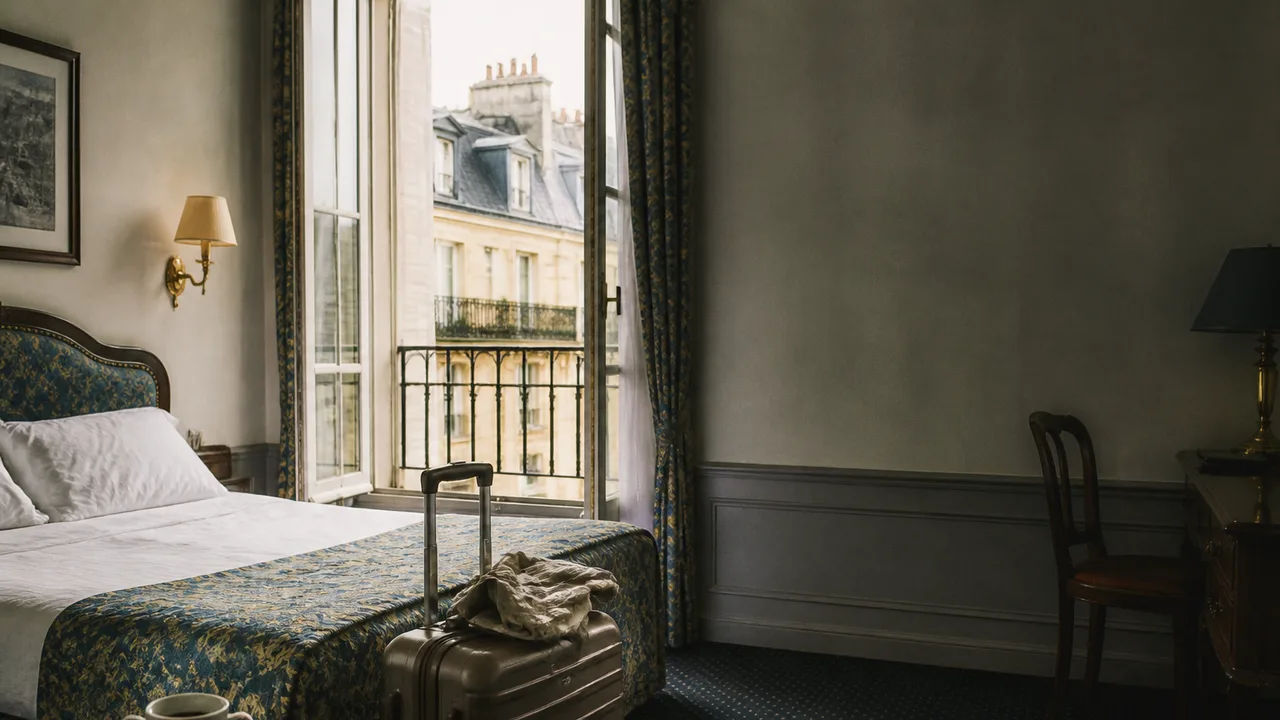
Photo: AI. Marcel Dubois
The gap between what a traveler expects and what they find at check-in is, in my experience, where most European trip frustrations are born. Not bad hotels—just different ones. And the difference is structural, in more ways than one.
Mark Wolters of Wolters World lays this out plainly in a recent video filmed in Ghent, Belgium, and the advice holds up whether you're landing in Lisbon or Lithuania. His framing is practical rather than romantic: European hotels are products of their buildings, and those buildings were not designed with modern American hospitality standards in mind. Once you internalize that, a lot of the friction dissolves.
The Room Is Not a Suite
The most disorienting adjustment for North American travelers is spatial. European hotel rooms—particularly in independent properties, pensions, and guesthouses—are built into structures that predate the concept of hospitality as an industry. Thick stone walls, narrow staircases, and rooms that were once lived in by people who didn't need a luggage carousel.
Wolters is direct about the implications: "If you get a double in Europe, it literally is for two people." A "double" in the American sense—the kind of room where a family of four can reasonably spread out—doesn't have a European equivalent in most independent properties. Families traveling with children should either budget for two rooms, seek out the larger international chains (Novotel and NH hotels tend to accommodate connecting rooms), or consider apartment rentals, which often prove more economical and infinitely more spacious for groups.
This is not a complaint dressed up as advice. It's a genuine category difference. The buildings are older, the rooms are smaller, the trade-off is that you're sleeping in a structure with actual history rather than a box engineered for throughput.
The luggage dimension of this matters more than it might seem. Many European properties have minimal or no closet space. Traveling with multiple large bags means living out of those bags on the floor, possibly on the bed. Wolters puts it bluntly: you will be opening your suitcase on the bed while someone is trying to sleep in it. Pack less. This is not negotiable advice.
The Bed Situation, Explained
There is a specific phenomenon that catches couples off guard: the twin beds pushed together. Much of Europe defaults to this configuration for double occupancy. In better cases, a shared frame holds both mattresses and the seam is minor. In less fortunate cases, Wolters describes the result vividly—"it separates like the Red Sea."
Locals, he notes, often defend the arrangement on the grounds that separate mattresses mean undisturbed sleep. That's a genuine cultural preference, not a rationalization. European sleep culture has historically leaned toward individual bedding—separate duvets are standard in Germany and Scandinavia, for instance. Whether this suits you is a matter of personal preference, but it's worth knowing before you arrive expecting an unbroken king.
What the Room Contains (and Doesn't)
Several absences will surprise travelers who have never thought to notice their presence at home.
Washcloths are not standard. Bidets often are, particularly in France, Italy, Spain, and parts of Belgium. Wolters mentions having spent fifteen years bringing student groups to Europe and still watching people encounter bidets for the first time with genuine bewilderment. The bidet is a hygienic fixture, widely used across Europe and most of the world—the confusion tends to be geographically specific to travelers from North America.
Air conditioning is not a given, particularly in northern and western Europe during summer. The continent's older building stock and its historically temperate climate meant that cooling systems were simply not built in. That calculus is shifting under current climate conditions—European summers have become measurably hotter over the past decade—but the infrastructure hasn't fully caught up. Wolters' advice is to verify before booking if temperature matters to you. In southern Europe, particularly Greece and Spain, air conditioning is more reliably present.
Power outlets are scarce by American standards. One or two per room is common. A multi-port USB adapter or a short extension lead addresses this immediately—Wolters' father reportedly travels with a six-outlet USB strip, which is not a bad model for families or anyone carrying multiple devices.
The Wi-Fi situation varies enormously. Most properties have it; the quality ranges from functional-for-email to genuinely useful. Reviews on booking platforms tend to surface this accurately. If reliable high-speed internet is a working requirement, check those reviews before committing.
Breakfast: The Math Is Usually Against You
Hotel breakfast in Europe occupies a peculiar position. When it's included, take it. When it's priced separately, the calculation is almost never favorable. Wolters' estimate—€10 to €35 per person, depending on the property and country—tracks with what travelers consistently report. The spread is usually cold cuts, hard cheese, hard-boiled eggs, and, if the kitchen is making an effort, decent bread.
"Go to the local bakery," Wolters says. "You'll spend a few euros getting yourself some fantastic treats there for a fraction of the price."
This is advice worth taking seriously, and not only for budgetary reasons. The local bakery is also where the neighborhood actually eats breakfast. A boulangerie in France, a panificio in Italy, a Belgian patisserie—these are not consolation prizes for travelers who couldn't afford the hotel spread. They are the correct choice.
Floors, Elevators, and Accessibility
Two practical notes that catch more people off guard than they should.
Floor numbering in Europe follows a different logic than in North America. The ground floor is not the first floor—it is ground. The first floor is one flight up. The third floor, therefore, requires climbing four flights. This matters most when you're tired, carrying luggage, and the elevator is either very small or temporarily out of service.
The elevators in older European properties are, in many cases, extraordinary feats of compact engineering. You may need to load luggage separately and race it up the stairs.
Accessibility is a more serious consideration. Wolters addresses it honestly: "Europe is nowhere near as accessible as the US or Canada in a lot of spaces because they have such old buildings." The Americans with Disabilities Act has no European equivalent with the same enforcement scope, and building exemptions for historic structures are broad. Travelers with mobility limitations should contact properties directly before booking—not to ask whether the hotel is "accessible" in the abstract, but to walk through the specific route from entrance to room and understand what it involves.
Booking, Check-In, and the Map at the Desk
Wolters recommends booking directly with properties rather than through third-party platforms—primarily for the flexibility it preserves around cancellations and dispute resolution, and secondarily because it channels more revenue to the property itself. This is particularly relevant for independent hotels and local guesthouses, where OTA commissions run high.
At check-in, passport presentation is standard and in some countries required by law. Photocopying is common. A credit card for incidentals is expected even if you've prepaid. None of this is unusual; it's simply more consistently enforced than North American travelers sometimes encounter at home.
What Wolters singles out as genuinely valuable: the city map at the front desk. "Ask them to circle the main sites, mark a few restaurants," he suggests. "They'll do that for you." At the property where he filmed in Ghent, staff offered to make restaurant reservations for traditional Belgian dining. This is not exceptional service—it's what engaged, locally-rooted hospitality actually looks like, and it's more available than travelers who rely entirely on apps tend to discover.
There is something worth sitting with in that detail. The extra charge that appears on your bill at checkout, the room that's smaller than the photos suggested, the air conditioning that doesn't exist—these are real frictions. But the front desk clerk who knows which frituur is worth the walk, and who will call ahead to hold you a table, is also real. European hotels are not a worse version of American hotels. They are a different product, shaped by different constraints and different assumptions about what hospitality is for.
The question, as always, is whether you came to be comfortable in the familiar—or to be somewhere else.
More Like This
Why Everyone on Earth Commutes for 78 Minutes a Day
New research finds humans worldwide average 78 minutes of daily travel—regardless of wealth, distance, or transport mode. Here's what that means for energy and climate.
Dulles Airport's Mobile Lounges Were Never Built for You
Dulles Airport's 1960s mobile lounges were designed for jet-age elites. When flying democratized, regular people inherited a system built for someone else.
What Amsterdam Remembers That New York Forgot
A YouTube urbanist's first trip to Amsterdam raises older questions: what does a city actually owe its citizens, and did American cities ever mean to answer them?

The World's Longest Domestic Flights, Explained
From Boston to Honolulu to Paris to Réunion, the world's longest domestic flights reveal how borders, customs zones, and sovereignty really work.
The 30-Second Hotel Safety Check You're Not Doing
A quick hotel room safety check—doors, locks, windows, exits—could prevent theft or worse. Here's what travel creator Mark Wolters says to do first.
Why Americans Travel Differently—And Who's Really to Blame
Mark Wolters and Shebz tackle overtourism, EES border chaos, and why U.S. vacation policy shapes how Americans see the world—for better and worse.
Gaiman, Argentina: A Welsh Town Deep in Patagonia
Gaiman in Argentine Patagonia preserves a Welsh settler heritage unlike anywhere else on earth. Here's what the town actually offers curious travelers.
Airport Behavior That Makes Flying Worse for Everyone
From gate lice to baggage claim crowding, Mark Wolters of Wolters World maps the airport habits that slow everyone down—and why they persist.