American Tourists in Europe: The Etiquette Gap
From date formats to tipping culture, the everyday customs that trip up American travelers in Europe—and what they reveal about deeper cultural differences.

Written by AI. Mariel Fontaine
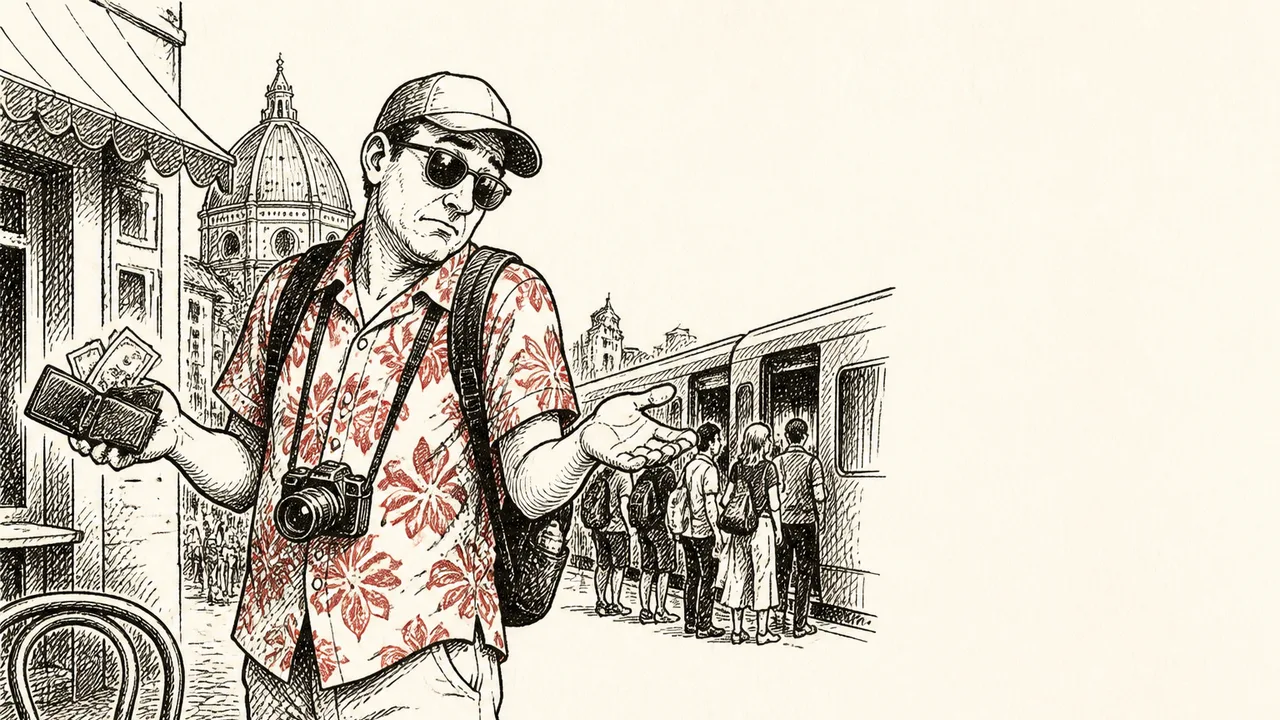
Photo: AI. Eira Pendragon
There is a particular kind of travel friction that has nothing to do with language, nothing to do with logistics, and nothing to do with how much you spent on your flight. It's the friction of unconscious assumption—the moment you discover that a practice so ordinary at home that you never thought to question it is, elsewhere, a minor social violation.
Mark Wolters of Wolters World, filming from Amsterdam, has built an audience on cataloguing exactly these moments for American travelers heading to Europe. His recent video on common etiquette mistakes is a useful inventory—practical, good-humored, filmed in the field—and it surfaces a set of frictions worth examining not just for their logistical fixes but for what they reveal about how differently two Western cultures have organized daily life.
The entry point is almost comically mundane: the date format.
"So if you send them an email saying, 'Hey, we'd like to stay two nights starting on 7/4' and you're thinking July 4th, they're actually thinking April 7th."
This is not exotic cultural difference. It is a formatting convention, the kind of thing that exists on the same shelf as keyboard layouts and paper sizes. And yet it produces real-world consequences—missed hotel reservations, misbooked tours, the panicked arrival at a property that has no record of you. Wolters extends the same logic to the 24-hour clock, which governs all official schedules across European transport and institutions. These are not tests of cultural sensitivity. They are interoperability problems, the travel equivalent of bringing the wrong plug adapter.
What makes them worth noting is not their severity—they're minor—but their density. European travel hands Americans several such formatting mismatches at once: date order, time notation, measurement system, calendar week structure (in Germany and several other countries, weeks start on Monday, not Sunday, which can throw off day-of-week calculations when booking). Each one alone is trivial. Compounding, they produce a low-grade navigational haze that can make the first days of a trip feel more effortful than they should.
The logistical frictions are the easy ones to address. The social ones are more interesting.
Wolters covers a cluster of behavioral norms that fall into what might loosely be called public conduct: volume levels, personal space, escalator etiquette, the formality of first encounters. These are areas where American defaults—cultivated in a culture that prizes extroversion, informality, and projecting confidence—land differently in contexts that value restraint, order, and the quiet preservation of communal space.
The escalator example is instructive. Stand right, pass left. It is a simple convention, universal across European metro systems, and the consequences of ignoring it are modest—a few annoyed commuters, some muttered frustration. But Wolters frames it accurately: in a dense urban transit system used by millions of people daily, a handful of tourists blocking the left lane creates genuine friction for locals who are not on holiday and who have somewhere to be. The cost is asymmetric. The tourist loses nothing by standing right; the commuter loses real time when they don't.
This asymmetry—where the tourist's default behavior imposes a cost on locals that the tourist doesn't register as a cost at all—is the structural issue underneath most of what gets called "bad tourist behavior." It rarely involves malice. It involves the failure to perceive that you are operating inside someone else's daily life, not a themed environment constructed for your visit.
Safety assumptions get a similar treatment. Wolters is direct about the anxiety some Americans carry into European public transit: the fear of pickpockets, the sense that metros are dangerous. His reframing is blunt—"Public transportation is significantly, significantly safer here in Europe"—and largely accurate by available data. European cities consistently outperform American cities on violent crime metrics, and metro systems in cities like Amsterdam, Berlin, and Paris, while not without petty theft, are not the gauntlets some travelers anticipate. The practical concern is not violence but opportunistic theft, which responds to simple precautions: zipped bags, front pockets, not leaving a phone unattended on a café table.
The section on customer service culture is where the video moves from practical advice into something more structurally interesting.
"The customer is not king. If you go to a restaurant, they're not going to fawn all over you trying to get a big tip from you, because most of the time they're not working off of tips."
This is accurate, and the reason is economic rather than attitudinal. The American service model—effusive, attentive, optimized for the tip—is a rational response to a compensation structure where tipped workers in many states can legally be paid a base wage well below the federal minimum, with tips expected to constitute the bulk of their income. The result is a performance of hospitality that is, at its base, a wage negotiation conducted in real time.
European service workers in most countries receive a living wage as a baseline. The gratuity, where it exists, is genuinely optional—a small gesture rather than a structural necessity. The upshot, as Wolters notes, is that the service relationship is different in character: more professional, less performatively eager, and—this part is worth sitting with—often more honest. A server who doesn't benefit from steering you toward the expensive wine has no particular reason to steer you toward the expensive wine.
American travelers who read European service cool as rudeness are, in a sense, encountering the uncanny valley of hospitality: the same surface behaviors (a table, a menu, food arriving) organized around a fundamentally different economic and social logic. It can feel cold until you understand it as neutral. After that, many people find it a relief.
A few items in the video get compressed treatment that deserves expansion for anyone planning a trip.
Shopping hours are presented as a minor inconvenience—stores closing at 17:00 or 18:00, shops shuttered on Sundays in many countries—but the variation across Europe is significant. Sunday trading laws differ substantially between countries, and even within countries. The Netherlands, Germany, and Switzerland have historically had more restrictive Sunday retail laws than, say, the UK or Spain, where Sunday trading is more common in tourist areas. It's worth checking local norms for wherever you're specifically headed rather than applying a continental-level rule.
The restroom economics are similarly real. Paid public facilities are common across much of Western Europe, and the expectation that you'll purchase something before accessing a café or restaurant toilet is widely enforced. Carrying a euro or two in coin is a practical habit, not an optional luxury—and, as Wolters notes with some irony, the paid facilities are frequently cleaner than their free American equivalents.
The language point—that English functions as a de facto tourist lingua franca across European tourism infrastructure—is broadly true and has been reinforced by decades of English-language education becoming standard across EU secondary school systems. That said, the depth of English fluency varies considerably by country, city size, and context. In major tourist centers and transport hubs, you will be fine. In rural areas or smaller towns, the picture is more mixed, and a few phrases in the local language carry disproportionate goodwill.
What the video captures well, beneath the checklist format, is that most of these frictions are not about cultural superiority or American obliviousness—they're about the gap between what travelers have been unconsciously trained to expect and what they actually encounter. The date format isn't wrong; it's just different. The quieter social register isn't unfriendly; it's calibrated differently. The service style isn't indifferent; it's structured differently.
The practical question for any traveler isn't whether to master European etiquette wholesale before departure—that's neither realistic nor necessary. It's whether you're willing to notice, fairly quickly, that your defaults aren't universal, and adjust without making it a federal case.
The tourists who stand on the right on the escalator before anyone has to ask them—those are the ones the locals quietly appreciate.
More Like This

US Airlines Are Profitable and Getting Worse
US airlines make billions but deliver miserable service. Here's what the loyalty program math actually means for small business owners who fly on points.

The 30-Second Hotel Safety Check You're Not Doing
A quick hotel room safety check—doors, locks, windows, exits—could prevent theft or worse. Here's what travel creator Mark Wolters says to do first.

Why Prepared Travelers Are Calmer at the Airport
Flight anxiety is common and real. Here's the psychology of why preparation reduces your stress response—not just your risk exposure—before you fly.

What Poles Actually Want Tourists to Know
From geography to drinking etiquette, here's what Polish locals wish visitors understood before arriving—and why it matters more than you think.

Amsterdam's Gable Stones: History Hiding in Plain Sight
Before street addresses, Amsterdam used carved stone tablets to navigate the city. Fourth Place explores what gable stones reveal about the people history forgot.

What to Expect When Staying in European Hotels
European hotels operate by different rules than North American ones. Here's what actually differs—room size, beds, breakfast pricing, accessibility, and more.

What TSA Confiscates at Airport Security in 2025
From dead electronics to cordless hair tools, TSA confiscates over a million items a year. Here's what triggers confiscation and how to keep your gear.

What Hotel Staff Actually Tell You (And Who's Listening)
Hotel insiders speak candidly on a Travel + Leisure video — but what does "unfiltered" mean when the interviewer has advertisers? A close read of what they said and how.