Mass Media Doesn't Change Your Accent. Your Friends Do.
A linguist breaks down why Netflix won't flatten your vowels, what the Peppa Pig effect actually proves, and why teenage girls lead every major sound change.

Written by AI. Tomas Reyes-Kim
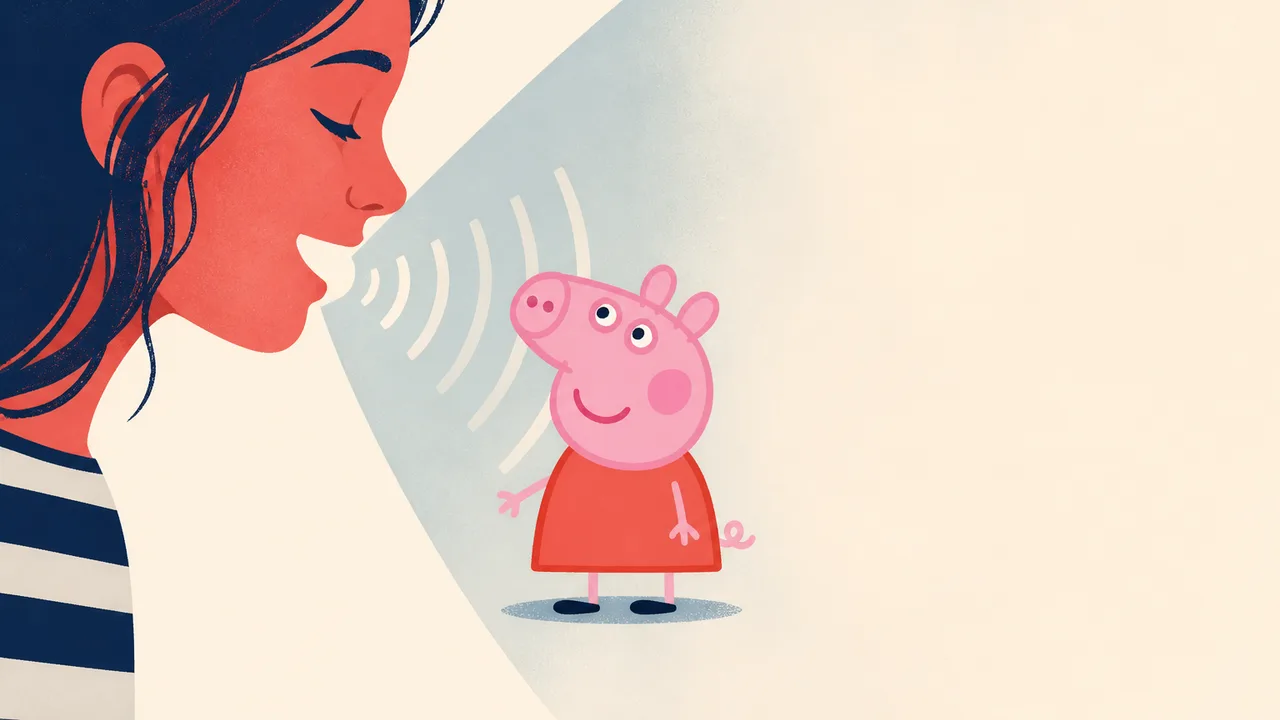
Photo: AI. Mika Sørensen
A few years ago, parents on social media started noticing something unsettling about their toddlers. The kids were saying mummy instead of mommy. Calling cookies biscuits. Picking up intonation patterns that sounded like they'd been raised somewhere near Bristol. The culprit was Peppa Pig. The phenomenon got a name — the Peppa Effect — and it set off a minor parenting panic that also happened to brush up against a much bigger question: in a world drowning in TikTok, Netflix, podcasts, and YouTube, are our accents all slowly converging into one undifferentiated audio slurry?
A new video from the linguistics channel languagejones takes that question seriously — and the answer, backed by decades of sociolinguistic research, lands somewhere more complicated and more interesting than either yes or no.
The data that should have killed this myth decades ago
The strongest piece of evidence in the video isn't new. It's from the 1960s.
William Labov — widely considered the founding father of modern sociolinguistics — spent years documenting what was happening to vowels in a stretch of American cities: Chicago, Detroit, Cleveland, Buffalo, Rochester. What he found was a dramatic, systematic sound change. In those cities, block was starting to sound like black. Black was drifting somewhere else entirely. Bet was moving toward but. The whole vowel system was rotating, like a slow-motion carousel inside people's mouths.
Linguists call it the Northern Cities Vowel Shift, and it's one of the most significant ongoing sound changes in American English.
Here's what makes it such a clean piece of evidence against the media-flattening hypothesis: it happened during the golden age of broadcast media. This shift developed and accelerated while Americans were watching the same three television networks every night, hearing the same Walter Cronkite-style "standard" accent delivered directly into their living rooms. As the languagejones video puts it, "mass media didn't stop it. Mass media didn't even slow it down."
Labov's conclusion, stated plainly: passive exposure to a dialect through media does not cause people to adopt that dialect. You can hear a voice ten thousand times through a speaker and your vowels will not move.
So what actually moves them?
The speech community. Specifically, face-to-face interaction with people whose social approval you actually want.
"We learn to talk like the people we talk with, not the people we listen to," the video explains. Your accent is shaped by your friends, your classmates, your coworkers, your neighborhood — the humans whose recognition has real stakes attached to it. Media, by contrast, is wallpaper. It's present, it's absorbed, but it operates at the surface layer: slang travels through TikTok just fine. Rizz, slay, no cap — those spread because vocabulary is easy to pick up and deploy. But vowels, consonants, prosody — the actual acoustic signature of where you're from — those come from somewhere else entirely.
This is also why the Peppa Effect is real and temporary. Toddlers are linguistic edge cases. Their speech communities are tiny, they're building their phonological systems from scratch, and a cartoon pig genuinely accounts for a significant chunk of their daily language input. But the moment those kids hit kindergarten and get embedded in a real peer group? The British features disappear. "The speech community wins," the video notes. "It always wins."
Two forces pulling in opposite directions
Here's where it gets more nuanced than the original panic question suggests. Accents are changing — they're just not all changing in the same direction.
Dialect leveling is real. When populations relocate and mix, regional features can soften. Britain's Estuary English spreading out from London is the textbook example: a blended variety that emerged from actual face-to-face contact as people moved around. The mechanism isn't television. It's bodies in rooms, talking.
But dialect divergence is also happening simultaneously, and it's the counterintuitive one. The Northern Cities cities sound less like the rest of America today than they did a hundred years ago. African-American English has by many measures diverged from surrounding varieties over the 20th century rather than converging. Pittsburgh, as the video notes somewhat delightfully, sounds more like Pittsburgh than ever.
Why would local accents get sharper in an age of global media saturation? Because an accent is not just a transmission system for words. It's a flag. It's a signal. It's one of the most powerful tools humans have for communicating group membership — and that function doesn't weaken when everything else becomes more homogeneous. If anything, it intensifies.
Labov's famous Martha's Vineyard study, conducted in 1963 and still widely cited, found that the islanders who most strongly identified with the island — who most wanted to be distinct from the summer tourists — produced the most exaggerated versions of local vowel features. Not consciously. Identity was, as the video puts it, "steering their mouths." Gerard Van Herk's paper "Fear of a Black Phonology" applies a version of the same logic to African-American English: when a community's linguistic identity feels contested or worth defending, divergence can be an act of resistance, whether anyone's aware of it or not.
The implication is quietly destabilizing for the media-flattening thesis: a hyper-connected, globally interchangeable world might actually increase the social value of sounding like somewhere specific.
The people actually running the future of English
There's one more piece of this that the video is careful to highlight, partly because it keeps getting dragged into bad-faith cultural commentary.
Across decades of sociolinguistic research, across multiple languages and multiple continents, one pattern repeats with enough consistency that linguists treat it as close to a baseline assumption: women and girls lead sound change. They adopt new variants earlier, use them more frequently, and push them further than male speakers do. The Northern Cities Vowel Shift — led by women. The California Vowel Shift — led by women. Uptalk, vocal fry, the spread of new vowel qualities in emerging dialects — all of them driven disproportionately by young female speakers.
The prevailing theories point to denser social networks, more acute attention to socially meaningful variation, and the role young women occupy as central nodes in the communities where linguistic innovation incubates. The precise mechanism is still being worked out, but the pattern is robust enough that finding a documented counterexample would, as the video puts it, "make a huge splash on the sociolinguistics conference circuit."
The cultural irony here is pointed. The same speech patterns that researchers identify as the leading edge of English's evolution — the features that will be unremarkable to everyone in thirty years — are routinely the ones that generate op-eds about how teenage girls are degrading the language. "They're not ruining anything," the video says. "They're showing you what English is going to sound like in 2055."
There's a version of this story that ends with a tidy reassurance: don't worry, your accent is safe, go back to your Netflix queue. But the more interesting version is what it suggests about why accents are safe. Not because language is stubborn or because media is weak, but because an accent is doing something that a screen fundamentally can't replicate — it's proof of belonging, of place, of the specific people who shaped you. The Peppa kids grow up, find their peer groups, and start sounding like them. Not like an algorithm. Like their community.
Which raises a question worth sitting with: as remote work keeps fragmenting the "speech community" into Slack channels and group chats rather than physical neighborhoods, does the mechanism that has always protected accent diversity actually hold? Or are we running a real-time experiment on whether digital proximity can eventually do what television never could?
More Like This
Crafting Supercars: The Science Behind Speed and Style
Explore how supercars like Alfa Romeo 4C and Aston Martin Vanquish are meticulously crafted using cutting-edge materials and precision engineering.

Exploring the Enigma of Antimatter at CERN
CERN's antimatter factory reveals mysteries of the universe's matter-antimatter asymmetry and the quest for new physics.
GPT-Realtime-2: Voice AI That Actually Does Things
OpenAI's GPT-Realtime-2 can operate UIs, call parallel tools, and translate live speech. Here's what that actually looks like in production.

The Psychology Behind Avoidant Lovers, Explained
Alain de Botton's viral School of Life video on avoidant attachment is everywhere on TikTok. Here's what it gets right — and what it leaves out.

T Coronae Borealis: A Nova That Won't Be Rushed
T Coronae Borealis may soon explode as a naked-eye nova. Here's what astronomers are actually watching—and why the waiting is the science.

Why Modern TTS Models Are Built Like LLMs
Mistral's Samuel Humeau explains why text-to-speech now runs on autoregressive transformers—and what's still unsolved about streaming audio in real-time agents.

Dual Internet Connections Are Still Needlessly Hard to Set Up
IPv6 multihoming could let you plug two ISPs into one network and get automatic failover. Here's how close we actually are—and what's still broken.

Travel Spending Is Rebounding—But Read the Fine Print
Travel spending rebounded in June and agents are booking again—but the data tells a messier, more interesting story than the headlines suggest.