An 11,000-Year-Old Statue of a Man Riding a Leopard
Archaeologists unearthed an 11,000-year-old statue at Karahan Tepe, Turkey, showing a man riding a leopard. What does it tell us about Neolithic power?

Written by AI. Sofia Ramirez
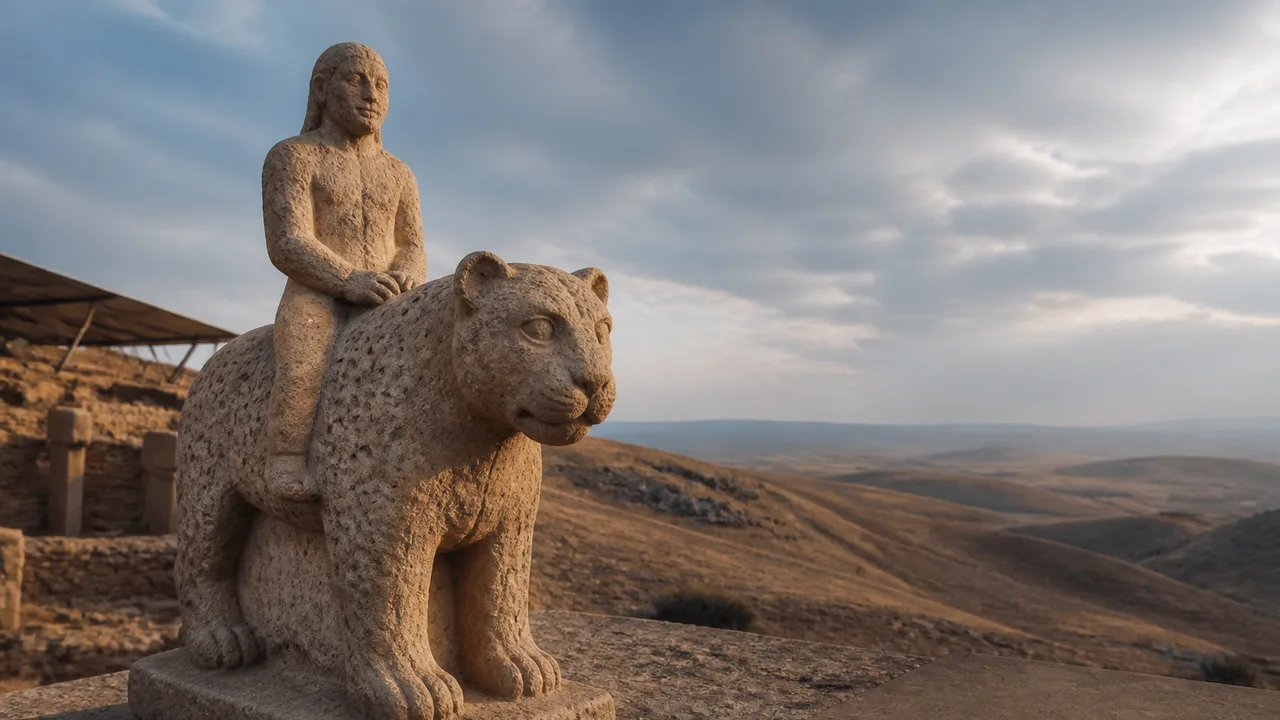
Somewhere in southeastern Turkey, about 11,000 years ago, a sculptor sat down and made something nobody had ever made before: a figure of a person riding a snarling leopard. Not hunting it. Not fleeing it. Riding it.
The statue was recently unearthed at Karahan Tepe, a Neolithic site that has been quietly rewriting what we thought we knew about early human society. Live Science called it "unlike anything seen before," which is one of those phrases that gets thrown around in archaeology coverage until suddenly it's actually true. This time, looking at the image of that figure perched atop a big cat frozen mid-snarl in stone, it feels warranted.
The find is getting a lot of attention, and reasonably so. But the more interesting story isn't just the object itself. It's what researchers don't yet agree on about what it means.
What Was Found, and Where
Karahan Tepe sits in the Taş Tepeler region of Turkey, part of a cluster of Neolithic sites that includes the more famous Göbekli Tepe. These places date to roughly 9000-10000 BCE, before agriculture had fully taken hold, before pottery, before most of what we conventionally think of as "civilization." According to All That's Interesting, the site has developed a reputation as a hub of early human creativity, with sculptures that repeatedly return to themes of power, dominance, and human-animal relationships.
The leopard-riding figure joins a body of sculpture at Karahan Tepe that is unusual by any measure. Previous finds at the site have included carvings of snakes, foxes, and human forms in various states of tension with the animal world. The new statue pushes that further: this isn't a human and animal coexisting, it's a human in apparent control, or at least performing control.
ARTnews described the figure as a person astride a leopard, emphasizing the specificity of the posture. This isn't an incidental pairing. Whoever made this wanted to show mastery, or at minimum, proximity to something dangerous and powerful.
The Question Archaeologists Are Actually Sitting With
Here is where it gets genuinely complicated. ZME Science ran a headline that is worth holding onto: "Archaeologists Aren't Sure Why." That's not a failure of interpretation. That's intellectual honesty about a 11,000-year-old object made by people who left no written language.
There are a few serious interpretive possibilities in circulation, and they pull in different directions.
The first is the status-and-hierarchy reading: the rider represents an early form of social authority, a leader or shaman whose power over dangerous animals signals power over people. This fits with a broader theory about Göbekli Tepe and its sister sites, which some researchers believe were built by hierarchically organized communities even before settled agriculture. The sculpture would be a kind of political art, propaganda in stone.
The second is the ritual and cosmological reading: the figure isn't a specific person but an archetype, a spirit-rider, a deity figure, or a representation of a transformed human (a shaman in animal-mastery during ritual). Leopards appear across Neolithic art in this region, and they don't seem to be everyday livestock. They're symbolic cargo. In this reading, riding the leopard means something closer to "moving between worlds" than "having authority over other people."
The third, less discussed possibility: we might be projecting. The visual grammar of "riding" as dominance is deeply familiar to us, from Roman emperors on horseback to cowboys on the frontier. But that grammar was built over millennia of specific cultural history. Whether a Neolithic sculptor in what is now Turkey was encoding the same meaning is genuinely uncertain. Indian Defence Review frames the find as revealing "a lost world of ancient beliefs hidden for millennia," which is accurate: the beliefs are lost. The object is what survived.
None of these readings cancels the others out. They might all be partially right, or the statue might have meant different things to different people who encountered it, which is how symbols usually work.
Why Karahan Tepe Keeps Mattering
It's worth stepping back to say why this site keeps generating headlines that aren't just "old thing found in dirt."
The conventional story of human progress used to run something like this: hunter-gatherers were simple, then farming created surplus, surplus created hierarchy, hierarchy built monuments, and somewhere in there, art and religion emerged as byproducts of settled life. Göbekli Tepe broke that story open when it was excavated in the 1990s: here were massive, elaborately carved stone structures built by people who were, apparently, still largely mobile foragers. The monument came before the village, or at least alongside it.
Karahan Tepe is deepening that disruption. The human-animal sculptures here are not crude. They are anatomically specific, emotionally charged, and clearly part of a shared visual vocabulary across the site. As All That's Interesting notes, the recurring motifs of human-animal interaction suggest a complex social structure focused on ritual and status. "Complex" is doing a lot of work in that sentence, and that's appropriate, because the complexity keeps revealing itself in unexpected forms.
What the leopard-rider adds is a new data point on intentionality. Someone decided a human could be shown not just near a dangerous animal but on top of one. That decision didn't happen by accident. It came from a visual and conceptual tradition that was already developed enough to have rules worth breaking.
What Gets Preserved and What Gets Lost
One thing I keep coming back to, looking at this find, is the question of whose stories archaeology can actually recover.
Karahan Tepe's sculpture survived because it was carved in stone. The overwhelming majority of Neolithic symbolic life, the songs, the body paint, the fiber-work, the stories told around fires, did not. Stone is a survival bias. What we're reading as a "hub of creativity" is really a hub of creativity that happened to express itself in durable material. There may have been communities equally sophisticated whose entire symbolic world was made of things that rot.
This doesn't diminish what's been found at Karahan Tepe. It just means that what the site can tell us about "early human society" in general has limits. The leopard-rider is a genuine window. But it's a narrow one, set in a very particular wall.
That said, even through a narrow window, what you can see is remarkable: a person, 11,000 years ago, decided to imagine a human being in control of something terrifying, and then spent enormous effort carving that vision into stone. Whatever they meant by it, they meant it enough to make it last.
The question archaeologists are still working through is whether "control" is even the right word for what's being shown. And honestly, the fact that the question is still open is what makes the statue worth talking about.
More Like This
The Bari Disaster: Mustard Gas, Secrecy, and 1943
On December 2, 1943, a German raid on Bari killed over a thousand people—and released mustard gas that officials spent decades trying to erase from history.
When the Dead Were Headed for the Stars
Ancient burial sites from Peru to Egypt share a striking obsession with the cosmos. What does that convergence actually mean—and for whom?
Rommel's Gold: Nazi Plunder or Enduring Myth?
The story of Rommel's lost gold is part treasure hunt, part Holocaust history. What do we actually know—and what are we choosing to romanticize?
Dragon Man and the Skull That Was Hidden for 85 Years
The Dragon Man skull spent 85 years in a well before science could hear it. What its rediscovery means for human evolution and who we were.
Ancient Egyptian Princesses Were Trained Weapon Users
New skeletal analysis of five Middle Kingdom mummies reveals ancient Egyptian princesses used bows and daggers — and a bias that buried that fact for decades.
Colossal Marble Statue Unearthed at Ancient Sardis
A 2.2-meter marble statue found at Sardis, Turkey, raises sharp questions about art, power, and identity in Persian-occupied Lydia circa 500 BC.

The Spanish Civil War at 90: What the Coup Unleashed
On July 17, 1936, a military coup fractured Spain and drew the world in. What the Spanish Civil War's 90th anniversary still asks of us.
Medieval England: How Peasants and Guilds Shaped Society
A new documentary traces medieval England's social divide through two real families—one peasant, one guild merchant—and the starkly different worlds they inhabited.