Ancient Egyptian Princesses Were Trained Weapon Users
New skeletal analysis of five Middle Kingdom mummies reveals ancient Egyptian princesses used bows and daggers — and a bias that buried that fact for decades.

Written by AI. Mei Zhang
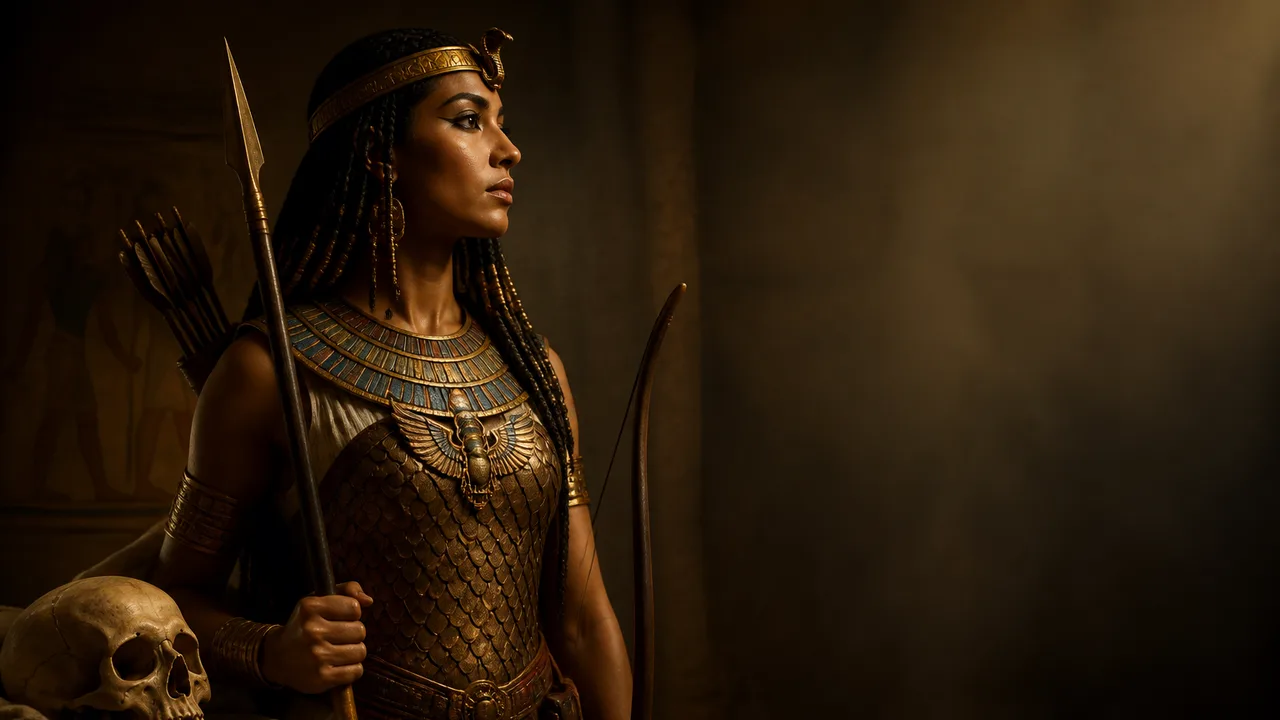
Princess Ita has been dead for nearly 4,000 years. Her bones are still telling stories — and the field of archaeology is only now learning to listen.
A new study published July 17 in Frontiers in Environmental Archaeology, led by Zaineb Hashesh at Egypt's University of Beni-Suef, examined the mummified remains of five ancient Egyptian princesses from the Middle Kingdom and found something that upended a long-standing assumption: these women weren't just buried with bows, arrows, and daggers — their skeletons show they actually used them. The bone changes are consistent with the repetitive physical stress of archery and close-quarters weapon handling. According to New Scientist, these women were "probably trained in using bows and daggers and put themselves at risk."
That last part — put themselves at risk — landed differently than I expected. This wasn't just ceremonial. This was physical. This was training.
What the skeleton actually knows
Here's the thing about bones: they remember. Every time you pull a bowstring, your skeleton adapts. Muscles attach to bone at points called entheses, and when you repeat a motion thousands of times, those attachment sites remodel. They roughen. They swell. Bioarchaeologists can read those changes the way a personal trainer reads wear patterns on a gym shoe — they tell you exactly what movement was being performed, and roughly how often.
The five royal mummies in this study had those markers. Measurably. Phys.org reports that researchers found bone changes consistent with bow use and dagger handling — not light, decorative involvement, but the kind of repetitive use that physically reshapes your skeleton over years. Think about that. Four thousand years later, the training is still visible. 🧬
And it wasn't just the bones. The burial goods aligned. The weapons found alongside these princesses — including Princess Ita's now-famous dagger, which The Independent describes as one of the most striking Egyptian artifacts ever recovered — had previously been classified as ceremonial. Symbolic. Decorative status items.
Because of course they were.
The bias has a name, and it's been running the whole show
Let me be direct about something, because this is the part of the story that I can't shake: the "ceremonial" interpretation of women's burial weapons isn't just an innocent academic default. It's a pattern. A documented, recurring, consequential pattern in archaeology where identical burial assemblages get coded differently depending on the perceived sex of the body they're found with.
Men buried with weapons? Warriors. Women buried with weapons? Ritual. Symbolic. Status display.
This isn't speculation. The field has been grappling with this for years. The landmark 2017 reanalysis of the Viking Birka burial — where a high-status grave full of weapons and two sacrificed horses had been assumed male for over a century, until genetic analysis confirmed the remains were female — cracked open the conversation publicly. But the interpretive reflex that produced that error didn't disappear. It showed up again here, in Egypt. Five princesses buried with functional weapons, weapons their own bodies prove they used, and the prior scholarly consensus was: probably just for show.
The study framed by National Geographic notes that Egypt's own iconography complicated things further — the goddess Neith was associated with bows and arrows, which made it easy to hand-wave women's weapons burials as religious symbolism rather than personal practice. That's not wrong, exactly. Neith's influence on royal women's identities was real. But "possibly religious symbolism" became a default stop, a destination the interpretation reached before it asked whether the bones agreed.
The bones did not agree.
What bothers me — genuinely, not performatively — is thinking about all the Egyptian women we've misread because of this. Not just these five princesses. Not just warriors. All the women whose burial objects were re-categorized, downgraded, or dismissed because the interpretive framework assumed female lives were softer, more domestic, less physical. That's not a footnote. That's a methodology error that has been running quietly through the historiography for generations, shaping every textbook, every museum label, every documentary narrator who described ancient Egypt's women as queens and consorts and priestesses while the soldiers and hunters remained generically male.
The skeptics have a point — and the study anticipated it
Live Science gave space to outside researchers who aren't fully convinced, and their hesitation is worth sitting with. Bioarchaeological stress markers are genuinely tricky. Activities as varied as weaving, agricultural labor, and combat can produce overlapping skeletal signatures, depending on the joint and the motion. Some experts want more comparative data before they commit to "trained fighter" as the conclusion.
I get it. Extraordinary claims and all that. But here's the counter: the researchers didn't just identify stress markers and call it a day. They cross-referenced which markers appeared, where on the skeleton they appeared, and compared that against the specific biomechanical demands of archery and dagger use. According to Science News, the analysis matched the weapons in the burial — which is a much harder coincidence to hand-wave than a single ambiguous data point. The bone changes weren't random. They tracked.
The skeptics are asking the right questions, but the study seems to have asked them first.
4,000 years of reclaiming what's owed
There's a reason this story is going to resonate beyond the archaeology crowd. We live in a cultural moment where the image of the capable, weapon-fluent woman is everywhere — from Beyoncé's visual albums reworking warrior iconography, to the relentless online discourse about women in action films getting real fight choreography instead of hair-flipping and running in heels. We are primed to find this story satisfying. And I want to be careful about that, because there's a real difference between "this genuinely happened" and "this is the narrative we wanted."
But here's the thing: the bones don't care about narrative. The skeletal markers don't care what the cultural zeitgeist needs. And the convergence of physical evidence with burial context with historical iconography — the Daily Mail notes that the weapons types found with these women were traditionally associated with men — makes this something more robust than wish fulfillment.
These women trained. Their skeletons say so. Their graves say so. Their culture's own goddess of warfare says so.
The story we told about ancient Egyptian women was always missing something. What's new is that we have the tools — and, increasingly, the willingness — to notice.
What I'm watching now
The question I can't stop turning over isn't about these five princesses specifically. It's about the other tombs we haven't revisited. How many other female burials in Egypt, across the ancient world, have weapons in them that got filed under "ritual" before anyone checked the bones? The Hashesh study is a proof of concept as much as it is a finding — a demonstration that applying bioarchaeological rigor to women's remains produces different, fuller answers than the interpretive defaults that came before it.
I want to know what else changes when we start asking the bones instead of assuming the answer. My guess is: a lot.
More Like This
How Maxwell Unified Electricity and Magnetism
A compass needle twitched in 1820 and set off a chain of discoveries that now powers every wireless signal in your life. Here's the physics behind it.
The Gods of Pre-Islamic Arabia, In Their Own Words
Ancient desert inscriptions reveal the polytheistic world before Islam—gods, prayers, sacrifice, and fate, recorded by the nomads who lived it.

The Neuroscience of Discipline: Automation Over Motivation
Explore how discipline evolves from motivation to neural automation, making actions automatic and emotions irrelevant.
Asherah: Was She the Wife of the God of Israel?
Inscriptions, figurines, and Ugaritic myth suggest ancient Israelites worshipped a goddess alongside Yahweh. The evidence is real. The debate is very much alive.

Scotland's Carved Stone Balls: A Neolithic Mystery
Nearly 500 carved stone balls have been found across Scotland. Archaeologists still don't know what they were for. Here's where the theories stand.

Black Hole Paradox: Are Reference Frames the Key?
Exploring how reference frames might resolve the black hole information paradox.

SpaceX Starship Flight 13 Aborts at Launch
SpaceX's Starship Flight 13 aborted at the last second when engines failed to ignite. What the scrub reveals about iterative testing, redundancy, and real stakes.

Space Stations Beyond the ISS: A Forgotten History
From a Cold War spy base to a Soviet ice rescue to China's chicken-wing oven in orbit — the real history of space stations is wilder than you think.