Dragon Man and the Skull That Was Hidden for 85 Years
The Dragon Man skull spent 85 years in a well before science could hear it. What its rediscovery means for human evolution and who we were.

Written by AI. David Oyelaran
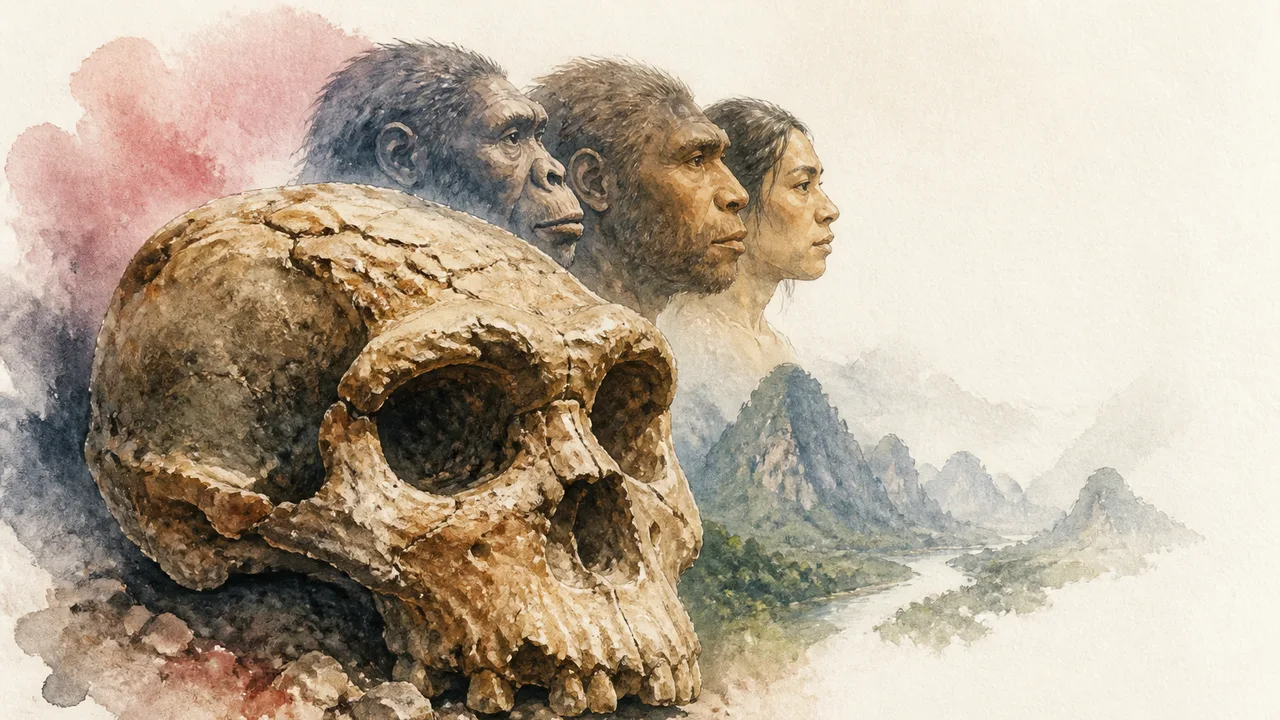
Sometime around 1933, a man found a skull in the sediment of a construction site near the Songhua River in Harbin, northeastern China. He wrapped it carefully and lowered it into a well he knew — a dry one, somewhere he would remember. He told no one except, eventually, his family. He was working under Japanese occupation, and the skull, he sensed, was not something you handed over.
He died without handing it over himself. The knowledge of where the skull was passed to his children, and from his children to his grandchildren, and it traveled that way — carried in the family's memory rather than any archive — for eight and a half decades, until 2018, when one of his grandchildren finally retrieved it from the well and delivered it to the Geoscience Museum of Hebei GEO University.
I want you to hold that story, because I'm going to keep coming back to it. The science that followed is genuinely extraordinary. But the science was only possible because a family held knowledge in trust for 85 years and then chose — at a specific moment, for reasons we don't fully know — to let it go.
In 2021, paleoanthropologist Qiang Ji and a team of international colleagues published their formal analysis of the skull in The Innovation, describing it as a new species they proposed to call Homo longi — Dragon Man, after the Long Jiang region where it was found. Using uranium-series geochemical dating of sediment matrix still attached to the cranium, Ji et al. established that the skull was at least 146,000 years old. Possibly older.
The skull itself is worth sitting with before the taxonomy. It is massive — larger than any Homo sapiens cranium — with a braincase that, in terms of volume, falls within the modern human range. But the face below it is heavy and wide, the brow ridge thick and projecting, the cheekbones broad in a way that reads as older, more archaic. It has been compared in structure to other Middle Pleistocene specimens found across Eurasia, fossils that have long resisted clean classification and floated between informal categories like "archaic Homo sapiens" and "late Homo erectus" for decades.
The Ji et al. analysis placed Dragon Man not as a close cousin of Neanderthals — where many Mid-Pleistocene Asian fossils had been tentatively filed — but in a sister lineage to modern humans, potentially more closely related to us than Neanderthals are. The phylogenetic trees in their paper put Homo longi and Homo sapiens sharing a more recent common ancestor than either shares with Neanderthal populations. That is a significant repositioning.
Here is where preservation and science run into each other in a way that feels worth naming: the skull's 85 years in the well, improbable as that sounds, may have protected the sediment matrix that made precise dating possible. What looks like an interruption in the scholarly record was also, inadvertently, a form of conservation.
The harder problem — and it is genuinely hard — is where Dragon Man sits relative to the Denisovans.
The Denisovans are among the stranger presences in recent paleoanthropology. As a population they are genetically well-documented: ancient DNA recovered from a Siberian cave site beginning around 2010, with high-fidelity archaic hominin genome sequencing revealing a distinct lineage that diverged from Neanderthals roughly 400,000 years ago, interbred with the ancestors of modern populations in East Asia and Oceania, and then vanished from the physical fossil record almost entirely. What we have of them, as actual specimens, is fragments — a finger bone, a few teeth, a fragment of jawbone found in Tibet. No face. No skull.
When Ji et al. ran their morphological analysis, they tentatively identified Dragon Man as a possible Denisovan — or at least as a population closely related to them. The skull's geography, age, and physical characteristics were consistent with what we might predict a Denisovan to look like, if we had enough specimens to make that prediction confidently. Which we don't.
This is where the comparison to the family who kept the skull stops being incidental and starts being structural. The Denisovans are a population that existed — we have the DNA of their descendants, living people who carry Denisovan-derived immune gene variants — and yet remain physically almost invisible to us. We know they were there. We have no face for them. The man who hid the skull from the river kept it safe in the dark for reasons his grandchildren only partially know; the Denisovans kept themselves in the dark, from our perspective, by leaving so little behind. Both absences are real. Both required someone else to make the knowledge survivable.
Some researchers, including the paleontologist Chris Stringer at London's Natural History Museum, have argued for caution on the Denisovan identification — noting that the morphological case is suggestive but not definitive without ancient DNA from the Dragon Man skull itself, which has not yet been successfully extracted. If aDNA can eventually be recovered from the specimen, the picture may sharpen considerably. For now, the most accurate thing to say is that Dragon Man is either a Denisovan, a close relative of the Denisovans, or a distinct sister lineage whose relationship to known populations we cannot yet fully determine. Those are three very different answers, and the field is sitting with all three simultaneously.
What the Ji et al. study does establish, with some confidence, is that the Middle Pleistocene of East Asia was more populated with distinct hominin lineages than our earlier frameworks accommodated. The family tree metaphor — branching, divergent, clean — has been giving way for years to something messier: a picture of populations moving, meeting, interbreeding, and leaving traces of themselves in the genomes of descendants who don't always look like what the tree would predict.
Dragon Man is a node in that messier picture. The skull doesn't resolve the picture; it extends it in a direction we hadn't fully mapped.
I spend a lot of my time thinking about what gets preserved and how, and the Dragon Man story keeps folding back on itself when I hold it against that question. The skull survived Japanese occupation in a dry well. The family's knowledge of the well survived across three generations without institutional support, without any particular reason for the world to care about their careful keeping. The skull arrived at the museum in 2018 with almost no provenance documentation, because the provenance had been living in human memory, not in any archive.
That is actually how a significant portion of the historical record works. Not the officially preserved portion — that part has its own institutions and its own problems — but the record that made it through conditions of disruption and suppression and time. Someone chose to keep it. Someone else chose to keep it after them. At some point, someone chose to let it go.
The 2021 Ji et al. study exists because of Qiang Ji and his colleagues, yes. And it exists because one man, working near a Chinese river under occupation in 1933, trusted a dry well and his own descendants more than he trusted official channels. His grandchild made a choice in 2018 that the scientific world is still unpacking.
What I don't know — and the record is genuinely thin here — is what that grandchild knew about what they were holding, what they hoped would happen when they handed it over, whether the timing was deliberate or circumstantial. That's the piece of the story that isn't in any published study. It may never be.
Which is, I think, where this story actually lives: not in what the skull tells us about the deep past, astonishing as that is, but in the uncertainty about who keeps the record and why, and what gets lost in the gap between the keeping and the telling. Dragon Man waited 146,000 years in the ground and then 85 more years in a well. The science got 2021. The family got the 85 years before that, and whatever knowing that brought them. Those are not the same story, and I'm not sure we know how to hold them together yet.
More Like This

Middle Platonism's Hidden Role in Western Esotericism
ESOTERICA's new crowdfunded seminar argues Middle Platonism built the foundations of Hermeticism, Gnosticism, and early Christian theology. Here's what that means.
Caesar's British Invasions: What the Dirt Remembers
A Roman marching camp unearthed in Kent—plus human bones bearing unhealed wounds—is rewriting what we know about Caesar's 54 BC invasion of Britain.
Unveiling the Mayan Secrets of the Oldest American Book
Explore the Códice Maya de México and its astrological secrets tied to Venus, revealing Mayan culture's celestial insights.
Ghost DNA Found in All Humans From Unknown Ancestors
New genetic research has detected an unidentified 'ghost' population in the DNA of every living human — a people with no name, no bones, and no recorded history.

Mexico's Radioactive Milk Scandal After Chernobyl
After Chernobyl, Mexico distributed Cesium-contaminated powdered milk to its poorest communities. The families who consumed it left almost no testimony behind.
Where Did Humans Actually Come From in Africa?
We know humans came from Africa—but where exactly? New genomic research points to Southern Africa as the crucible of modern Homo sapiens. Here's what the evidence says.
DNA Names a Revolutionary War Teen Soldier After 245 Years
Genetic genealogy has identified Private John Pumphrey, a Maryland teen who died at the Battle of Camden in 1780 — one of America's oldest John Doe cases.
Homo Erectus Survived 1.9 Million Years. We've Managed 300,000.
Homo erectus outlasted us by six to one. A new look at the fossil record asks whether our big brains are an advantage—or a liability with a slow fuse.