Where Did Humans Actually Come From in Africa?
We know humans came from Africa—but where exactly? New genomic research points to Southern Africa as the crucible of modern Homo sapiens. Here's what the evidence says.

Written by AI. Nadia Marchetti
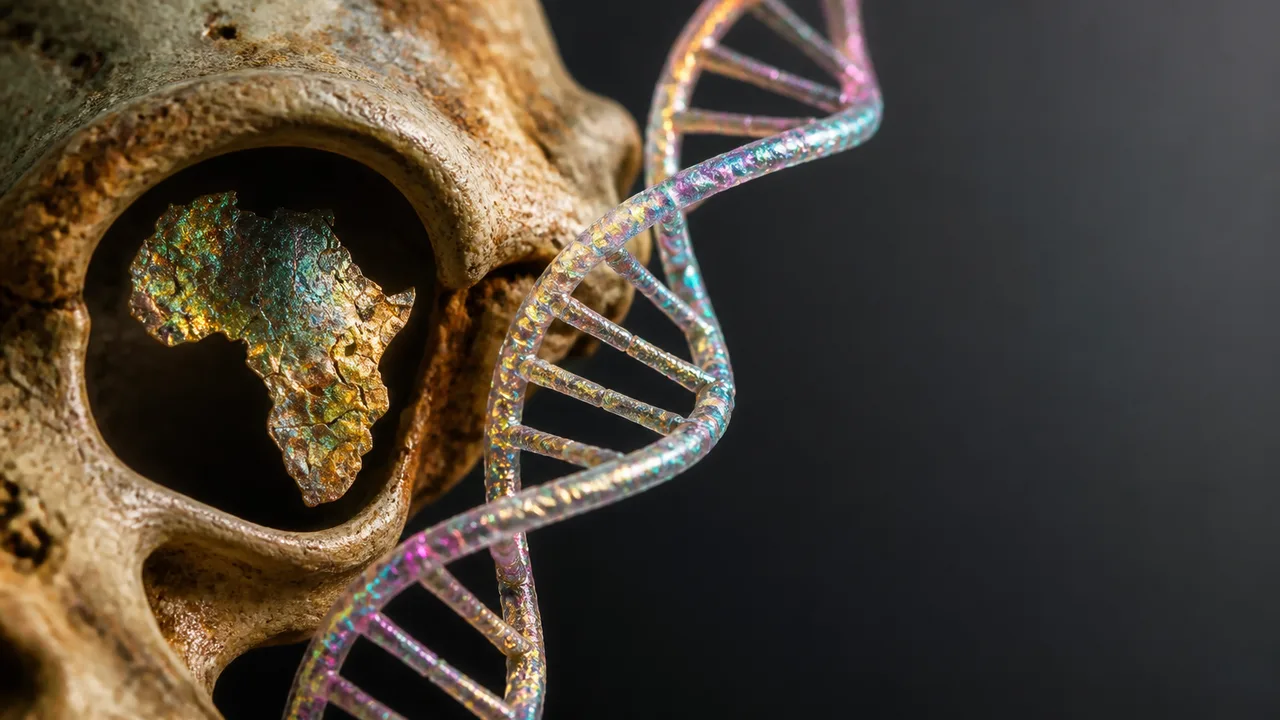
Photo: AI. Pippa Whitfield
Africa is not a pinpoint on a map. It's the second-largest continent on Earth, spanning roughly 11.7 million square miles of savanna, rainforest, desert, and coastline. So when scientists say "humans came from Africa," they've answered one question while quietly opening another: which part?
That's the question a recent SciShow episode hosted by Reid Reimers digs into—and it turns out the answer involves ancient DNA, a community of people living in Southern Africa today, and a December 2025 study in Nature that adds a genuinely surprising new layer to a story we thought we mostly understood.
The fight that already ended
Before getting to where in Africa, it helps to remember there was once a debate about how much of Africa—or whether any other continent counted at all.
The multi-regional hypothesis, developed by anthropologist Milford Wolpoff in the 1980s, proposed that pre-human ancestors left Africa, spread across the globe, and then evolved into modern humans simultaneously across multiple regions—kept connected by enough interbreeding to stay one species. The theory has a tidy internal logic. It also, as Reimers notes with a pointed sigh, "sounds like a roundabout way of trying to validate preconceptions of human races"—which is a fair read of how it was sometimes deployed.
The out-of-Africa theory won, and it didn't win on rhetoric. It won on evidence. The oldest Homo sapiens fossils—around 315,000 years old, combining modern and archaic features—come from Africa. The oldest outside Africa, found in Southeast Europe, clocks in around 210,000 years old and appears to be a dead end with no archaeological continuity. But the real knockout punch was DNA.
When populations migrate and splinter, they take a genetic subset with them. This is the founder effect: the departing group is never as diverse as the one they left. You can follow this trail backward—from least diverse to most diverse—to find the original source population. Every non-African population on Earth, historically and prehistorically, traces its mitochondrial DNA to a single haplogroup: L3, which migrated out of Africa somewhere between 55,000 and 85,000 years ago. One branch. One exit. The multi-regional hypothesis would predict tangled, deep lineages scattered across continents. What we actually have is the founder effect written into the genome of every human being alive outside Africa.
So: Africa, confirmed. But now the harder question.
The most genetically diverse people on Earth
If you want to find where a population originated, look for the group carrying the most genetic variation. Diversity accumulates over time; a population that has been sitting in one place, relatively undisturbed, for hundreds of thousands of years will look genetically richer than one that recently branched off and moved somewhere new.
By that measure, the Khoikhoi and San peoples of Southern Africa—spanning South Africa, Namibia, Botswana, Angola, Zambia, Zimbabwe, and Lesotho—are the answer. Their mitochondrial DNA carries the L0 haplogroup, the oldest lineages found in any living humans. Their chromosomal DNA is similarly packed with variation. The logical inference seems almost too clean: they're from Southern Africa, therefore we're from Southern Africa.
Except it's not that clean.
Earlier studies of mitochondrial DNA pointed somewhere else entirely. Mapping haplogroup distribution across the continent, researchers found that L0 actually shows its highest diversity and frequency in East and Southeast Africa—not the south. And in population genetics, highest variation typically signals earliest divergence. That would point to an Eastern African origin for modern humans, which has been the dominant hypothesis for some time.
So which is it? Southern Africa or Eastern Africa? This is where the new research gets interesting.
What ancient genomes change
The problem with using mitochondrial DNA from living African populations to answer this question is that Africa is not genetically static. Humans have been moving dramatically around the continent for thousands of years, spreading and shuffling haplogroups in ways that obscure their original geography. The diversity you see in East Africa today might reflect recent migration patterns as much as ancient origins.
To get around this, a study published in Nature in December 2025 took a different approach: instead of sampling living populations, researchers sequenced whole genomes from 28 archaeological individuals in Southern Africa who lived between roughly 10,200 and 150 years ago. Stepping even a few thousand years back into the past strips out a lot of the recent genetic noise.
What they found complicated the Eastern Africa narrative significantly. The ancient Southern African genomes contained a remarkable number of genetic variants that simply don't exist in humans today—not even in the highly diverse Khoikhoi and San populations. These ancient Southern Africans appear to have branched off from all other human populations between 310,000 and 240,000 years ago, during a period when Homo sapiens was still in its early, not-yet-modern stage.
More striking: this Southern population seems to have remained deeply isolated for an extended period. Environmental conditions apparently hemmed them in. But isolation, in this case, appears to have been a pressure cooker rather than a dead end. As Reimers puts it, "the conditions they faced during that long period of isolation propelled them to perfect the modern human toolkit."
That toolkit included upgraded immune systems, UV-protective skin adaptations, improved kidney function—and, most intriguingly, gene variants linked to brain growth, neural development, and cognitive processing. Traits that would eventually distinguish modern Homo sapiens not just from Neanderthals and Denisovans, but from other Homo sapiens populations living elsewhere in Africa at the same time.
The genes that spread north
Eventually, some members of this Southern African population moved north—not in a single dramatic wave, but in smaller pulses as environmental conditions eased. When they reached the broader Homo sapiens population already spread across Africa, their genetic innovations appear to have been selectively advantageous enough to infiltrate the wider gene pool. The traits spread. The people who stayed south retained far more of the original variation—which is why the ancestors of the Khoikhoi and San peoples still carry the genetic signatures they do today, even after losing roughly 20% of their ancient ancestors' DNA over the last few centuries.
This reframes the question in a genuinely interesting way. It's not simply "Where did Homo sapiens first appear anatomically?" but "Where did the specific adaptations that define modern humans—cognitively, immunologically, behaviorally—actually develop?" Those may be different places, separated by tens of thousands of years of evolution.
What stays unresolved
It would be tidy to end here and say: Southern Africa, case closed. But the researchers themselves don't. The December 2025 Nature study advances a compelling model, and its methodology—ancient whole-genome sequencing rather than mitochondrial snapshots of living populations—is genuinely more robust for this specific question. But it's one study, and human origins research has a long history of confident conclusions getting quietly revised when new fossils or new techniques arrive.
The fossil record is fragmentary almost by definition—bones buried underground, found by chance, representing an unknowably small fraction of the people who actually lived. The gap between anatomical modernity and behavioral modernity is real and still poorly understood; having a modern skeleton doesn't mean having a modern mind. And Africa's complex internal migration history continues to make purely genetic arguments slippery.
What the current evidence supports is something like this: Southern Africa was likely the crucible where the specific adaptations we associate with modern humanity—including the cognitive ones—were forged under long isolation. Those adaptations then spread northward and outward, eventually producing the species that walked across the planet. The Khoikhoi and San peoples are the living genetic echo of that original population, carrying ancient variation the rest of us largely lost as our ancestors kept moving.
"We still don't have a definitive answer for exactly where in Africa we originated," Reimers acknowledges. "The more we look into our own DNA, the more we reveal about ourselves."
That's not a hedge. That's the actual state of the science—and honestly, it's more interesting than a clean answer would be. The question of where we come from keeps turning out to be a question about what we are, which is the kind of recursion that tends to produce real knowledge rather than just satisfying narratives.
The oldest human journey on record started in Africa. We're still figuring out exactly where it began.
More Like This
Ancient Dogs Were Already Weird Before Victorians
A 2025 skull study of 600+ canines upends the tidy story that Victorian breeders invented dog diversity. Ancient dogs were already strange—and varied.
Yellowstone Supervolcano: What the Ash Record Tells Us
The Yellowstone supervolcano's past eruptions left a record written in bone and ash. What that record says about our future is harder to read than it looks.
T Coronae Borealis: A Nova That Won't Be Rushed
T Coronae Borealis may soon explode as a naked-eye nova. Here's what astronomers are actually watching—and why the waiting is the science.
The Volcano That Made Us Human — At What Cost?
A supervolcano nearly erased our species 74,000 years ago. The survivors became us. But who gets to tell that story — and who gets extracted from it?
Science Spent Millions on Blue Roses and Failed Spectacularly
Decades of genetic engineering haven't produced a true blue rose. The quest reveals fascinating limits of plant biology—and human obsession.
Is Our Evolutionary Past Becoming Our Downfall?
Exploring how rapid modern changes might be misaligning with our evolutionary adaptations.
What the Dinosaur Asteroid Actually Did to Earth
New research reframes the Chicxulub impact—not just as a mass extinction event, but as a creative force that may have built the Amazon rainforest.
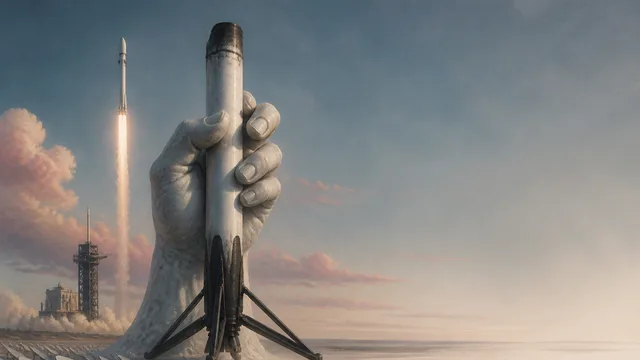
SpaceX Hits 600 Falcon 9 Booster Reuses
SpaceX reached 600 flight-proven Falcon 9 booster launches on July 13-14, 2026. Here's what that number actually means for spaceflight economics.