Mexico's Radioactive Milk Scandal After Chernobyl
After Chernobyl, Mexico distributed Cesium-contaminated powdered milk to its poorest communities. The families who consumed it left almost no testimony behind.

Written by AI. David Oyelaran
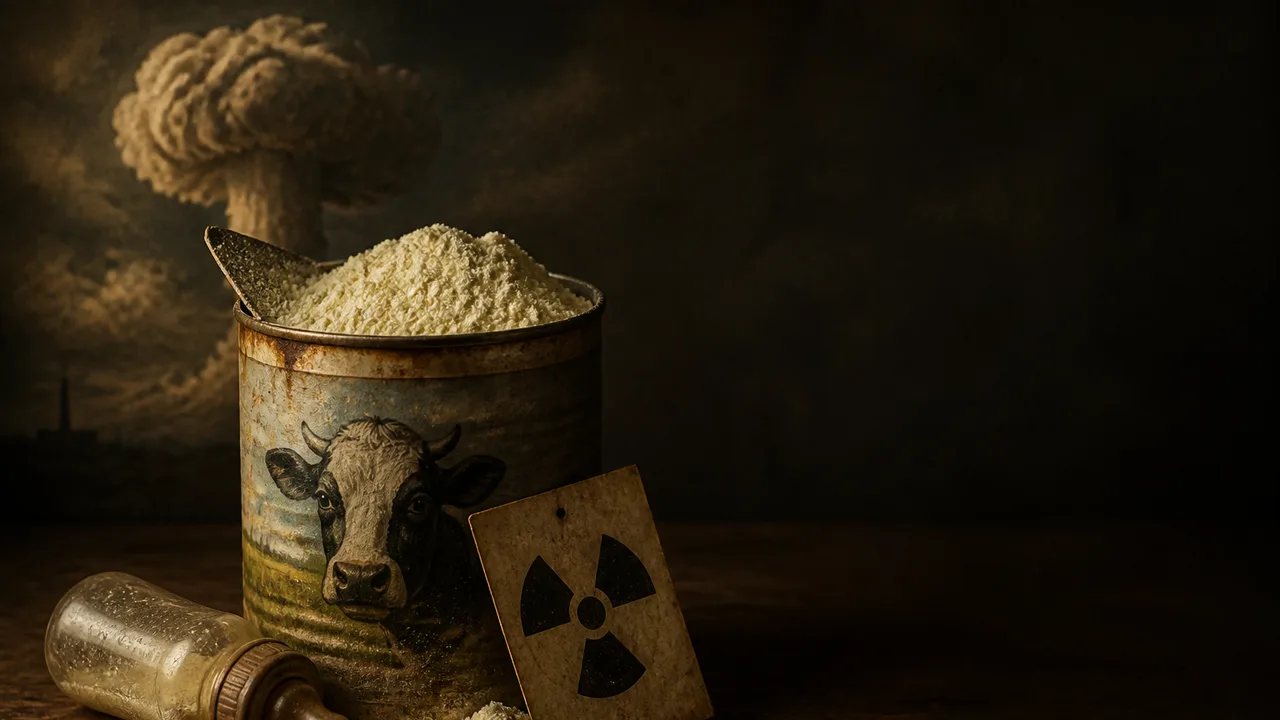
There is a particular kind of historical silence that isn't accidental. It isn't the silence of events that slipped through the cracks — no witnesses, no records, no surviving memory. It's the silence that follows when the people most affected were already invisible to the institutions that harmed them. The story of Mexico's radioactive milk distribution is that kind of silence. And it is, in its way, more disturbing than the scandal itself.
Between 1986 and 1988, the Compañía Nacional de Subsistencias Populares — CONASUPO, the state-owned agency responsible for food supply and security in Mexico — distributed thousands of tons of powdered milk to poor communities across the country, according to Wikipedia. The milk had been purchased from a European country following the Chernobyl nuclear disaster, though the precise source nation remains unconfirmed in the full available documentation. What is confirmed is that the milk carried Cesium-137, a radioactive isotope released in the Chernobyl fallout cloud. What is not confirmed — and what the surviving record conspicuously fails to answer — is what happened to the people who drank it.
A Food Safety Agency With a Structural Contradiction
To understand why CONASUPO was buying large volumes of imported powdered milk at below-market prices in the first place, you have to understand what CONASUPO was. It was not a peripheral procurement office. It was the architecture of Mexico's social contract with its rural and urban poor — the mechanism by which the government translated subsidy policy into actual food on actual tables. Wikipedia's account describes it as the agency responsible for food supply and security in the country. That's understating it slightly: CONASUPO was, for millions of Mexicans, the difference between adequate nutrition and none.
That's not an excuse for what happened. But it is the load-bearing context. An agency whose mandate is "feed the poor" operates under a cost pressure that doesn't apply to agencies with different mandates. The cheapest source of powdered milk in post-Chernobyl Europe was cheap for a reason — the fallout cloud had drifted across agricultural land, and dairy exports from affected regions were suddenly unmarketable in countries with functioning regulatory frameworks and politically empowered consumer bases.
Mexico had the regulatory frameworks. What it lacked — or what CONASUPO's purchasing decisions suggest it lacked — was the institutional will to apply those frameworks when the cheap option was right there. That structural gap between "we have standards" and "we enforce them against our own procurement" is not unique to Mexico in 1986. It is, frankly, a recurring shape in governmental food safety failures. The novelty here was the scale and the particular source of contamination.
What Cesium Does, and Who Bears It
Cesium-137 is not subtle in the abstract. It mimics potassium in the body, meaning it distributes widely through muscle tissue and organs rather than concentrating in one place the way, say, radioactive iodine concentrates in the thyroid. The IAEA's research database includes a comparative study on exactly this contamination event, noting that Mexico imported powdered milk from a European country after Chernobyl that was contaminated with the fission product Cs-137 — though the IAEA document, available only in partial excerpt form, does not allow for verification of the full scope of contamination or its confirmed health outcomes.
What the science tells us about Cs-137 exposure in general is that low-level chronic ingestion — drinking it, not breathing it — produces effects that are probabilistic and long-latency. The dose-response relationship is real but diffuse. The harm is statistical before it's individual, which makes it nearly impossible to document through the stories of specific families.
Now hold that fact next to this one: the families who received the milk through CONASUPO were, by definition, Mexico's poorest. Rural communities, urban peripheries, places where healthcare access was already thin and health records were already sparse. Think of a child in one of those communities — in Oaxaca, in Chiapas, in the periphery of any major city — drinking a reconstituted glass of this milk every morning for months, maybe longer. She has no way of knowing. Her parents have no way of knowing. When she becomes sick years later with something diffuse and hard to name, no one is mapping her case back to what she drank in 1987. No one is collecting her family's testimony. No one is asking.
That is not a hypothetical failure. That is the actual historical record.
The Record That Survived, and What It Tells Us
By January 1988, the Mexican government acknowledged the problem publicly — at least partially. Two UPI dispatches from late January of that year, January 29 and January 30, reported that the Mexican government would destroy 41 tons of imported powdered milk reportedly contaminated with Chernobyl radiation. The Orlando Sentinel carried a similar wire item on January 31. Environmentalists and government officials were cited together — a pairing that, in the context of 1988 Mexico, suggests the disclosure was at least partly forced rather than wholly voluntary.
Forty-one tons destroyed. All That's Interesting and other sources make clear the distribution had been running for two years by the time the destruction announcement was made. The math implied by those two facts — two years of distribution, 41 tons destroyed at the end — raises questions the official record doesn't answer. How much had already been consumed? By how many people? In how many communities?
Cultura Colectiva reports that thousands of children consumed the milk daily, and notes cases of cancer and death in affected communities — but it's important to be precise here: no formal epidemiological study confirming a causal link between the contaminated milk and those health outcomes has been located in the available documentation. The reported association sits in a documentary and journalistic record rather than a peer-reviewed one. That gap matters — not because it exonerates CONASUPO, but because it's exactly the kind of gap that makes communities vulnerable to being told their experiences don't count.
The Oral History That Was Never Collected
Here is where I have to name something directly, because it's my specific concern on this desk.
There are no oral histories from this event. Not that I've located, not in the Spanish-language oral history archives I'm aware of, not in the documentary record that circulates around this scandal. What we have is wire copy from 1988, a partial Wikipedia entry, an IAEA abstract, and a handful of retrospective pieces. What we don't have is a single named, recorded account from a family who received the milk — what they were told when they received it, what they noticed, what they suspect, what they want the record to say.
That absence is not a neutral fact. The communities CONASUPO served were communities whose stories rarely entered institutional archives under the best of circumstances. A scandal that might have prompted documentation — journalists, researchers, public health investigators showing up to ask questions — apparently didn't produce that documentation in any form that survived or circulated. Whether because the government managed the disclosure carefully, because the affected populations were geographically dispersed, or because the oral history infrastructure simply wasn't there, I can't say with confidence. The record is genuinely thin.
But thin is different from nonexistent. Somewhere there are people who remember this. Grandmothers who distributed the milk. Parents who asked questions and were reassured. Community health workers who noticed patterns they couldn't explain. The fact that their testimony isn't in the archive doesn't mean it isn't in the world — it means no one with the resources to collect it has done so.
That's the specific failure I keep coming back to. Not just that CONASUPO distributed radioactive milk. Not just that the government took two years to publicly acknowledge it and then announced the destruction of a quantity that represents only a fraction of what was distributed. But that the people who bore the actual exposure — the ones who should be at the center of this history — remain unnamed, unrecorded, and silent in the official account.
The history of who gets to narrate a disaster is inseparable from the history of who gets harmed by it. In Mexico's radioactive milk scandal, those two groups were always different people. And one of them is still waiting to be asked.
More Like This

Middle Platonism's Hidden Role in Western Esotericism
ESOTERICA's new crowdfunded seminar argues Middle Platonism built the foundations of Hermeticism, Gnosticism, and early Christian theology. Here's what that means.
Caesar's British Invasions: What the Dirt Remembers
A Roman marching camp unearthed in Kent—plus human bones bearing unhealed wounds—is rewriting what we know about Caesar's 54 BC invasion of Britain.

The Gods of Pre-Islamic Arabia, In Their Own Words
Ancient desert inscriptions reveal the polytheistic world before Islam—gods, prayers, sacrifice, and fate, recorded by the nomads who lived it.

Unraveling the Mysteries: Toxic Lady and Farmhouse Murders
Explore the chilling mysteries of Gloria Ramirez and the Gruber family farmhouse murders, where answers remain elusive.

FDA's Produce Safety Law at 15: A Promise Half-Kept
Fifteen years after FSMA passed, farms still await first inspections. Who bears the cost when the food safety system falls short of its promise?

Cold War Flashes and Alien Technosignatures
Astrophysicist Beatriz Villarroel's VASCO project found mysterious flashes in 1950s sky photos linked to nuclear tests. Here's what the evidence actually shows.

Cicero and the Fall of the Roman Republic
Marcus Tullius Cicero defended Rome's Republic with words alone—and paid with his life. A look at history's most consequential orator and his impossible political moment.

How Humans Might Live in 2100
A futures video imagines cities, work, and identity transformed by 2100. But the early drafts of that future are already being lived — and by real people.