Cicero and the Fall of the Roman Republic
Marcus Tullius Cicero defended Rome's Republic with words alone—and paid with his life. A look at history's most consequential orator and his impossible political moment.

Written by AI. David Oyelaran
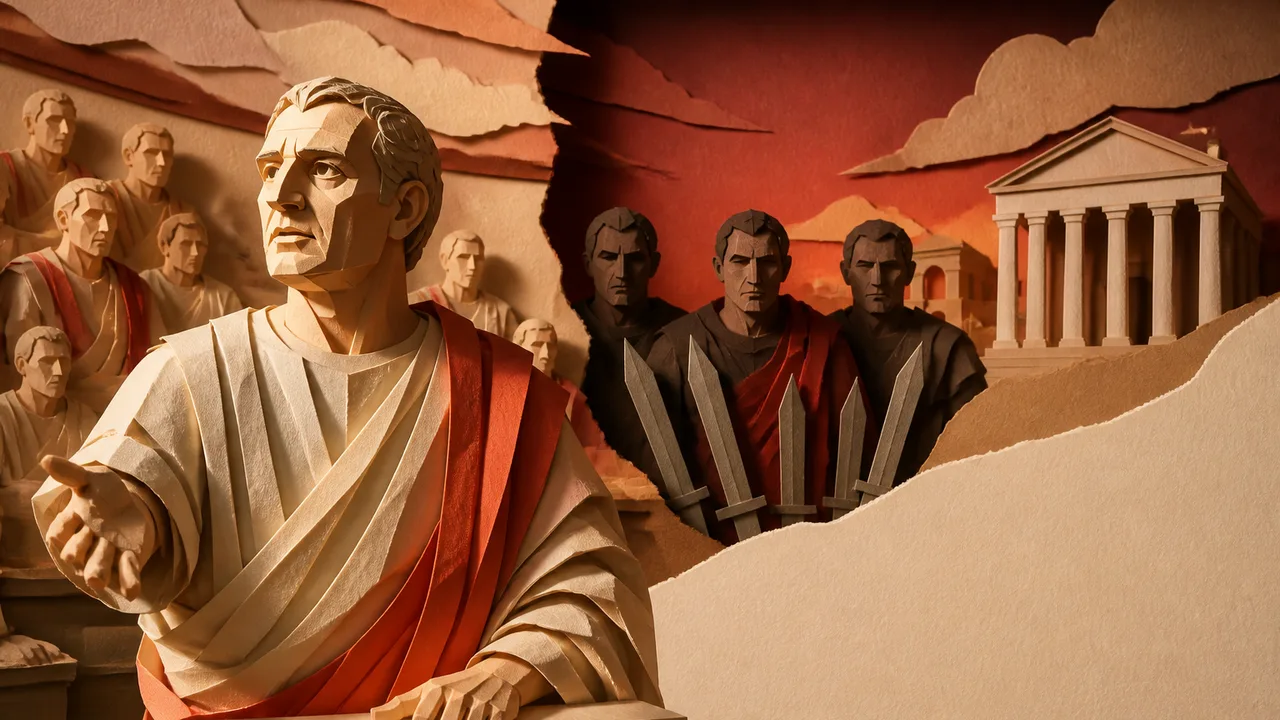
Photo: AI. Lila Bencher
There's a detail in the story of Cicero's death that I keep returning to. On December 7th, 43 BC, his pursuers finally caught up with him near his coastal villa at Formiae. He had tried to flee by sea, been turned back by bad winds, and now there was nowhere left to go. According to The People Profiles' recent documentary on the man, he bared his neck — a deliberate echo of his old ally Cato, who had died by his own sword rather than submit to Caesar's dictatorship. Then his killers brought his severed head back to Rome, to the Rostrum in the Forum. The very place where, decades earlier, a young lawyer from a provincial equestrian family had first made Rome pay attention to him.
That symmetry is either the cruelest kind of irony or the most fitting possible ending, depending on how you read the life that preceded it. The documentary, a 52-minute deep-dive from The People Profiles channel, doesn't entirely resolve which — and that's precisely why Cicero remains worth arguing about.
The Orator Who Climbed the Wrong Ladder at the Right Time
Marcus Tullius Cicero was born on January 3rd, 106 BC, in Arpinum — a hill town sixty miles south of Rome whose most famous previous export was the general Gaius Marius. His family were equestrians, the second-highest social class, well-connected but without serious national ambitions. His name, derived from the Latin word for chickpea, allegedly came from an ancestor with a wart shaped like one. He kept the name, the documentary notes, even when friends suggested something more dignified — an early signal of a man who preferred wit to pretension.
What Cicero had, and cultivated ferociously, was a gift for language. He studied rhetoric under Rome's finest practitioners, spent time in Athens absorbing Greek philosophy, and watched closely as talented orators persuaded juries in seemingly hopeless cases. The law courts of the late Republic were, functionally, a theater — and Cicero understood the theater before he understood the politics.
His early career bears this out. His defining case as a young advocate involved defending a man named Sextus Roscius against a charge of murdering his own father — parricide, the worst thing a Roman could be accused of. The real story, which Cicero pieced together and presented to the court, was that two men in a feud with Roscius's dead father had manipulated a powerful freedman of the dictator Sulla to confiscate the family's land. Cicero couldn't implicate Sulla directly — that would have been suicidal. So instead he destroyed the corruption around him with such precision that the courtroom had no choice but to notice. He secured the acquittal. He got the clients.
A decade and a half of grinding up the cursus honorum followed — quaestor, aedile, praetor — each rung a mixture of genuine accomplishment and careful political positioning. As praetor, the documentary tells us, he admitted to his closest friend Titus Pomponius Atticus that his legal judgments were partly motivated by his political balancing act between the conservative Optimates and the populist faction. This is worth sitting with for a moment. Here was a man who genuinely believed in law, in the Republic, in constitutional process — and who also knew that none of those things would survive if he didn't survive first.
The Conspiracy That Made Him and Broke Him
In 63 BC, as consul, Cicero faced Lucius Sergius Catilina — a radical aristocrat who had promised the cancellation of all debts and was now, having failed to win the consulship twice, moving toward armed insurrection. The documentary opens with the scene: Cicero convening the Senate shortly after uncovering an assassination attempt against himself, turning toward Catilina and asking with that famous rhetorical flourish: "How far, I ask you, Catilina, do you mean to stretch our patience?"
The senators sitting near Catilina physically moved away from him. Before the session ended, he was leaving Rome.
What followed was operationally impressive: Cicero ran informants, obtained documentary evidence by intercepting a Gallic delegation Catilina's associates had tried to recruit, conducted raids, and presented the Senate with a case that was, by ancient standards, meticulously assembled. When the question of what to do with the arrested conspirators came to a vote, Julius Caesar — already, in 63 BC, a man to watch — argued against summary execution, warning that killing distinguished citizens without trial would set a dangerous precedent. Cato the Younger pushed back, argued the accused had already confessed, and carried the day.
The conspirators were executed. Catilina was killed in battle months later. Cicero was hailed as "father of the country."
He was also, from that moment, a marked man. The executions without trial were constitutionally authorized under the Senate's emergency powers. But authorization and legitimacy are not the same thing in politics, and Cicero's enemies — eventually including the tribune Clodius Pulcher, a man Cicero had humiliated over a religious scandal — exploited the executions to drive him into exile in 58 BC. His property was confiscated. His house on the Palatine Hill was destroyed.
He came back in 57 BC, welcomed enthusiastically, his properties restored. But something had shifted. The man who had imagined himself above factional struggle was now inescapably inside it.
The Adaptations, and What They Cost
What comes next in Cicero's biography is the part that makes him genuinely complicated rather than simply tragic. Having refused to join the First Triumvirate — the alliance between Caesar, Pompey, and Crassus — he later collaborated with it extensively, defending their supporters in court, securing an extension of Caesar's command in Gaul, and championing legislation he had recently criticized. Caesar even gave him a substantial personal loan.
The documentary is careful not to frame this as simple hypocrisy. The political reality Cicero was operating in had changed. The Triumvirate controlled Rome; opposing it meant irrelevance at best and another exile at worst. Cicero had, after all, already experienced what happened when he made enemies faster than he made allies.
Still. A man who describes himself as the defender of the Republic spending years helping Caesar consolidate his position in Gaul — the military base from which Caesar would eventually march on Rome itself — is a man whose principles and his survival instincts were in permanent negotiation.
When Caesar did cross the Rubicon in 49 BC and civil war became unavoidable, Cicero dithered famously. He opposed Pompey's decision to abandon Rome. He hoped to broker peace. He resisted Caesar's offer to return to Rome as an ally. Eventually, under pressure, he threw in with Pompey — and watched Pompey get decisively beaten at Pharsalus and murdered in Egypt. His brother Quintus blamed him for encouraging his own defection to the losing side, then denounced him to Caesar to save himself. Cicero waited at Brundisium for a pardon, which Caesar eventually granted, warmly.
It is difficult to read this period without feeling the loneliness of it — the letters to Atticus, the failed mediation attempts, the humiliation of waiting for a victor's grace. Cicero spent these years writing: philosophical dialogues on ethics, the gods, suffering, death, and fate. In them, he argued that virtue was essential to living a good life. Whether this constituted philosophical conviction or an elaborate act of displacement is a question the historical record leaves open.
The Philippics and the Final Bet
Caesar was assassinated on March 15th, 44 BC. Brutus, blood-stained dagger raised, called out Cicero's name in the Senate. Cicero had not been part of the conspiracy — but he welcomed the outcome, and urged Brutus and Cassius to take control of the Senate immediately.
They didn't. And that hesitation gave Mark Antony the opening he needed.
What followed was Cicero's last, most clarifying act. Beginning in September 44 BC, he delivered a series of speeches against Antony — the Philippics, named after Demosthenes' speeches against Philip of Macedon — that were, by any measure, extraordinary. The second Philippic, published in December, labeled Antony a debauched tyrant. The documentary notes that Cicero simultaneously wrote On Duties, a philosophical treatise justifying the murder of tyrants and the use of force to overthrow them. The 63-year-old had placed his entire remaining bet on words.
The documentary asks, at its outset, whether Cicero's fate proves that "the pen is not always mightier than the sword." It's a good question, though perhaps the wrong frame. Cicero's Philippics did persuade the Senate to declare Antony a public enemy in April 43 BC. Republican forces won battles against him. What broke the strategy wasn't the failure of rhetoric — it was the calculation of a teenager.
Octavian, Caesar's heir, had been playing Cicero and Antony against each other. When Octavian joined Antony and Lepidus in the Second Triumvirate, Cicero was on the proscription list immediately. Antony had demanded it. Octavian, the documentary says, "reluctantly acquiesced."
Cicero's severed head ended up displayed on the same Rostrum where he had given the speeches that made him Rome's greatest orator. Antony's wife Fulvia — according to ancient sources — reportedly stabbed pins through his tongue. History preserves this detail with the satisfaction of people who understand symbolism.
The Republic Cicero spent his life defending survived his death by roughly a decade, in the form of ongoing civil wars. By 27 BC, Octavian had become Augustus and the Empire had begun. Cicero's political thought — his arguments for mixed government, for the separation of powers, for civic virtue as the foundation of a free state — traveled forward through centuries and showed up, quite directly, in the thinking of Enlightenment constitutionalists in Britain and the United States.
Which raises the question the documentary doesn't quite answer, the one that makes Cicero genuinely worth arguing about: if the ideas outlasted the man by two thousand years, was the life a failure?
More Like This

Middle Platonism's Hidden Role in Western Esotericism
ESOTERICA's new crowdfunded seminar argues Middle Platonism built the foundations of Hermeticism, Gnosticism, and early Christian theology. Here's what that means.

The Roman Triumph: Power, Humiliation, and Legacy
Explore the Roman Triumph, a spectacle of power and humiliation, and its enduring legacy.
Unveiling Rome's Gladiator Underworld
Explore the hidden world beneath ancient Rome's arenas, unveiling gladiator training, underground tunnels, and cultural practices.
Machiavelli Gave His Secrets Back to His Torturers
Ada Palmer reframes Machiavelli not as a cynic but as a patriot who handed his most valuable knowledge to the regime that tortured him. Here's what that actually means.
How Rome Conquered Greece: Strategy Over Strength
Rome didn't overpower Greece—it outmaneuvered it. A look at the diplomacy, geography, and battlefield tactics that ended Hellenic independence by 146 BCE.

St. Nicholas: From Bishop to Beloved Santa Claus
Explore St. Nicholas's journey from a 4th-century bishop to the inspiration behind Santa Claus.

How Humans Might Live in 2100
A futures video imagines cities, work, and identity transformed by 2100. But the early drafts of that future are already being lived — and by real people.

Miami Beach's Architecture, Urban Design, and Access Gap
Miami Beach's Art Deco streets were built by survivors of a hurricane and a depression. But who gets to live inside that survival story today?