Machiavelli Gave His Secrets Back to His Torturers
Ada Palmer reframes Machiavelli not as a cynic but as a patriot who handed his most valuable knowledge to the regime that tortured him. Here's what that actually means.

Written by AI. Vanessa Torres
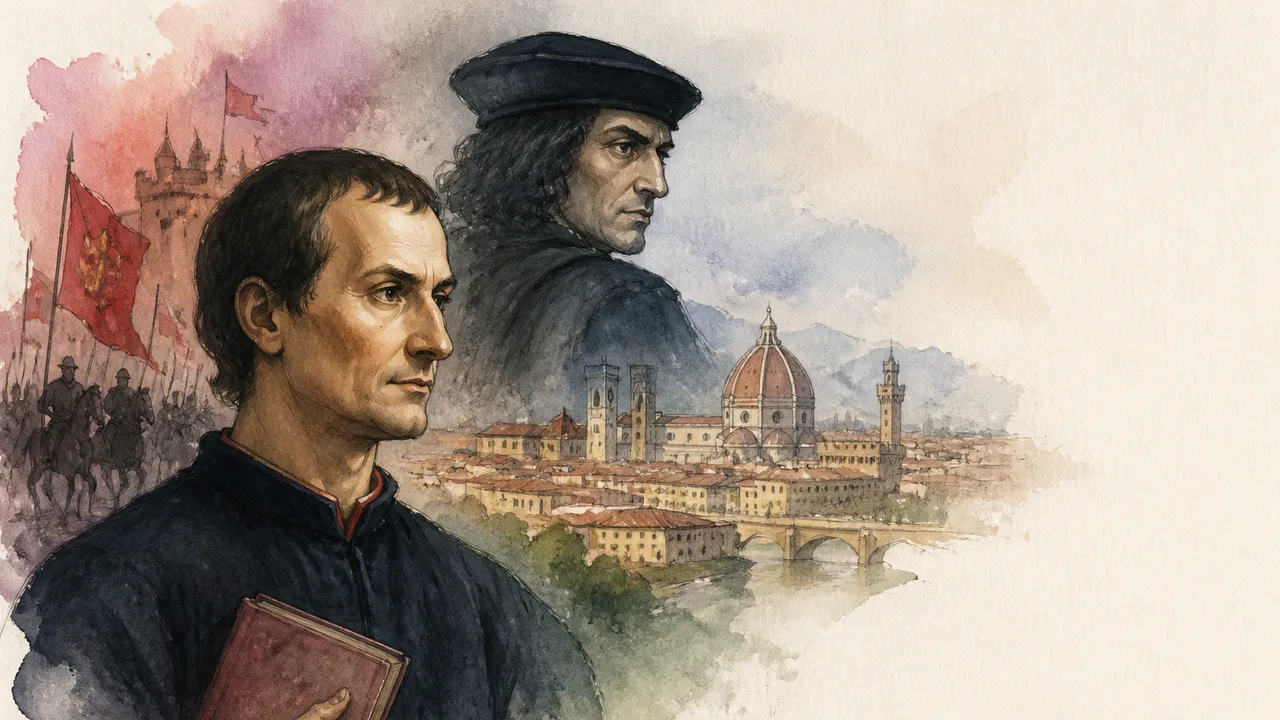
Photo: AI. Júlia Almeida
Every few years I come back to The Prince expecting it to confirm what everyone says it is — a cold-blooded instruction manual for cynics, the original hustle-bro bible — and every time something snagged me that didn't fit that story. I could never square the alleged amorality of the book with the biography of the man who wrote it. Historian Ada Palmer, in a recent conversation with Dwarkesh Patel, finally handed me the frame that makes it cohere. And it turns out the most interesting thing about Machiavelli isn't anything in the book. It's the choice he made about who got to read it.
But before we get there, you need to understand how badly things were broken.
Italy was not losing stability. It had already lost it.
The Medici retook Florence in 1512. Within months, they had arrested Niccolò Machiavelli — the republic's diplomat and political operative for nearly fifteen years — on suspicion of involvement in a coup attempt. The suspicion was wrong. They tortured him anyway, using the strappado: hands bound behind the back, then hoisted by a rope until the shoulders dislocated. Then they exiled him to a hamlet in the Tuscan countryside with no political contacts, no instructions, and nothing to do.
That was the organization he'd given his working life to.
To understand what Machiavelli was diagnosing when he sat down to write, Palmer starts with a structural fact about political legitimacy: it depends on continuity. When a government has been in power for a long time, people believe in it — even when they complain about it. When that thread breaks, you don't get one regime change. You get five, in rapid succession, because the new thing has no staying power either. England's Wars of the Roses, France's cycles of republic and restored monarchy — Palmer uses both as analogies. By the time Machiavelli was writing in 1513, the majority of Italian city-states had already had their governments uprooted, and were primed to be uprooted again.
Layer on top of that the papacy — and this is where Italy's situation gets uniquely dire. Every new pope inherited the precedent set by the previous ones, and those precedents had been marching in one direction: more military aggression, more arbitrary overthrow of local governments, more placing of papal relatives into positions of power. Palmer hedges reasonably that papal tenures in this era varied widely, but the structural dynamic is clear regardless of any individual pope's reign length: the next one was elected by a coalition of people who hated the current one, which meant every succession brought a systematic reversal of everything the previous regime had built. You couldn't plan around it. There was no hereditary logic to exploit.
Machiavelli looked at this landscape and saw a perfect storm: no government with deep roots, no pope with stable incentives, nothing but churn. The last chapter of The Prince — the plea to Lorenzo de' Medici to be the one who finally stabilizes this — reads less like flattery and more like a man describing a building on fire.
The carpenter's son
Here's a detail Palmer introduces that stopped me: when Cesare Borgia — called Valentino in the period — conquered cities in central Italy, he massacred the ruling families and installed his own regime. And the people of those cities, to everyone's surprise, loved him for it.
Not because they approved of the massacres. Because for the first time in living memory, they had something approaching neutral justice.
Think about what justice looked like before. If your teenage son got drunk and killed someone in a brawl, whether he was executed or fined depended almost entirely on which faction his employer belonged to. The carpenter working for the powerful family might get his son's charges quietly reduced. The carpenter working for the out-of-faction family got the full weight of the law. As Palmer puts it: "The outcome of the sentence will be entirely who's in power and out of power and not the fairness of the case."
Borgia's outside regime had no dog in those fights. His people weren't owed favors by the local patron families. So when a homicide case came before his judges, they judged it on its facts. To people who had lived with factional justice their entire lives, this was genuinely revelatory.
That carpenter is Machiavelli's actual reader. Not in the sense that literate Tuscan tradespeople were his target audience — they weren't — but in the sense that the problem he was trying to solve was the problem the carpenter lived inside every day. Arbitrary power. No recourse. An entire social order built on who you knew and who that person owed.
Machiavelli's argument throughout The Prince is that the means by which power is acquired determine how durable it will be. Not because nice methods produce nice rulers — that's not the claim at all. The claim is structural: if you gained power through mercenaries, your power rests on people who are stronger than you and whose interests diverge from yours. If you gained it through betrayal of a specific, trackable kind, you're fine; if through another kind, it will eventually collapse. This is engineering, not ethics. But the reason Machiavelli cares about engineering stability — the reason the whole project matters — is that stable, legible governance is the only thing that gives a carpenter's son a trial rather than an execution.
The book as a job application to his torturers
Now here's the part I find genuinely difficult to categorize.
After the torture, after the exile to nowhere, Palmer describes a clear expectation among Machiavelli's contemporaries: that he would do what any rational actor would do. He had political contacts across Europe. Courts were hungry for skilled Florentine historians and diplomats. He could have monetized his knowledge, worked for any number of cardinals or kings, tripled his income and never looked back at the government that had broken his shoulders.
He didn't. Instead, he sat in that Tuscan hamlet and wrote The Prince — which Palmer describes as, among other things, a job application. He addressed it to Lorenzo de' Medici, the man representing the regime that had wronged him, and kept it off the market entirely. His other works circulated publicly. The Prince did not, at least by his design — though some scholars believe it may have reached more readers during his lifetime than Palmer's framing suggests, and the historical record is genuinely murky on this point. What isn't murky is his stated intent: the knowledge in this book was not for sale to anyone who might use it against Florence.
Palmer reaches for the analogy of Szilard writing to Roosevelt about nuclear fission — a scientist who grasped that what he knew could be weaponized, and who felt a patriot's obligation to ensure it wasn't. That parallel tracks.
What I keep turning over is what it says about identity. Machiavelli had built his entire self around being Florence's man — its observer, its analyst, its operator. The Medici had taken that from him unjustly. And his response was not to transfer that identity somewhere more appreciative. His response was to double down on it, in the only form available to him: to produce the best possible version of his work and hand it to the people who'd hurt him, for the sake of the thing they both claimed to serve.
This is not the move of someone who treated knowledge as personal capital to be leveraged. The actually Machiavellian play — the one bearing his name as a pejorative — would have been to shop those insights around, maximize his position, let the market determine their value. He refused.
There's a word for this kind of loyalty to an institution that hasn't earned it: some people call it admirable, some call it a failure of self-preservation, most people I know have lived some version of it and don't know what to call it. The company that laid you off after twelve years, the organization you kept defending in public long after it stopped deserving it, the career you didn't pivot away from when every rational signal said to go.
Machiavelli got tortured and then wrote a masterwork for his torturers and waited to be recalled. He never was. The Prince was published posthumously.
I don't think the lesson is that loyalty is stupid. I think the lesson is that what we call "Machiavellian" — cold calculation, self-interest optimized — is almost the exact opposite of how Machiavelli actually operated. He understood power as clearly as anyone who ever wrote about it. He just refused to use that understanding for himself.
That refusal is either the most Florentine thing imaginable, or the most human.
Ada Palmer discusses Machiavelli, Cesare Borgia, and Renaissance political theory in a full-length conversation with Dwarkesh Patel, available on his podcast and YouTube channel. Palmer is also launching Beforecast, a new podcast whose first season covers Machiavelli.
Vanessa Torres covers career development, workplace dynamics, and professional growth for BuzzRAG.
More Like This

Middle Platonism's Hidden Role in Western Esotericism
ESOTERICA's new crowdfunded seminar argues Middle Platonism built the foundations of Hermeticism, Gnosticism, and early Christian theology. Here's what that means.
Eric Ries: Good Governance Is a Builder's Job
Eric Ries argues that without structural governance, every mission statement is a lie. His new book Incorruptible makes the case for building corruption-resistant companies.
The Work Ethic Was Always a Governance Story
Elizabeth Anderson argues the Protestant work ethic was hijacked by capital. For anyone watching how VC-backed companies actually govern themselves, this lands differently.
What Tolstoy Knew About Over-Processing
Tolstoy's War and Peace argues that every system kills the thing it tries to preserve. An audio engineer reads that and feels it in their bones.
How Roman Virtues Sparked a Renaissance Revolution
Explore how resuscitating Roman virtues in Renaissance Italy led to cultural shifts and the scientific revolution.

The Science and Stories Behind Earth's Fiercest Winds
Explore the science of deadly winds, from hurricanes to tornadoes, and the people dedicated to understanding and surviving them.

Paulina Amador's Case for a Broader Idea of Genius
Paulina Amador's TEDx talk redefines genius as a state of consciousness anyone can access—not a rare trait reserved for Einsteins. Here's what she argues, and what to make of it.

Daily Habits That Help Calm Trauma Responses
Psych2Go outlines eight daily habits grounded in neuroscience that may help trauma survivors retrain their nervous systems—without requiring therapy access.