How Geography Traps Russia and China in Old Thinking
Military historian Sarah Paine explains how Russia and China are prisoners of continental-power logic — and what that means for the rest of us.

Written by AI. Ellis Redmond
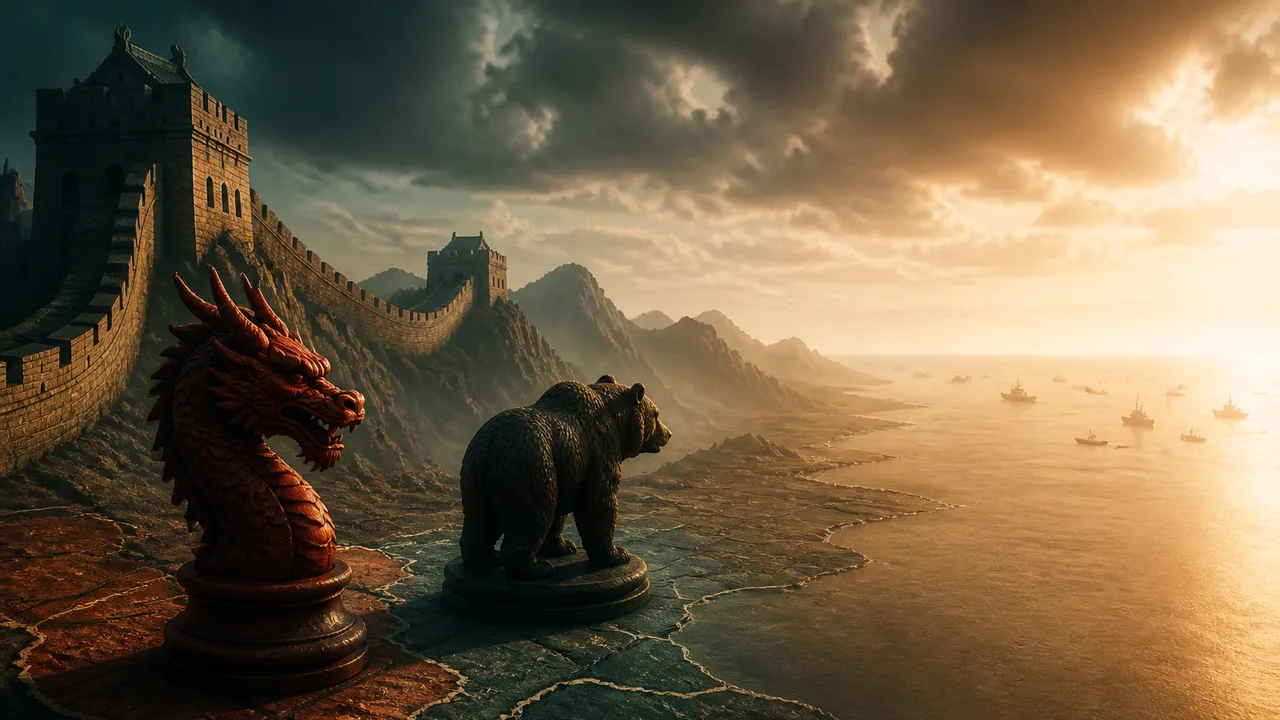
Photo: AI. Astrid Lehmann
At some point in my late twenties, I became the kind of person who had a productivity system for managing my productivity system. A spreadsheet tracking my streaks. A morning routine optimized to protect the morning routine. I was, without knowing it, running a continental empire out of my apartment — treating every uncontrolled edge of my life as a threat to be absorbed or neutralized, and wondering why I was exhausted.
I thought about that a lot while watching military historian Sarah Paine's recent lecture on the Dwarkesh Patel channel, which lays out one of those frameworks that doesn't just explain the news — it explains a whole shape of thinking you recognize in yourself and institutions around you.
The framework: for two thousand years, the world has been organized around a clash between two fundamentally different operating systems. Continental powers — China, Russia, historically most of Eurasia — pursue security through territorial control. Expand the buffer zone. Absorb the neighbor before the neighbor absorbs you. Maritime powers — Britain, the US in its later phase, the Dutch before Napoleon ate them — pursue security through trade. Build a moat, grow wealth, buy or build alliances, and let the ocean do the defending.
Paine spent a significant stretch of her career at the Naval War College developing this framework, and the lecture is the foundation for an entire series. It's dense, funny, and occasionally bleak in the way that only a very good historian can be bleak — with the calm of someone who's seen the pattern play out so many times that she's past outrage and into taxonomy.
Paine's shorthand: continental powers are elephants, maritime powers are whales. She didn't invent the terminology — it's a Naval War College tradition — but she uses it to clarify what's otherwise a muddy debate about "hard power vs soft power" or "autocracy vs democracy."
The distinction is sharper than ideology. It's structural. An elephant can't just become a whale because it decides to. The prerequisites for a maritime power are specific and unforgiving: you need a moat (no land border that invites invasion), a dense internal transportation grid, reliable sea access, a coastal population oriented toward commerce, and — and this one's doing a lot of work — stable institutions capable of passing and enforcing commercial law over time. Transparent elections are Paine's litmus test for that last one. Dictatorship for life, she notes, "does not remotely qualify."
Run that checklist against Russia and China and you get the same failing grade twice. Neither has a moat — between them, they share more neighbors than any other two countries on earth, and many of those neighbors, as Paine puts it, "don't like them at all for excellent reasons." Russia has sea access in the north but, as she observes with magnificent dryness, "no one lives there. What do you want to do, go pet a polar bear? The polar bear will not work out." China has a dense coastal population, but it's sitting on shallow, island-cluttered seas that become kill zones the moment relations with neighbors deteriorate.
The implications are stark: China's maritime trade access exists only in peacetime. The moment a conflict starts, those narrow straits become blockade points, and the merchant traffic stops. Paine doesn't frame this as a threat from outside actors — it's just geography doing what geography does.
The playbook Putin is running
The continental security logic, once you see it, is everywhere. The goal isn't expansion for its own sake — it's the relentless attempt to eliminate threat by eliminating proximity. Absorb the unstable neighbor before someone else does. Set up buffer zones. Take on neighbors sequentially, never simultaneously. Sow mutual resentments between your neighbors so they fight each other rather than you. Wait for the weakened ones and move in.
"This is Vladimir Putin's game," Paine says, without much apparent need to elaborate.
The problem with this game — and this is the part that Paine unpacks with real care — is that it has no offramp. There's no counsel on when to stop. The logic always demands another buffer zone, another absorbed neighbor, another destabilized border state. Russia and China are both, as she notes, surrounded by "some of the most dysfunctional places on the planet," and the question she poses is the most clarifying one I've heard in years: are they unlucky, or are they complicit?
There's also a cost Paine makes viscerally plain through WWII casualty figures. The numbers she cites in the lecture — while worth examining against multiple scholarly sources, given that estimates vary significantly for Soviet military deaths (figures range from roughly 8.7 to over 10 million depending on methodology) and the commonly accepted total for US WWII deaths runs closer to 405,000 across all services and theaters — tell a directional story that's not in dispute. Continental powers fight on home territory. The civilians die. The buildings get leveled. The fighting is on your street, not someone else's. Maritime powers, insulated by oceans, get to decide whether to intervene, when, and how. That asymmetry isn't a moral verdict. It's what geography does to your options when someone decides it's your turn.
The part that took her fifteen years to notice
Here's the observation in Paine's lecture that I keep turning over: the maritime world is invisible.
The continental world is visible because it's about positive objectives — taking territory, making things happen. You can see whether you did it or not. The maritime world is about preventing bad things from happening. And you can never prove you prevented anything. Maybe no one was going to try anything anyway. The thing you stopped never occurred. How do you point to nothing?
This is why the post-WWII institutional order — the UN, IMF, NATO, the trade frameworks — gets so relentlessly undervalued and attacked. The generation that built those institutions had watched two world wars and a Great Depression and concluded, as Paine describes it, that "the solution was institution building on a global scale." They built things that held the peace in the industrialized world for eighty years. Eighty years of not-World-War is invisible. It's the thing that didn't happen.
Which is also, I'd note, why your therapy is hard to justify to your skeptical relative at Thanksgiving. All that prevented suffering — the relationships that didn't blow up, the decisions you didn't spiral on, the crises you de-escalated before they became crises — is invisible. You can't point to the disaster that didn't happen. The continental mindset wants to see territory taken, problems eliminated. Prevention doesn't count.
The civilizational burden of history
What makes Paine's framework interesting rather than just tidy is that she takes seriously why Russia and China keep running the continental playbook even when it's clearly costing them.
The 19th-century Russian historian Vasily Klyuchevsky (this is a paraphrase that circulates widely; precise sourcing is worth checking against original texts) described his country as "a history of a country in process of colonizing itself," growing its area of colonization in tandem with its national territory — with, as Paine pointedly notes, "absolutely no mention of the people who actually live on this land." Dostoevsky was writing in his diary about Russia going to Asia as masters. Finance minister Witte was declaring in 1903 that Russia had the "undisputed right to the lion's share of the expected prey" in the crumbling Ottoman and Chinese empires. This isn't fringe ideology — it's the mainstream of how Russian statesmen have thought about the world for centuries.
The burden of that history is real. China benefited more than any other country from Deng Xiaoping's pivot toward the maritime trading order, lifting hundreds of millions of people out of poverty in the process. And yet, as Paine observes, Xi Jinping has been "privileging the crony sector over the private sector" and the pull toward continental logic — toward Taiwan, toward exclusive maritime zones, toward the Belt and Road's land-based ambitions — keeps reasserting itself. The Belt and Road, she notes with obvious relish, is discontinuous, uses multiple rail gauges requiring constant loading and unloading, runs through some of the most unstable territory on earth, and faces the brute economic reality that a container ship can carry over 21,000 units of cargo, while the longest train carries around 600 on a good day. The sea is just cheaper and more resilient. Geography, again.
The part that's aimed at you
I said I recognized this pattern in myself and I want to be specific about it, because I think this is the most useful part.
The continental mindset — control the perimeter, neutralize every uncontrolled edge, treat any uncertainty in the buffer zone as an existential threat — is not just a geopolitical pathology. It's a management style. It's a relationship dynamic. It's what a lot of "productivity optimization" actually is: the attempt to expand control over your environment until there's nothing left that can surprise you, at the cost of enormous resources and a growing ring of resentful, destabilized "neighbors" (colleagues, partners, creative projects, your own nervous system).
The maritime alternative isn't laissez-faire. It requires real infrastructure — the institutional equivalent of a moat, a transportation grid, stable rules enforced consistently over time. It's harder to build than it looks. But it's positive-sum. You're not fighting over fixed territory; you're growing the total amount of wealth, or energy, or whatever resource you're managing.
Paine's framework doesn't tell you which you're running. But if you finish her lecture and you're not at least a little uncomfortable about something in your own life, you probably missed a step.
The optimists in 1989 thought everyone would choose the maritime party once they saw it working. Paine has clearly stopped waiting for that to happen. The question isn't whether the continental operating system is irrational — it's rational given its own premises. The question is whether you, looking at your own premises, still think the premises are right.
More Like This

Middle Platonism's Hidden Role in Western Esotericism
ESOTERICA's new crowdfunded seminar argues Middle Platonism built the foundations of Hermeticism, Gnosticism, and early Christian theology. Here's what that means.
Unveiling Rome's Gladiator Underworld
Explore the hidden world beneath ancient Rome's arenas, unveiling gladiator training, underground tunnels, and cultural practices.

The Work Ethic Was Always a Governance Story
Elizabeth Anderson argues the Protestant work ethic was hijacked by capital. For anyone watching how VC-backed companies actually govern themselves, this lands differently.

Your Inner Climate Is Already Shaping Every Room
Ajai Kumar's TEDx talk on "inner climate" offers a practical framework for emotional influence—here's what it gets right, and what's worth questioning.
Ocean Currents, Arctic Strategy, and a Broken Thermostat
A retired colonel examines what ocean current science means for Arctic strategy, NATO stability, and the defense planners who keep nodding politely.
The Science and Stories Behind Earth's Fiercest Winds
Explore the science of deadly winds, from hurricanes to tornadoes, and the people dedicated to understanding and surviving them.

Aprilynne Alter's Framework for YouTube Growth
YouTube strategist Aprilynne Alter breaks down the system behind channel growth—from idea filtration to titles, thumbnails, and the psychology of clicks.

Why Being Complicated Might Be the Point
Yahia Ghaleb's TEDx talk argues we should stop flattening ourselves into simple labels. Here's what the psychology actually says about living in the gray.