What Tolstoy Knew About Over-Processing
Tolstoy's War and Peace argues that every system kills the thing it tries to preserve. An audio engineer reads that and feels it in their bones.

Written by AI. Patricia "Pat" Hadley
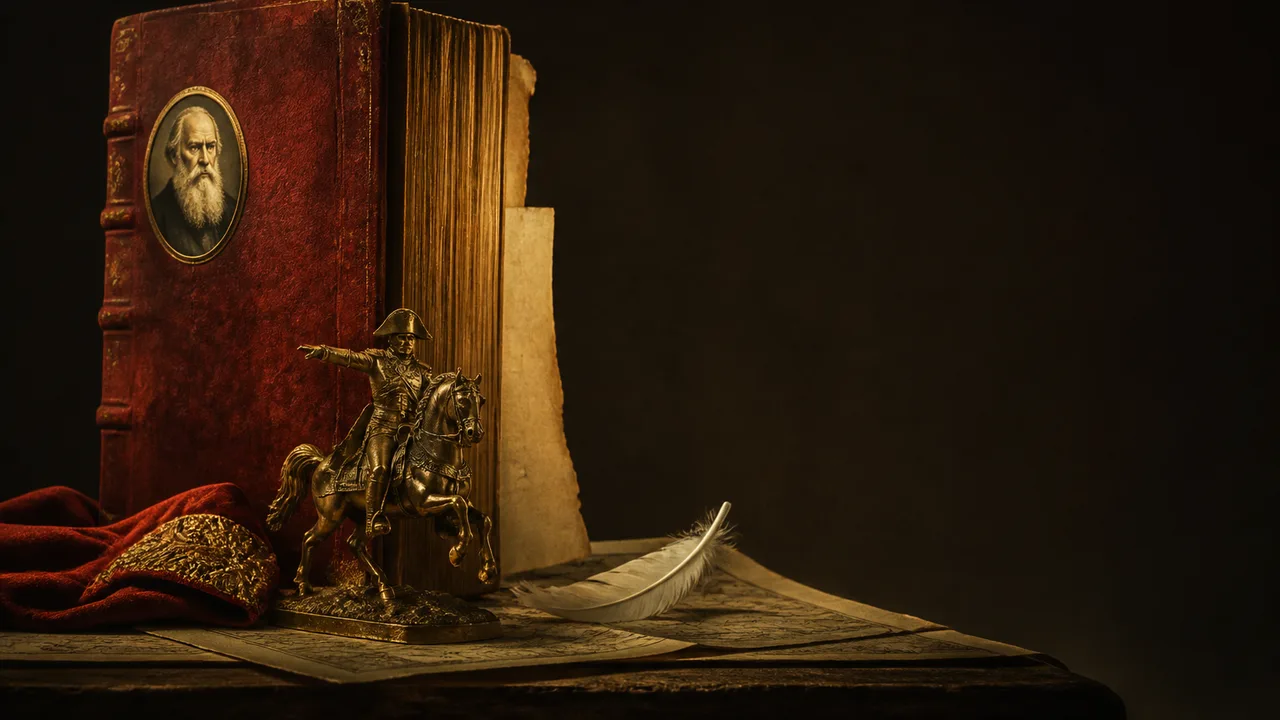
Photo: AI. Soraya Hadid
I've spent a lot of time in rooms where someone was ruining something beautiful by trying to improve it.
You know the session. The vocal take is alive — there's a crack in the singer's voice on the bridge that shouldn't work and absolutely does. Then the producer starts reaching for tools. A little more compression to even it out. Some pitch correction on that slightly sharp note. A de-esser. A limiter. By the time they're done, the take is technically perfect and emotionally inert. The thing that made it worth recording is gone. Not degraded. Gone.
I thought about that a lot while watching Great Books Explained's recent walkthrough of War and Peace. I don't usually write about nineteenth-century Russian literature. But the video's presenter, working through Tolstoy's central argument, kept describing something that sounded less like literary criticism and more like a problem I recognize from the studio.
Tolstoy's thesis — if you can reduce a 1,400-page novel to one — is that every system human beings construct to impose order on experience ends up destroying the thing it was meant to preserve. Religion, military hierarchy, aristocratic ritual, Freemasonry, numerological mysticism: Pierre Bezukhov tries all of them, and each one is infected by exactly the vanity and emptiness he was trying to escape. The system is the problem. Not any particular system. The act of systematizing.
That is not a foreign concept to anyone who has watched a piece of audio get processed to death.
The Pierre Problem
Pierre is the character who carries most of Tolstoy's philosophical weight, and his arc is essentially a tour through the failure modes of frameworks. He inherits a fortune, discovers that wealth doesn't provide meaning, marries into the aristocracy, discovers that status doesn't either. He joins the Freemasons after meeting a charismatic mentor who tells him: "Purify thyself, and as thou art purified, so shalt thou come to know wisdom." Pierre commits, only to find the brotherhood is running on the same social ambitions as the world outside it. He pivots to mystical numerology and convinces himself he is personally destined to assassinate Napoleon. At every stage, he reaches for a more elaborate structure to contain his experience, and at every stage the structure collapses.
What's interesting is that Tolstoy doesn't diagnose Pierre as stupid or weak. He's actually the most intellectually capable character in the novel. The problem is precisely that intelligence. He can't stop reaching for frameworks because frameworks are what intelligent people do. They theorize. They build systems. They try to understand.
I know engineers like Pierre. I've been Pierre. There's a kind of producer who cannot leave a mix alone because their ear is too trained, their toolset too extensive. They can hear every imperfection. And the ability to hear it comes bundled with the compulsion to fix it. The result is a mix that has been optimized into lifelessness.
What Natasha Actually Does
Tolstoy's counterweight to Pierre is Natasha Rostova, who the video's presenter describes as the emotional center of the novel. Where Pierre searches through ideas and Prince Andre searches through ambition, Natasha simply lives. She responds to music and beauty directly, without intermediary framework. "She was not in love with anyone in particular, but with everyone." At the Rostov estate, she performs a traditional Russian folk dance — instinctively, not because she's studied it — and the moment lands as a kind of truth the intellectual characters can't access through all their striving.
Natasha is, in production terms, the raw take. She is the vocal with the crack in it. She's what you had before you started processing.
The video's presenter is careful not to oversimplify this — Natasha's story includes real suffering, a disastrous near-elopement, a period of shame and despair that fundamentally changes her. She becomes, by the novel's end, less impulsive and more grounded. Tolstoy isn't arguing for naivety. He's arguing for something more specific: that direct emotional experience has a kind of information in it that systematic frameworks cannot replicate, and that the attempt to replicate it through systems is where you lose the signal.
That distinction matters. "Raw is always better" is as wrong in audio as it is in life. An unprocessed recording in a bad room is still a bad recording. Natasha is not an argument against technique. She's an argument against letting technique crowd out the thing technique exists to serve.
The Manuscript and the Machine
A useful footnote here: Sophia Tolstaya, Tolstoy's wife, reportedly copied the novel's manuscript — estimated at somewhere in the range of 580,000 to 700,000 words, depending on which edition and which scholarly count you trust — by hand approximately six times as Tolstoy endlessly revised. (Some sources say more; scholarship varies, and this particular number is harder to pin down than you'd expect.) She was managing a household with thirteen children while doing it. This is either an extraordinary act of devotion or an extraordinary act of endurance, possibly both.
What I find technically interesting is the revision process itself. Tolstoy kept expanding the scope because the existing framework kept proving inadequate to what he was trying to capture. The Decembrist Revolt was too small. Napoleon's invasion was bigger but still insufficient. He kept widening the container because no container was actually big enough. When the narrative structure couldn't hold his ideas, he stopped writing fiction and wrote philosophical essays directly. The form kept breaking under the weight of the content.
That's a version of a problem that comes up in mastering. You can push a limiter to get more loudness, but you're borrowing headroom you don't have. At some point the ceiling breaks. Tolstoy's solution wasn't to compress harder — it was to add more headroom. He made the novel longer. The result is a book that famously resists categorization: not a novel, not an epic poem, not a historical chronicle. Tolstoy himself acknowledged this explicitly. It's something else, something the existing genre labels can't process without distortion.
Why Any of This Matters Now
The Great Books Explained video is a solid piece of work — thorough on the biographical context, clear on the philosophical architecture, and honest about the tensions in Tolstoy's argument. The presenter notes that Tolstoy's pacifism eventually led him toward nonviolence and moral resistance that influenced figures like Gandhi and Martin Luther King Jr. He draws a line from the novel's argument about systems to a broader warning about what happens when institutions stop being able to see the individual human beings inside them.
That's a legitimate reading, and I'm not going to argue with it. But the part that stays with me is more specific: Tolstoy's insistence that each time Pierre reaches for a new framework to preserve something authentic, the framework becomes the thing, and the authentic thing evaporates.
The version of this I live with is simpler and more immediate. In audio, every process you apply is a decision about what to keep and what to discard. Compression discards dynamic range. Pitch correction discards micro-intonation. Noise reduction discards some of the room. The decisions are often correct. The room might genuinely be bad. The dynamic range might be genuinely distracting. But the decisions are never neutral, and every one of them moves you further from what was originally captured. At some point you have to ask: what were you trying to preserve? Is it still there?
"Seize the moments of happiness, love, and be loved. That is the only reality in the world. All else is folly."
Tolstoy puts that line in Pierre's mouth near the end of the novel, after Pierre has burned through every system available to him and come out the other side. It reads like a conclusion, but it's more accurately a residue — what's left when everything that could be processed away has been.
That's either wisdom or defeat, and I'm not sure Tolstoy was certain which.
More Like This
Obsession, Discipline, and the Parent Who Has Neither
Chris Williamson's framework on obsession vs. discipline is sharp — but what does it mean when you have twins, a mortgage, and zero uninterrupted hours?

What Camera Sensors Can Teach You About Sound
StudioBinder's sensor explainer is solid filmmaking education — but it reveals something bigger about how creators misunderstand the infrastructure beneath their craft.
The Self-Loathing Monologue Playing on Loop
Alain de Botton's School of Life video on loneliness gets the diagnosis right — but who's actually providing the antidote? A music critic weighs in.

Lee Cronin's The Mummy Wears Egypt Like a Mask
Lee Cronin's The Mummy sells Egypt and delivers Evil Dead. The visual identity gap between what it promises and what it shows is where the film collapses.
Consciousness Transfer: Science Fiction or Reality?
Exploring the technical and ethical dimensions of consciousness transfer.

Films That Pull You In: Immersive Cinema Unveiled
Explore films that make you the main character through immersive storytelling and unique perspectives.
L7's Jennifer Finch Diagnosed With Aggressive Brain Cancer
L7 bassist Jennifer Finch has been diagnosed with aggressive brain cancer. What her diagnosis means for the instrument, the band, and musician healthcare.
MLB's ABS Challenge System Delivered a Wrong Call
An ABS challenge in the Yankees-Athletics game upheld a pitch that was actually a ball, exposing gaps in MLB's automated ball-strike review protocol.