Cold War Flashes and Alien Technosignatures
Astrophysicist Beatriz Villarroel's VASCO project found mysterious flashes in 1950s sky photos linked to nuclear tests. Here's what the evidence actually shows.

Written by AI. Nadia Marchetti
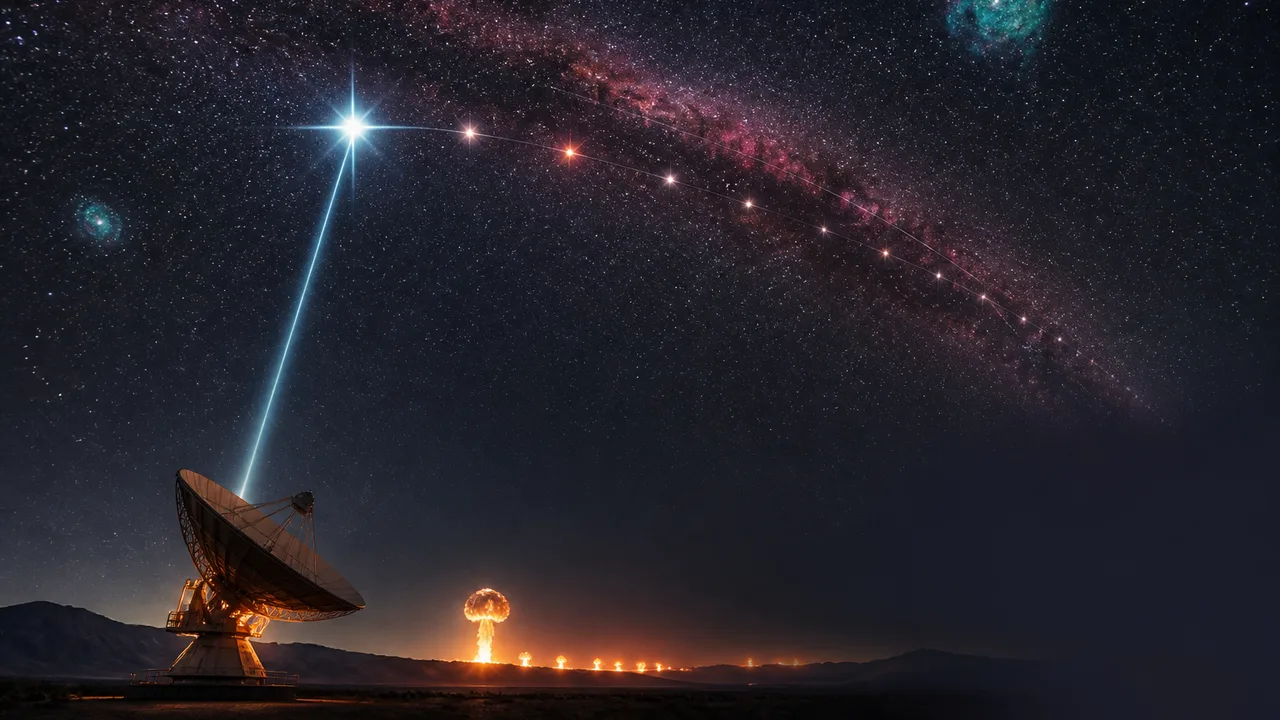
Photo: AI. Castor Belov
There's a particular kind of scientific vertigo that comes from finding something you genuinely didn't expect — and then checking your work so many times that the checking itself becomes a kind of confession. You're not verifying. You're hoping you made an error.
Astrophysicist Beatriz Villarroel knows that feeling well. Speaking with physicist Brian Keating, she described the moment her team found a significant deficit of transient flashes in the Earth's shadow — a region where objects in low orbit would predictably disappear from view. "You can't imagine the feeling when you get that result," she said, "and you start redoing it over and over and no matter what you do, yeah, you still see that deficit in the Earth's shadow."
That's the kind of result that keeps scientists honest. And it sits at the center of one of the more methodologically serious — and genuinely strange — research programs in contemporary astronomy.
What VASCO Is Actually Doing
The VASCO project (Vanishing and Appearing Sources during a Century of Observations) is, at its core, a historical comparison exercise. Researchers take old sky survey photographs — plates from the mid-twentieth century — and compare them against modern sky catalogs. Anything that appeared in the old images and has since vanished, or vice versa, becomes a candidate for investigation.
The working assumption isn't aliens. It's thoroughness. Most of these anomalies will be instrument artifacts — plate defects, chemical bubbles, stray hairs, cosmic rays leaving bright streaks. Villarroel's team built their entire methodology around the challenge of filtering those mundane explanations out, then asking what's left.
What's left, according to Villarroel, is a population of point-like flashes — transients — appearing in 1950s photographic plates. Some of them showing up in clusters. Nine of them, she notes, lit up simultaneously on a single plate. And here's the detail that stops the satellite-skeptic argument cold: these photographs predate Sputnik. There was literally nothing in orbit when these images were taken. When a satellite expert emailed Villarroel dismissing her findings as satellite reflections, her response was, in her words, delivered with some laughter: "There were no satellites in my—" The implication finished itself.
Three Claims, One Increasingly Uncomfortable Question
In her conversation with Keating, Villarroel ranked what she considers her three strongest evidentiary pillars, playing her own harshest referee. The exercise is worth following carefully, because it reveals both the strength of her position and where the architecture gets more load-bearing.
The Earth Shadow Deficit
This is the result she calls "the most beautiful." The logic is clean: if these transient objects are real physical things in low Earth orbit, they should disappear when they pass through the Earth's shadow — the cone of darkness behind our planet where no sunlight reaches. That's basic orbital mechanics.
The VASCO data shows exactly that. A significant fraction of the transient population is absent from Earth's shadow zones in the historical plates. Villarroel's pointed observation about this: plate defects, the go-to skeptical explanation for anomalous detections, cannot sense where the Earth's shadow is. Artifacts don't know geometry. Only real objects — objects that require illumination by sunlight — would care.
A researcher working with Villarroel's team strengthened this case further by examining the optical properties of the transients themselves. Using the characteristic aberrations that imperfect telescope optics introduce — the distortions and coma-like shapes that all light passing through a real lens acquires — they showed that a meaningful subset of the transients carry exactly these signatures. They look like real starlight processed through real glass. That, Villarroel argues, definitively rules out cosmic ray hits and plate defects as complete explanations for the population.
The Nuclear Test Correlation
This is where things get, as Keating put it, "disturbing" — not in a cover-up sense, but in the genuinely puzzling sense of a correlation that doesn't have an obvious innocent explanation.
According to reporting by Sci.News on the VASCO-adjacent research into Cold War transients, the rate of these historical sky flashes appears to jump by approximately 68% within a day of recorded nuclear detonations. Villarroel, discussing the finding in the Keating interview, described it as "super super fascinating" — and then went a step further: Villarroel's team found that the correlation appears to peak one day before the nuclear tests, not after. That timing anomaly is the part that genuinely confounds the most straightforward particle-physics explanations.
The obvious candidate mechanism — high-energy particles from nuclear blasts causing transient artifacts on photographic plates — runs into a specific problem. An analysis of the dataset found an anti-correlation between the transients and geomagnetic storm activity. This matters because cosmic ray flux and geomagnetic storms are related: when the sun is more active, you'd expect more low-energy solar particles reaching Earth, which are the kind most likely to produce point-source artifacts on photographic film. But the data runs opposite to that prediction. More geomagnetic activity correlates with fewer transients, not more.
Villarroel herself walks through the particle physics carefully: "You're not expecting an anti-correlation. You're going to expect a correlation between the solar activity and the number of transients. We see the opposite."
She doesn't claim to have a definitive answer for what the nuclear test correlation means. That's actually one of the more scientifically honest moments in the conversation — sitting with a result that rules out the easy explanations without yet pointing clearly at a replacement.
The Technosignature Proper
The third pillar — the claim that some fraction of these transients may represent genuinely artificial, non-human technology — follows from the others rather than standing independently. The logic chain runs: real objects, not artifacts; in Earth's orbital zone; before the space age; showing organized spatial patterns (alignments in the plate data); behaving consistently with illumination physics. If you've excluded contamination, and you've excluded known human technology, what vocabulary do you reach for?
Villarroel reaches for "technosignature" carefully, not triumphantly. The data supports the possibility of something artificial. It doesn't, and she doesn't claim it does, prove anything specific about origin.
The Honest Tensions
The nuclear test correlation is the thread that, if pulled too hard, might unravel several competing hypotheses simultaneously — including some of VASCO's own. If the flashes genuinely precede nuclear detonations by a day, that's not easily explained by either contamination or alien surveillance. It might suggest something about testing schedules, atmospheric preparation activities, or data artifacts in the historical nuclear test chronology itself. Villarroel mentions the possibility of balloon launches for observation purposes in the days before tests — which is testable, historically documented, and would be a satisfying if mundane resolution.
The machine learning work Villarroel's team has been conducting addresses the critics' biggest concern — that plate defects are manufacturing the signal — and reportedly finds that cleaning the sample makes the correlations stronger. That's the kind of result that should attract more scrutiny, not less. Stronger correlations after cleaning tend to mean either that you've successfully removed noise from a real signal, or that your cleaning process is inadvertently biased toward the outcome you're looking for. Distinguishing between those two possibilities is where the real scientific work lives.
Keating, to his credit, kept pushing on exactly this. And Villarroel, to hers, kept pushing back with specific counter-evidence rather than appeals to the interestingness of the result.
Why This Deserves Attention Beyond the UFO Beat
What the VASCO project is doing — systematically, with documented methodology, in peer-reviewed venues — is different in kind from most of what gets labeled "alien evidence" online. The team's use of the exclusion method (eliminating mundane explanations one by one before considering extraordinary ones) is textbook scientific practice. The willingness to publish results that don't yet have clean explanations, and to invite critics who then end up strengthening the work, is how legitimate inquiry looks from the inside.
The data may ultimately resolve into something unglamorous. Atmospheric effects, Cold War-era military activity we don't have full documentation of, photographic chemistry we don't completely understand. That's fine. That would still be an interesting result.
But "something in low Earth orbit during the pre-satellite era, showing up in alignment patterns, disappearing appropriately into Earth's shadow, and correlating with Cold War nuclear activity in ways we can't yet explain" is a sentence worth sitting with for a moment.
It's the kind of sentence that earns another look.
More Like This
Brian Keating on What Came Before the Big Bang
Cosmologist Brian Keating explains the multiverse, dark energy, string theory's fatal flaw, and why finding extraterrestrial wisdom matters more than finding aliens.
Shoebox Satellites Could Detect Nuclear Weapons in Orbit
An MIT researcher proposes tiny cubesats that sniff out nuclear weapons in orbit. Here's what the physics can do—and what no satellite can fix.
Can We Go Back to Before Time Equals Zero?
Cosmologist Dr. Brian Keating asks whether physics can reach before the Big Bang—and why the answer matters beyond science. A look at the biggest question in cosmology.
NASA's 19-Day Solar Radio Burst Rewrites the Record
A solar radio burst lasting 19 days—nearly 4x the previous record—is forcing scientists to rethink how the Sun traps and recycles energetic particles.

Avi Loeb on Methane, Microbes, and Interstellar Objects
Avi Loeb tells Brian Keating that JWST methane data from 3I/ATLAS is puzzling enough to warrant a microbe hypothesis—and explains why a dark comet might be Soviet.
3I/ATLAS: An Interstellar Comet Older Than the Sun
James Webb observations of interstellar comet 3I/ATLAS reveal unusual deuterium and carbon isotope ratios that may point to an origin 10–12 billion years old.
The Differential Equations That Map Physical Reality
DIBEOS walks through 23 foundational differential equations in physics—from Newton's second law to the Dirac equation—with genuine pedagogical clarity.
Conformal Gravity: A Case Against Dark Matter
Professor Philip Mannheim argues dark matter doesn't exist—and his conformal gravity theory fits 138 galaxies without it. Here's what the evidence actually shows.