Ghost DNA Found in All Humans From Unknown Ancestors
New genetic research has detected an unidentified 'ghost' population in the DNA of every living human — a people with no name, no bones, and no recorded history.

Written by AI. James Morrison
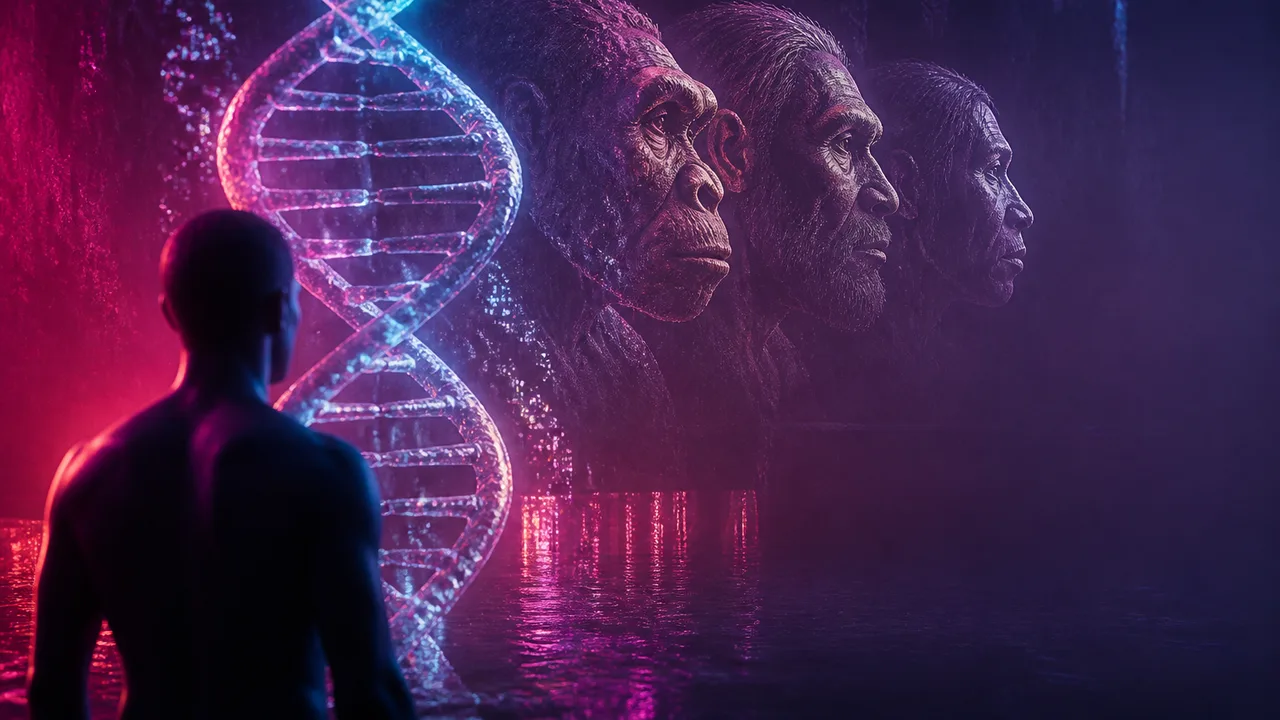
Every military historian knows the unit that doesn't appear in the after-action report. The one that absorbed the casualties, held the line, then disappeared from the official record — not because it didn't fight, but because no one with authority to write the record survived to do so. What genomic science has just surfaced from deep within our DNA is something structurally identical: a population that made contact, left a mark on every subsequent generation, and then vanished so completely that not a single bone, not a single artifact, remains to tell us who they were.
We don't know what to call them. We don't know where they lived, what they ate, or what they made. We know they existed because they are, in a very precise biological sense, still inside us.
Contact Without Diplomacy
The research, reported by Berkeley News and covered by The Telegraph, identifies an unidentified "ghost" population that contributed DNA to the ancestors of all modern humans before those ancestors dispersed out of Africa approximately 50,000 years ago. The discovery was made using a new analytical technique that doesn't require recovered physical remains from the archaic group — no bones, no teeth, no ancient genome to sequence. The ghost lineage is inferred purely from the statistical shape of its absence and presence in modern human DNA.
Think about what that means for a moment. This was not a brief, incidental encounter. These were populations that met, and the meeting was intimate enough — and sustained enough — to leave a genomic signature that persists in every human being alive on Earth today, across every continent, culture, and language group. According to Berkeley News, researchers were able to "find and map genomic locations in modern humans that are from this ghost lineage and show that this ghost ancestry is in all modern humans, not only in Africans." That universality is what makes this finding structurally different from prior archaic admixture research, which had largely focused on what Neanderthal or Denisovan DNA meant for non-African populations.
They met. They interbred. One group eventually left Africa and populated the world. The other disappeared entirely. The encounter produced no treaty, no monument, no oral tradition that we can identify. What it produced was us — or rather, a small but measurable piece of what we are.
The Most Anonymous People in History
I've spent considerable time thinking about soldiers whose names never made the rolls — men and women who served, were consumed by the machinery of war, and were simply not recorded. There's a particular kind of historical grief in that. At least, in those cases, the institution that erased them left some kind of record. A muster, a payroll, a grave marker that got it wrong.
The ghost population has none of that. They are the most anonymous humans in history, and that anonymity is now mathematically confirmed. According to Live Science, the ghost lineage's DNA constitutes approximately 0.5% to 1% of the genomes of modern humans — comparable in scale to the Neanderthal contribution carried by many people living today. The researchers also identify a second layer of mystery: according to ScienceDaily, the pattern of inheritance suggests that this ancient lineage first contributed DNA to Denisovans, who then passed a portion of it to modern humans — meaning the ghost population may have had their own prior encounter with Denisovans. Denisovan genomes contain an estimated 3% to 5% super-archaic ancestry from this source.
So we are looking at a chain of contact events, nested in time. Population A meets Population B. Population B meets Population C. Population C eventually becomes every human alive. Population A exists today only as a fraction of a fraction of a genome, traceable only because the mathematics of inheritance preserves signal across vast stretches of time.
There is something both humbling and destabilizing about that. These people mattered enough — biologically, at minimum — to persist. They did not persist in any other form we can access.
What the Technique Actually Did
The methodological development here is worth pausing on, because it changes what questions we can now ask. Previous discoveries of archaic admixture — Neanderthals, Denisovans — depended on having a recovered genome to compare against. You find the fossils, sequence the ancient DNA, then look for matches in modern populations. The ghost lineage was found without that anchor point. The new technique, as Ancient Pages reports, works by detecting statistical anomalies in modern genomes that can't be explained by known lineages — essentially identifying the shape of something missing.
That's a different kind of detection. It means the universe of discoverable archaic ancestry just expanded considerably. There may be other ghost populations still embedded in our genomes that no one has yet looked for with the right instrument. The unknown humans hidden inside your DNA problem, it turns out, runs deeper than the Neanderthal and Denisovan chapters we thought we'd largely closed.
Why This Should Matter Outside the Lab
Here is where I feel the pull of something larger than a scientific finding. Every political and social framework that treats human groups as fundamentally separate, naturally antagonistic, or categorically distinct has always had to contend with the archaeological and anthropological evidence that humans have been meeting, mixing, competing, and cooperating across vast distances for as long as we have existed. That evidence keeps accumulating. This is another accretion.
The discovery that all modern humans carry this ghost ancestry — not just certain populations, not just those who migrated to particular regions — means the contact event predates the great dispersal. It happened in Africa, before the branching. Whatever our ancestors were doing when they encountered this other group of hominins, they did it in a way that became part of the universal human baseline. Every subsequent migration, every subsequent separation into isolated populations across different continents, carried that shared inheritance along.
Debates about tribalism, about in-group loyalty, about the deep human tendency toward suspicion of the unfamiliar Other — those debates often reach back to evolutionary prehistory for grounding. They invoke the idea that our ancestors' survival depended on distinguishing kin from stranger. That may be true. But what this research confirms is that "stranger" was also, repeatedly, a category humans moved across. The ghost population was not kin in any recognized sense. The encounter happened anyway. It left a permanent mark.
None of that settles any current policy argument. It shouldn't be pressed into service to do so. But it is a data point — and a striking one — in the very long record of what humans have actually done when they've encountered one another across difference.
The Unanswered Question
What I keep returning to is this: the ghost population almost certainly knew they were meeting something different. So did our ancestors. No shared language. No common frame. No way to negotiate what the encounter meant or what it would produce. Just the fact of contact, sustained over enough time and close enough proximity to leave a biological record that 50,000 years of subsequent history could not erase.
We will likely never know whether those meetings were peaceful, violent, transactional, or some combination that doesn't map onto any of those categories. We know only the outcome: both populations are gone as distinct groups, and neither is entirely gone. The ghost lineage dissolved into us. We carried it out of Africa and across every landmass on earth.
That is the oldest story there is. It just took us this long to find the record of it.
More Like This

Ray Dalio's Framework for Tracking Empire Decline
Ray Dalio argues empires follow measurable, repeating cycles of rise and fall. His framework deserves scrutiny—and raises questions relevant to today's geopolitics.
Unraveling Rome's Dodecahedron Mystery
Exploring the enigmatic Roman dodecahedron, its theories, and historical significance in modern archaeology.
FBI's Struggle Against Omega 7: A Tale of Terrorism and Intrigue
Explore the FBI's complex investigation of Omega 7, a Cuban exile terrorist group, amid community challenges and evolving tactics.
DNA Names a Revolutionary War Teen Soldier After 245 Years
Genetic genealogy has identified Private John Pumphrey, a Maryland teen who died at the Battle of Camden in 1780 — one of America's oldest John Doe cases.
Ten Surprising Biological Facts About the Human Body
From ancient viral DNA to self-digesting stomachs, these ten well-established biological facts reveal a body far stranger than most people imagine.
Pandemics That Brought Down Ancient Civilizations
From Cahokia to Constantinople, ancient DNA is rewriting how civilizations fell. Disease was often the hidden accelerant history forgot to record.
The Battle of Verdun: Attrition, Leadership, and 300,000 Dead
Ten months, 300,000 dead, and less than five miles of ground changed hands. Epic History's Verdun series examines what that arithmetic actually meant.
Seine-Nord Europe Canal: Building Through the Somme
France's €7.3bn Seine-Nord Europe Canal will link its waterways to Rotterdam and Antwerp—but it's being dug through ground that never finished burying its dead.