DNA Names a Revolutionary War Teen Soldier After 245 Years
Genetic genealogy has identified Private John Pumphrey, a Maryland teen who died at the Battle of Camden in 1780 — one of America's oldest John Doe cases.

Written by AI. David Oyelaran
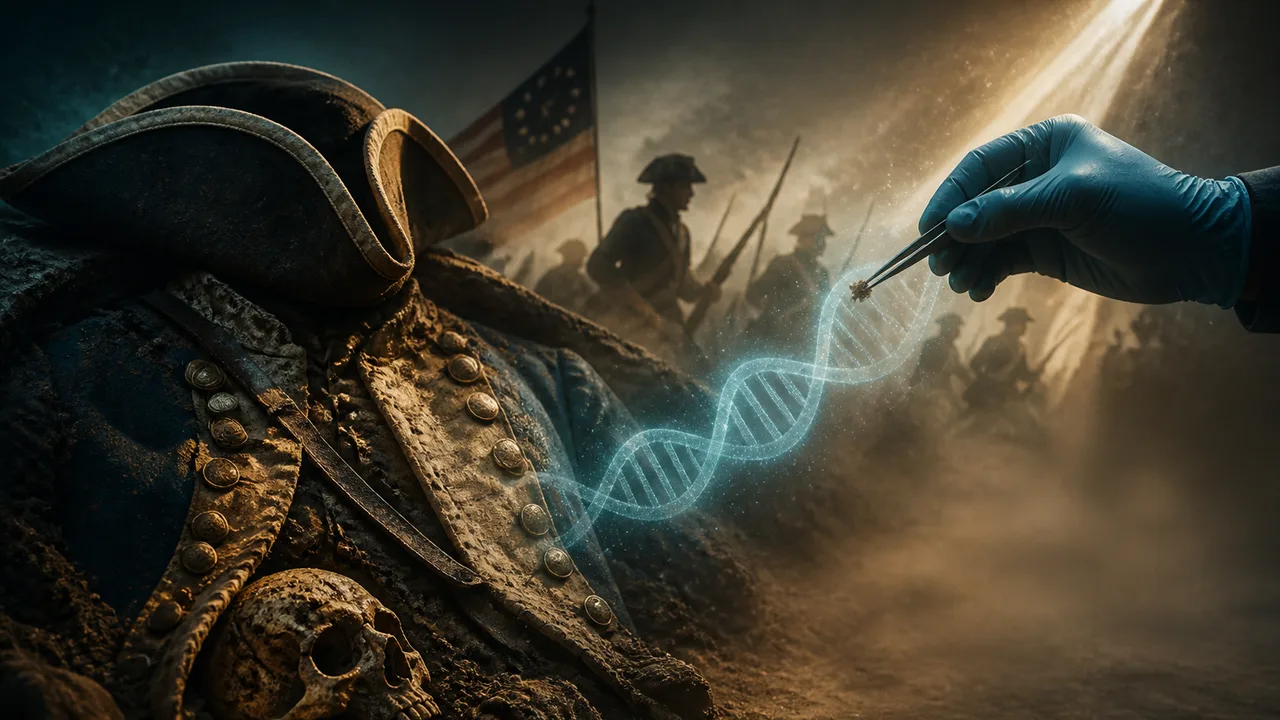
For 245 years, he was a set of bones with a number.
The number was 9B. The bones belonged to someone who had died in South Carolina in the summer of 1780, during the bloodiest battle of the American Revolutionary War. He had a name once — people who loved him called him something, probably in Maryland, probably in a house that no longer stands. But the war swallowed him before history could write him down, and for nearly two and a half centuries, that name stayed buried with the rest of him.
It doesn't anymore. His name was Private John Pumphrey. He was a teenager. He enlisted in the Continental Army's 7th Maryland Regiment as young as 13 years old, according to CBS News. And he has just become, almost certainly, one of the oldest identified John Doe cases in American history.
The story of how he was found is worth slowing down for, because it pulls together threads from several different disciplines and several different centuries — and the method that closed the case didn't even exist a decade ago in its current form.
Researchers excavated Pumphrey's remains in 2022, according to Smithsonian Magazine. The site was a South Carolina battlefield, though the sources are careful not to specify beyond that, and I won't manufacture precision the record doesn't support. What the record does support: researchers recovered enough skeletal material to extract usable DNA from someone who had been dead since 1780. That alone is a significant technical achievement — ancient DNA degrades, contaminates, and fragments over time, and getting clean enough data from 18th-century remains to run against a modern genealogical database requires both specialized lab techniques and a measure of luck.
The match, when it came, was striking. As the Times of India reported, the team used cutting-edge DNA technology and investigative genealogy to work through the identification. The brief from which this piece was reported notes that Pumphrey's remains were ultimately matched to over 20,000 living relatives — which sounds staggering until you remember that he died young, childless, and that nearly 250 years of cousins have since been born. That number isn't a fluke of Pumphrey's particular family; it's a demonstration of how deep the genealogical database has become.
There's something worth pausing on in the family tree mechanics here. Pumphrey was so young when he died that he left no direct descendants, WMAR2 News reports. The chain of connection runs through his siblings, who did have children, whose children had children, and so on down through eight or nine generations until you arrive at living people who submitted their DNA to a consumer genealogy service without having any particular reason to think they were related to a Revolutionary War casualty. Genealogists stitched together that extended family tree, matched the DNA profiles across it, and traced the path back to John Pumphrey himself. It is, in a structural sense, the same technique law enforcement has used to identify suspects through familial DNA — but run backward, toward a victim rather than a perpetrator, and across a timespan that would have seemed like science fiction to the researchers of even twenty years ago.
The historical context matters as much as the science does, and the two are inseparable in this case.
The Battle of Camden, fought in August 1780, was — as WBAL-TV notes — among the bloodiest engagements of the entire war. The Continental Army suffered a catastrophic defeat; British forces under General Cornwallis routed American troops under General Horatio Gates, and the casualties among the Continental regiments from Maryland were severe. "We know a few months later, he — with the few men from Maryland — stood in the face of the bloodiest battle in the war," a researcher noted to WBAL-TV, describing what Pumphrey's final months would have looked like.
He was, by the time he died, somewhere between 13 and his mid-teens. He had enlisted — or been permitted to enlist — in one of the most storied regiments of the Continental Army. The 7th Maryland had a reputation for discipline and tenacity. Whether Pumphrey understood what he was stepping into, whether he was there out of conviction or circumstance or something else entirely, the sources don't tell us. The historical record is thin enough on common soldiers even when they survive the war; for those who died young and nameless on contested ground, the silence is usually total.
That's the gap this identification starts to fill. Not with documents, not with a memoir, but with a name. With the simple fact that he existed and can now be said to have existed — specifically, on purpose, in the record.
There is a timing element to this story that deserves at least a passing note. Yahoo News reports that Pumphrey's identification came just before America's 250th anniversary — the Semiquincentennial, which the country is actively in the process of commemorating. That context isn't incidental. The national conversation around the founding era tends to traffic in commanders and Founding Fathers, in constitutional architecture and ideological argument. Pumphrey is a corrective to that — not a symbol of anything so much as a reminder that the war was fought by people who were largely very young, largely poor, largely undocumented, and largely forgotten the moment the battles ended.
CBS News quoted a researcher calling the identification "a gift to the whole country," and I think that's genuinely true, even if it risks making Pumphrey's story feel like a lesson rather than a life. What the identification actually gives us is something smaller and more specific than national symbolism: it gives his descendants the knowledge of where one branch of their family tree ends, and how. It gives historians a data point about age, geography, and unit composition that can be cross-referenced against other records. It gives the people who excavated and studied his remains the resolution that careful scientific work deserves.
And it raises, quietly, a harder question. The identification of Private John Pumphrey required the intersection of ancient DNA analysis, a massive consumer genealogy database, investigative genealogists willing to do painstaking tree-building, and researchers with the resources and the focus to pursue an 18th-century cold case for years. That combination aligned here. But the Revolutionary War alone involved tens of thousands of soldiers who died and were buried without names, and that's before you start accounting for the enslaved people, the Indigenous fighters on multiple sides, the women who traveled with armies and died with them, whose remains are even less likely to surface and even less likely to be studied when they do.
John Pumphrey got his name back. The question the science doesn't answer is how many others are still waiting, and who's going to look.
More Like This

Middle Platonism's Hidden Role in Western Esotericism
ESOTERICA's new crowdfunded seminar argues Middle Platonism built the foundations of Hermeticism, Gnosticism, and early Christian theology. Here's what that means.
Benedict Arnold: Patriot, General, Traitor
Benedict Arnold won the Battle of Saratoga then betrayed his country. A new documentary examines the grievances, ambition, and political failures that made both possible.
Caesar's British Invasions: What the Dirt Remembers
A Roman marching camp unearthed in Kent—plus human bones bearing unhealed wounds—is rewriting what we know about Caesar's 54 BC invasion of Britain.
Ancient Dogs Were Already Weird Before Victorians
A 2025 skull study of 600+ canines upends the tidy story that Victorian breeders invented dog diversity. Ancient dogs were already strange—and varied.

The Gods of Pre-Islamic Arabia, In Their Own Words
Ancient desert inscriptions reveal the polytheistic world before Islam—gods, prayers, sacrifice, and fate, recorded by the nomads who lived it.
Did the Minoans Inspire the Atlantis Legend?
Archaeological and geological evidence connects Plato's Atlantis to the Minoan civilization and the catastrophic Bronze Age eruption of Thera (Santorini).
Cicero and the Fall of the Roman Republic
Marcus Tullius Cicero defended Rome's Republic with words alone—and paid with his life. A look at history's most consequential orator and his impossible political moment.

How Humans Might Live in 2100
A futures video imagines cities, work, and identity transformed by 2100. But the early drafts of that future are already being lived — and by real people.