Colossal Marble Statue Unearthed at Ancient Sardis
A 2.2-meter marble statue found at Sardis, Turkey, raises sharp questions about art, power, and identity in Persian-occupied Lydia circa 500 BC.

Written by AI. James Morrison
When Cyrus the Great's forces rolled through western Anatolia in 547 BC and took Sardis without prolonged resistance, the Persians faced a decision that every occupying power faces eventually: what do you do with a city that is more valuable standing than burning? Sardis was the capital of the Lydian Kingdom, a hub of trade and accumulated wealth, and it sat at the natural western anchor of what would become the Royal Road — the imperial communications and logistics spine that ran east to Susa. The Persians made Sardis a satrapal capital and kept it intact. That decision, as much as any battle, shaped the next century of history in the eastern Mediterranean.
It is worth holding that context in mind when reading about the marble statue unearthed there this summer.
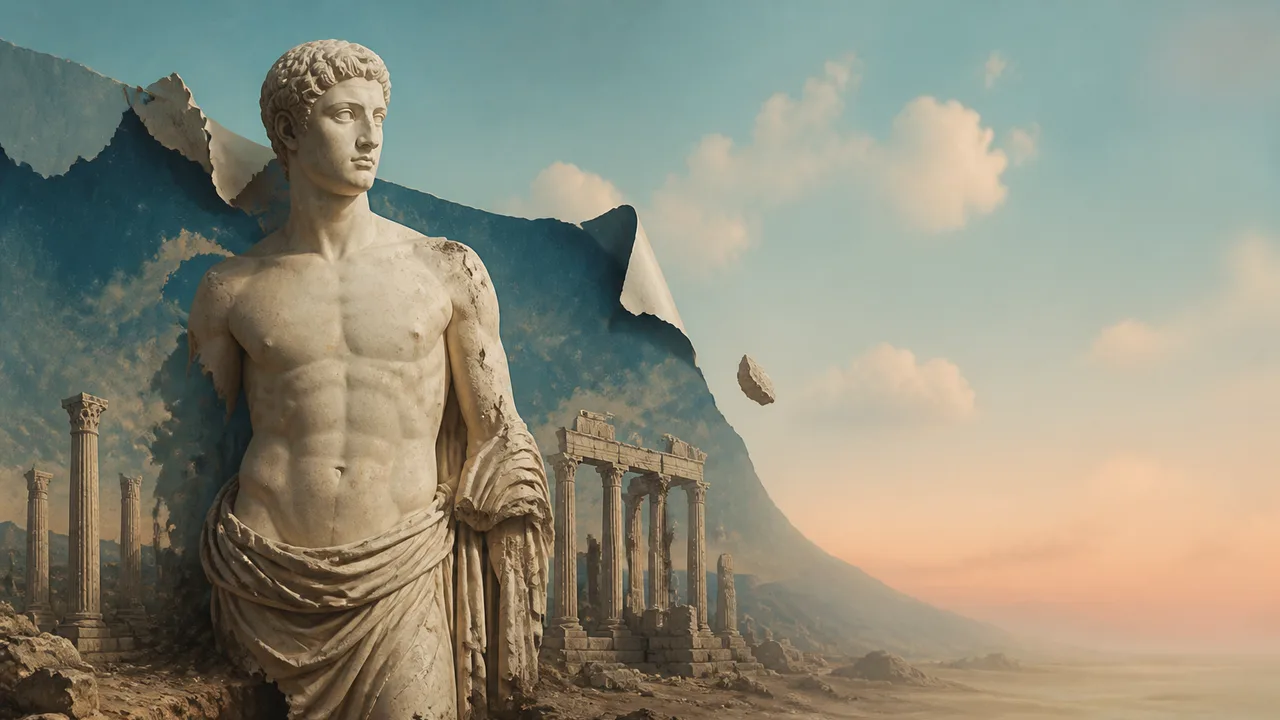
Archaeologists excavating the ancient city of Sardis in western Turkey have uncovered a monumental marble statue of a young man, dating to approximately 2,500 years ago — placing its creation squarely in the early Classical period, in the decades immediately following the Persian conquest, according to Archaeology Wiki. Daily Sabah reports the find has been described by officials as one of the most significant recent discoveries at the site. Turkey's Minister of Culture and Tourism, Mehmet Nuri Ersoy, formally announced the discovery, according to La Brujula Verde, which also reports the statue stands 2.2 meters tall — colossal by any standard — and depicts the young man holding a quince. Arkeonews notes the figure is long-haired and described as remarkably well preserved. Ancient Pages and Azernews both confirm the statue is male and broadly dated to around 2,500 years ago.
The Figure in Stone, and What It Tells Us About Who Was Running Things
The statue belongs to a sculptural tradition that art historians call the kouros — the standing male youth, rendered in marble at near-life or above-life scale. The Metropolitan Museum of Art's collection illustrates how the type was conventionally rendered: an idealized young male form, long-haired, with the formal stillness characteristic of Archaic Greek sculpture. What makes the Sardis figure striking is not that it conforms to Greek convention — it is that it conforms to Greek convention while standing in a city that, at the moment of its carving, was administered by Persia.
That collision of aesthetic traditions is not decorative. It is political.
The question archaeologists and historians will now work to answer — and the sources do not yet resolve it — is who commissioned this statue. That is not a small question. Commissioning a 2.2-meter marble figure requires resources, connections to sculptors and stone, and a deliberate decision about what statement to make in public space. In Persian-occupied Sardis, both the resources and the decision carry weight.
Consider the two most plausible candidates. The first is a Lydian aristocrat, someone from the old elite who survived the conquest with their property and status partially intact, performing cultural continuity — telling their community, in stone, that Lydian civic and religious identity persists regardless of who controls the treasury and the garrison. The second is a Persian satrap or his administrative circle, commissioning work in the dominant regional artistic idiom to signal cultural competence and local legitimacy — the ancient equivalent of a colonial governor learning the language of the governed. Both motivations have precedent. Both were rational strategies for managing a conquered population. And the two are not mutually exclusive; patronage can serve the commissioner's interests and the occupier's simultaneously.
The statue does not answer this. But the ambiguity is itself historically revealing, because it reflects exactly the kind of layered, negotiated identity that Sardis embodied during the early Classical period.
What the Royal Road Actually Meant
Sardis was not simply a wealthy city with strategic position. It was the western terminus of the Royal Road — and that designation deserves more than a passing geographic note.
The Royal Road was a Persian military and administrative infrastructure project: roughly 2,700 kilometers of maintained road connecting Susa, the imperial administrative center, to Sardis. Royal couriers could cover it in days by relay; armies moved along it; tribute flowed east on it. The Greek historian Herodotus documented it. For the Persians, Sardis was not the frontier — it was the anchor of the western command. For anyone in Sardis after 547 BC, the road behind them led, eventually, to the Great King.
Understanding this changes how you read the statue. Sardis in the early 5th century BC was not a peripheral backwater processing the aftermath of conquest. It was an active node in a functioning imperial system, a city where Persian administrators, Lydian elites, Greek merchants, and soldiers from across the Achaemenid Empire were all present and in negotiation with one another. A 2.2-meter marble youth placed in that environment is not simply art. It is a statement made within earshot of empire.
That period also coincides almost exactly with the Greco-Persian Wars — the conflicts that would produce Marathon in 490 BC and Thermopylae in 480 BC, and that would define how the Western tradition has understood the confrontation between East and West for the two and a half millennia since. The statue may predate or postdate specific campaigns depending on where exactly scholars land on its dating, but the cultural and military ferment it was carved into is not background noise. It is the main event.
The Long View on Sardis
The site has been excavated for decades. Archaeology Wiki describes Sardis in western Turkey as a site that continues to yield material shedding new light on Lydian artistic traditions and cultural identity. Each excavation season adds specificity to a city that, in ancient sources, appears primarily as a marker of wealth and a staging ground for conflict.
Sardis was the capital of the Lydian Kingdom under Croesus — a name synonymous with wealth in the ancient world — before the Persian conquest. It survived subsequent absorption into the Macedonian empire after Alexander the Great's campaigns, then Roman administration, then the Byzantine period, then Ottoman rule. The city sat at a crossroads in the most literal sense: between the Aegean coast and the Anatolian interior, between the Greek world and the Persian world, between whatever power held the western littoral and whatever power held the eastern plateau. Its history is a recurring case study in how cities navigate the transition between imperial administrations while trying to preserve something of what they were.
The marble youth, carved right at one of those transition points, is a document of that navigation.
Why Ankara Announced This
It is worth noting — without cynicism, but without naivety — that Turkish Culture Minister Mehmet Nuri Ersoy chose to personally announce this discovery. Turkey sits on the same geographic crossroads that Sardis embodied. Modern Turkey administers a country that straddles the boundary between what Western strategic discourse has long called "East" and "West" — a framing that traces its intellectual lineage directly back to Herodotus writing about the Greco-Persian Wars. The announcement of a major find at a site of Lydian-Persian-Greek confluence is not merely a cultural press release. It is a reminder that this territory's depth of history belongs to the country that holds it now.
That claim is legitimate. It is also complicated, in the way that all such claims are complicated when the people who built the thing and the people who govern the ground are separated by twenty-five centuries and several civilizational turnovers. Archaeology has always been entangled with national identity — the question is whether that entanglement distorts or enriches the story being told.
In this case, the find is significant enough to carry its own weight. A 2.2-meter marble figure, remarkably preserved, carved in a conquered city during the height of the Greco-Persian conflict, by a patron whose identity and motives remain unknown — that is a genuinely important artifact, and it does not need political framing to matter.
What it needs is the right question: not what was carved, but who decided to carve it, and what they were trying to say to an audience that included their conquerors. When archaeologists at Sardis can answer that, we will know something real about how power and identity were negotiated in the ancient world — and about a dynamic that has not, in any recognizable sense, gone away.
More Like This

Ray Dalio's Framework for Tracking Empire Decline
Ray Dalio argues empires follow measurable, repeating cycles of rise and fall. His framework deserves scrutiny—and raises questions relevant to today's geopolitics.
Unraveling Rome's Dodecahedron Mystery
Exploring the enigmatic Roman dodecahedron, its theories, and historical significance in modern archaeology.

FBI's Struggle Against Omega 7: A Tale of Terrorism and Intrigue
Explore the FBI's complex investigation of Omega 7, a Cuban exile terrorist group, amid community challenges and evolving tactics.
Daily Life in Ancient Greece: Beyond the Marble Myth
Ancient Greece gave us democracy and philosophy—but also silver mines that killed enslaved workers. A look at who really built the "golden age."
Unexplained Calls: Echoes from the Past
Explore eerie stories of calls from the dead, their impact on military and emergency responses.
Myth, Obsession, and the Men Who Dug for Troy
Arthur Evans and Heinrich Schliemann both found ancient civilizations while chasing myths. What does that tell us about archaeology—and obsession?

The Battle of Verdun: Attrition, Leadership, and 300,000 Dead
Ten months, 300,000 dead, and less than five miles of ground changed hands. Epic History's Verdun series examines what that arithmetic actually meant.
Seine-Nord Europe Canal: Building Through the Somme
France's €7.3bn Seine-Nord Europe Canal will link its waterways to Rotterdam and Antwerp—but it's being dug through ground that never finished burying its dead.