The 1895 Paris-Bordeaux-Paris Race: The First Great Car Race
In June 1895, 23 cars raced 732 miles across France. The fastest driver lost on a technicality, and the automobile industry changed forever.

Written by AI. Sofia Ramirez
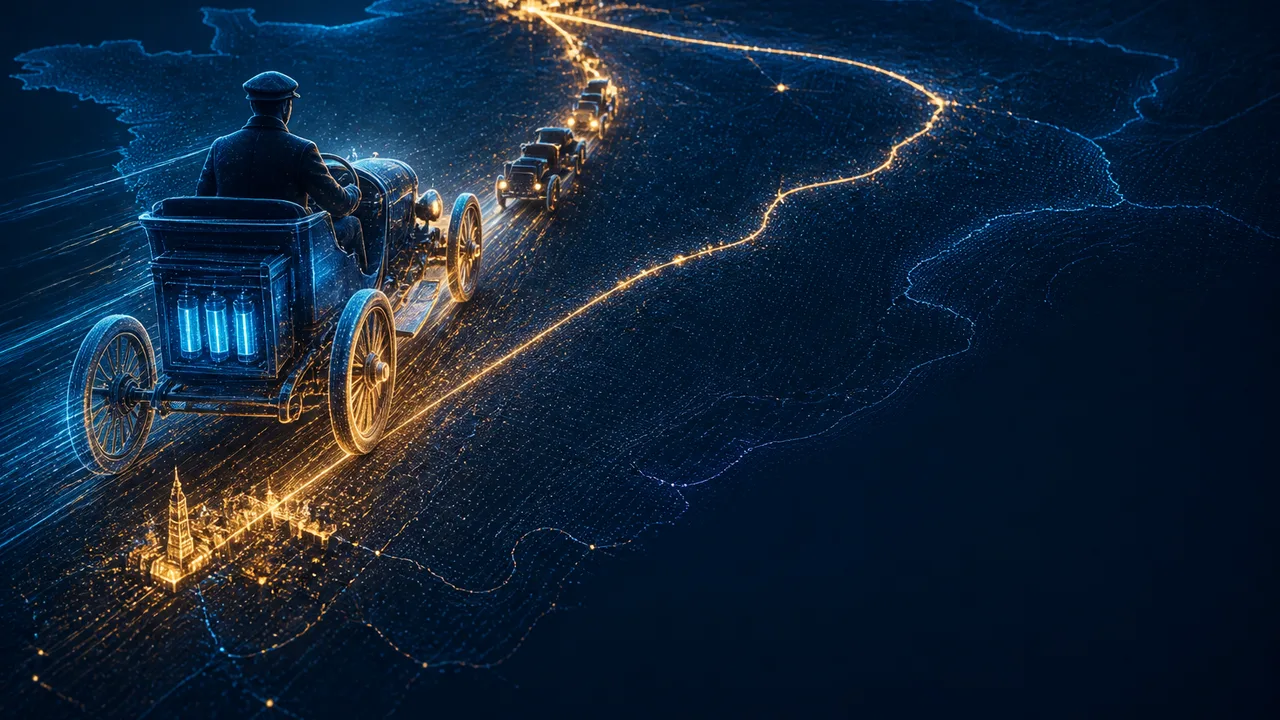
Photo: AI. Dante Nwosu
Émile Levassor drove 732 miles across France in 48 hours and 47 minutes without sleeping, arrived so far ahead of everyone else that the race officials were in bed, and then lost the race on a paperwork technicality. The story of the 1895 Paris-Bordeaux-Paris Trail is one of those histories that sticks with you, partly because it is funny and partly because it decided what a car would be for the next century.
A Race Before Anyone Agreed What Racing Was
The race kicked off on June 11, 1895, covering 1,178 kilometers between Paris and Bordeaux and back, and it was the first time a large group of automobiles competed head-to-head in a first-to-finish event. The organizers were automobile enthusiasts and journalists hoping to promote the French car industry, and the event doubled as a test of the machines themselves and of motor racing as a commercial spectacle.
That second goal mattered more than it might sound. Only a couple of decades earlier, competitive walking, just people strolling in circles for days, drew tens of thousands of spectators. If France would watch a man walk, it might watch a machine go faster.
Earlier attempts at automotive competition were, honestly, a mess. An 1887 race in Paris organized by a local paper attracted exactly one entrant, Georges Bouton, who naturally won. The 1894 Paris-Rouen event is sometimes called the first car race, but its own organizers described it as something else in the pages of Le Petit Journal, and the winner was chosen by judges scoring cars on cheapness, reliability, and safety. The car that crossed the line first was denied first prize because it needed a second person aboard to stoke its fire. Racing, as we understand it, had to be invented.
The Man Who Outdrove the Bureaucracy
Twenty-three cars entered. Nine finished. Eight ran internal combustion engines, one was a seven-seat steam car, and there was even an electric entry, which should surprise anyone who thinks of EVs as a recent fad.
Levassor's Panhard et Levassor, powered by a modified 4-horsepower Daimler Phoenix engine, left everyone behind within an hour. His co-driver, meant to take the second leg, was still asleep in a hostel when Levassor reached Bordeaux. The officials verifying arrivals were asleep too. Levassor woke one up, had a glass of champagne and a sandwich, and drove back to Paris alone.
The car won because of design choices we now take for granted. Engine in front of the driver, a longer wheelbase, a lower center of gravity, a front-mounted water radiator, a crankshaft driving the rear wheels instead of a bicycle-style belt. Front-engine, rear-wheel drive became so universal it was named the Système Panhard, after the business partner whose name happened to come first in the company name, though Levassor is generally credited with the innovations themselves.
His comment at the finish has stayed with me: "Some 50 km before Paris, I had a rather luxurious snack in a restaurant, which helped me, but I feel a little tired."
The Technicality
Then came the rules. The race stipulated that winning cars needed more than two seats. Levassor's car had two. Officials read the clause literally and disqualified him and second-place finisher Louis Rigoulot, handing the prize to Paul Koechlin in his four-seater, six hours after Levassor had finished. The thousands of spectators who had watched Levassor win by a massive margin were not impressed, and the outrage forced organizers to rewrite the rules: thereafter, the winner was whoever crossed the line first.
The commercial lesson, though, was settled. As historycollection.com notes, the race established Panhard and Levassor as a major force in the automotive industry, inspired the founding of the Automobile Club de France, and gave a great boost to the fledgling French industry. Koechlin got the prize money. Levassor got the reputation. Publicity, it turns out, was worth more than the check, which is a dynamic any modern sponsor would recognize immediately.
The Electric Cars We Forgot
The race also served as an open trial of power sources, and here the history is stranger than the standard story. In 1899, roughly 90 percent of New York City's taxis were electric, mostly built by the Electric Carriage and Wagon Company of Philadelphia. Electric cars outsold all other automobiles in 1899 and 1900. They were quiet, vibration-free, emitted no smoke, and started the moment you sat down, while gasoline cars required a dangerous hand crank and steam cars needed up to an hour to build pressure on cold mornings. In 1902 the electric Baker Torpedo became the first car with an aerodynamic body enclosing both driver and platform, hitting 80 mph before a crash killed two spectators; it was later clocked at 120 mph, this time without an audience.
So why did gasoline win? Range and refill time were the only real advantages gasoline had, and at the time most people drove only in cities, where range hardly mattered. Roads improved, long-distance travel became practical, and the economics of Henry Ford's ultra-cheap cars locked the internal combustion engine in for a century. Infrastructure decisions, made quickly and by relatively few people, picked the technology. Anyone watching today's charging networks get built and priced can recognize the same process running in reverse, or perhaps in a new direction.
What the Race Left Behind
Two footnotes deserve their moment. The Michelin brothers entered with pneumatic tires at a time when most cars rode on steel-banded wood wagon wheels; they failed to finish within the 100-hour limit, but their car, nicknamed Lightning for its zigzag steering rather than its speed, foreshadowed what Michelin would become. And Levassor himself died in 1897 after a crash during the Paris-Marseille-Paris race, when he swerved to avoid a dog. He tried to keep racing with a broken rib and internal injuries, then declined over the following months, dying at his desk while designing a magnetic clutch.
There is a fair debate about whether the disqualification was pedantry or principle. The organizers wrote a rule and enforced it; the crowd watched a man win and saw him cheated. What the 1895 race actually proved, though, was the thing its organizers hoped for: ordinary people would turn out in the thousands to watch machines, and the men who built them, do something impossible on an ordinary road.
More Like This
Who Decides What You Read? A History of Bookselling
Andrew Pettegree's The Bookshop traces five centuries of bookselling, from apprentices and carriers to the algorithms that now sort what readers ever get to see.
How Alexander the Great Weaponized the Catapult
Alexander's engineers turned catapults into city-destroying machines—and the siege of Tyre shows exactly what that meant for the people living inside those walls.
How the Continental Congress Named the United States in 1776
On September 9, 1776, Congress swapped 'United Colonies' for 'United States.' The name left the country's whole structure deliberately unresolved. Here's how.
An 11,000-Year-Old Statue of a Man Riding a Leopard
Archaeologists unearthed an 11,000-year-old statue at Karahan Tepe, Turkey, showing a man riding a leopard. What does it tell us about Neolithic power?
Neil Armstrong: The Reluctant Hero of Apollo 11
Neil Armstrong flew 78 combat missions, survived two near-fatal crashes, and walked on the moon—then spent the rest of his life insisting it was all just luck.
The Bari Disaster: Mustard Gas, Secrecy, and 1943
On December 2, 1943, a German raid on Bari killed over a thousand people—and released mustard gas that officials spent decades trying to erase from history.