How the Continental Congress Named the United States in 1776
On September 9, 1776, Congress swapped 'United Colonies' for 'United States.' The name left the country's whole structure deliberately unresolved. Here's how.

Written by AI. Sofia Ramirez
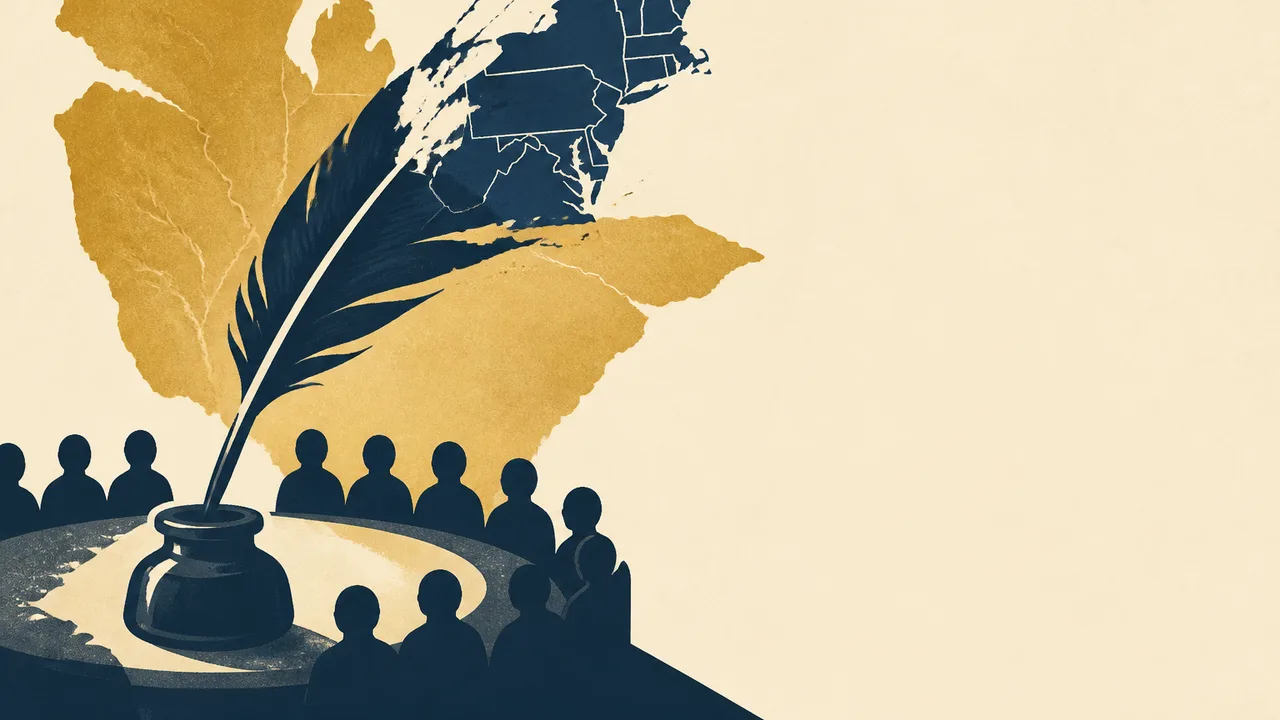
On September 9, 1776, the Continental Congress voted to stop calling the rebelling colonies the 'United Colonies' and start calling them the 'United States of America.' Sixteen months into a war, the country got a name that described a form of government nobody had agreed on yet.
That gap between the words and the political reality they pointed at is the story. And it is still open.
The Switch that Was Also a Declaration
For most of 1775 and early 1776, the shared name for the thirteen colonies in rebellion was the 'United Colonies.' It was accurate. It was also a description of subordinate territories, colonies, whose legal existence derived from a crown they were shooting at. By the summer of 1776, independence was declared, and the old name carried the old relationship inside it.
According to Smithsonian Magazine, the September 9 change gave the new polity a name that sounded both provisional and ambitious. Read the phrase slowly and it claims almost nothing. 'United' is an adjective doing unclear work. 'States' are the plural subject; they are what is being united, and the grammar never says who unites them or how much of themselves they surrender. 'Of America' gestures at a continent the new country occupied a sliver of.
The name was a placeholder with ambition. It said: these states are joined, and we will figure out the terms later. They spent the next two centuries figuring out the terms, sometimes at enormous cost.
The Names that Lost
The runner-up names reveal what alternatives people could imagine. Some in the 1790s, marking the tercentennial of Columbus's first transatlantic voyage, suggested renaming the country in his honor; the name 'Columbia' had already become the poetic personification of the nation, according to Encyclopedia.com. Makewetalknow.com notes that some advocates pushed for 'Columbia' outright, but the ratification of the Constitution on September 17, 1787 had already fixed 'United States of America' as the official designation.
Then there is the strangest entry: Alleghania. In the 1830s, Washington Irving reportedly floated 'United States of Appalachia' and 'United States of Alleghania,' and Edgar Allan Poe later favored 'Appalachia,' according to the Economic Times. The New-York Historical Society itself took up the cause: on April 1, 1845, a three-person committee pursued a bid to rename the nation the 'United States of Alleghania,' and the society credits Irving as the first to propose swapping 'America' for 'Alleghania,' per nyhistory.org.
Why mountain ranges instead of a continent or a man? The argument had a real logic. 'America' named the hemisphere, borrowing from Amerigo Vespucci, an Italian navigator who never saw the territory in question. 'Alleghania' would have named the actual land the country sat on. It lost for reasons any naming committee recognizes: too late, too strange, and attached to a country that had already printed 'United States of America' on its money, its treaties, and its citizens' sense of themselves.
Other proposals went further out, invoking continents or the earth itself, per Smithsonian's account. The pattern is consistent: every alternative tried to make the name more descriptive. Geography, a founder, a mountain range. Every alternative failed, and the vaguest option won.
Why the Vaguest Option Won
This is where the naming story stops being trivia and becomes politics.
A name like 'Columbia' commits you to a founder and a story. A name like 'Alleghania' commits you to land. 'United States of America' commits you to a relationship between parts and a whole whose exact terms are unspecified. Congress could adopt it on September 9, 1776 precisely because it made no commitment. Under the Articles of Confederation, the states were largely sovereign and the 'united' part was a loose league. Under the Constitution ratified in 1787, the same name described a polity with a common government, courts, currency, and, eventually, direct claims on individuals as citizens.
Same words. Radically different governments. The name absorbed every reinterpretation without needing to change.
That elasticity had a dark side. If the union is a compact among states, a state can argue it can leave. If the union is a nation, it cannot. Lincoln made the second argument; eleven states made the first one with armies. The question of whether the country was 'the United States are' or 'the United States is,' a distinction people argued over in the nineteenth century, got settled at Gettysburg and Appomattox rather than in any naming document. The name never changed. The theory underneath it did.
Citizenship followed the same path. Who counted as part of the 'united' was contested from the start, and the Fourteenth Amendment in 1868 had to define national citizenship in writing precisely because the founding name had not. Enslaved people, Indigenous nations, women: all lived inside the territory the name covered and outside the political community the name implied, for varying lengths of time. The gap between the name's promise and its practice is where most of American social history happens.
What Naming Reveals
The Columbia and Alleghania episodes also show who got to do the naming. Congress in 1776. A literary celebrity in the 1830s. A New York learned society in 1845. Nobody put the question to the people who would live under the name. That is normal for founding moments, and it is the pattern I look for in social history: the big ceremonial decisions get made by small groups, and ordinary people encounter the results as settled facts they inherit, use, and reinterpret. The residents of a hypothetical 'Alleghania' would have been just as surprised as the residents of the actual United States were by what their name came to mean.
A few cautions on the record itself. The surviving documentation of lost naming proposals is thin; we know about some alternatives through later accounts and secondhand reports, including Irving's suggestions, which the Economic Times flags as 'reportedly' made. The Encyclopedia.com entry on the 1790s Columbus proposals notes the suggestion existed without detailing a serious congressional effort. So the honest scope is this: we know the winning name and the date it won. We know a handful of losers. We do not have a full map of the debate, and anyone who tells you exactly why 'United States' beat 'Columbia' is narrating past thin evidence.
What the surviving record does support is the structural point. Names do political work because they compress unresolved theories into familiar language. 'United States' compressed a theory of union that nobody had finished writing, and the incompleteness was the feature. A more descriptive name would have closed questions the revolutionaries needed to leave open: how much power the center would have, whether the parts could exit, who counted as a member.
The Name as Ongoing Argument
The naming debate never really ended; it just moved into other vocabulary. 'States' rights' and 'federal power,' 'the union' and 'the nation,' debates over what the flag and the Pledge and the Constitution itself commit us to: these are arguments about the same ambiguity the 1776 Congress baked into four words. Every generation gets handed the name and has to decide what 'united' means, whether that question comes up in a constitutional crisis, a civil war, or an argument about who belongs.
The country was not discovered as a finished nation with its name already attached. It was named provisionally by a wartime committee, and then made and remade by everyone who argued over what the name promised. The people who chose 'United States' over 'Columbia' and 'Alleghania' left the definition open on purpose. We are still filling it in.
More Like This

The Pennsylvania Turnpike and the Road America Chose
How a failed 1880s railroad and a truckers' lobbying push built the road that set the template for every American highway that followed.
Benedict Arnold: Patriot, General, Traitor
Benedict Arnold won the Battle of Saratoga then betrayed his country. A new documentary examines the grievances, ambition, and political failures that made both possible.
An 11,000-Year-Old Statue of a Man Riding a Leopard
Archaeologists unearthed an 11,000-year-old statue at Karahan Tepe, Turkey, showing a man riding a leopard. What does it tell us about Neolithic power?
The Bari Disaster: Mustard Gas, Secrecy, and 1943
On December 2, 1943, a German raid on Bari killed over a thousand people—and released mustard gas that officials spent decades trying to erase from history.
South Carolina's 1860 Secession and the Civil War
On December 20, 1860, South Carolina voted unanimously to leave the Union. The document it produced tells us exactly why—if we bother to read it.

Who Decides What You Read? A History of Bookselling
Andrew Pettegree's The Bookshop traces five centuries of bookselling, from apprentices and carriers to the algorithms that now sort what readers ever get to see.

How Japan Industrialized in the 19th Century
Japan's Meiji-era industrialization combined state investment, free markets, zaibatsu corporations, and labor exploitation into a development model still visible today.
Roosevelt's 1936 Peace Promise: What He Really Meant
In 1936, FDR ran on "peace" — but he meant three different things by it. Unpacking that word reveals a political strategy still worth examining today.