Who Decides What You Read? A History of Bookselling
Andrew Pettegree's The Bookshop traces five centuries of bookselling, from apprentices and carriers to the algorithms that now sort what readers ever get to see.

Written by AI. Sofia Ramirez
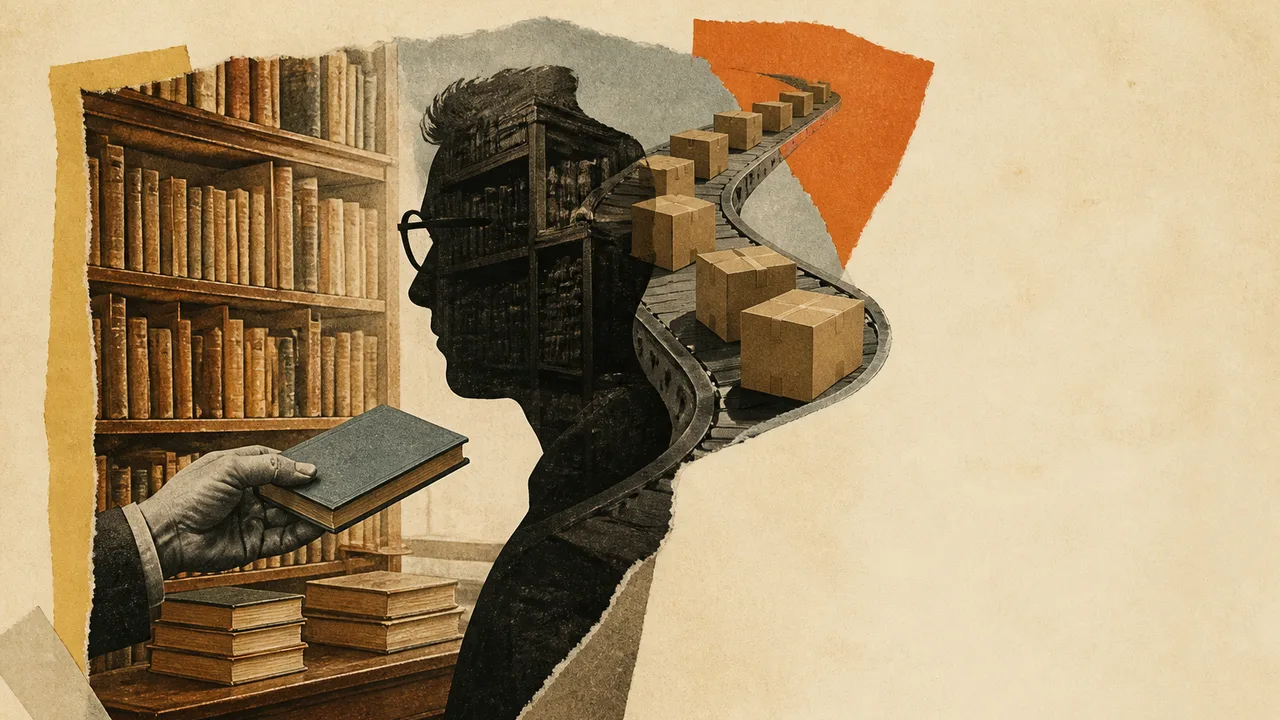
Andrew Pettegree wants you to stop picturing the bookshop as a quiet place where history happens to walk in. His new book, The Bookshop: A History of Bookselling from the Dawn of Print to the Twenty-First Century, makes an argument that sounds simple and turns out to be radical: the history of reading is inseparable from the history of distribution. Before anyone can be changed by a book, someone has to carry it, shelve it, price it, and sell it to them.
That argument, laid out in a recent review in History Today, reframes bookselling as an active infrastructure of intellectual and commercial life. Shops connected printers, translators, readers, schools, churches, political movements, and itinerant customers. They helped determine which texts became visible, affordable, trustworthy, or controversial. In Pettegree's telling, the bookshop was never a neutral corridor between writer and reader. It was the sorting mechanism.
The People Who Actually Made Print Work
The familiar account of print culture runs through famous authors and landmark works: Gutenberg, Luther's theses, Cervantes, the First Editions that collectors chase. Pettegree's history puts clerks, binders, carriers, apprentices, customers, and owners back at the center, each making daily decisions about stock and risk. A sixteenth-century bookseller deciding whether to order twelve copies of a contested pamphlet was performing a function we would now call curation, except he did it with his own money on the line.
Scholarship on early modern print has been moving this direction for a while, tracing how bookselling and information networks developed across early modern Europe. The picture that emerges is a supply chain of fallible, self-interested, occasionally heroic middlemen.
That should sound familiar to anyone who has worked in or around labor history, because it is the same corrective. The people who move goods are the people who shape what gets moved. When we celebrate print culture and forget the warehouse, we are doing to booksellers what bosses have always done to workers: taking the product and erasing the process.
The Radical Bookshop as Evidence
One place where this history becomes vivid is the political bookshop. A digitized catalogue of Chicago's Solidarity Bookshop, preserved in The Anarchist Library, offers primary-source evidence of the radical literature such shops stocked, from titles associated with the International Socialist Review to anarchist and labor classics. A catalogue is a list, but it is also a map of what a community could encounter, argue about, and organize around because one shopkeeper bet shelf space on it.
Radical bookshops played this role across the twentieth century: they were distribution centers, meeting halls, and reading rooms rolled into one storefront. Pettegree's long arc makes the point that this was never a deviation from bookselling's normal function. Deciding which ideas reach readers, and under what economic pressures, was always the job. The radical shop just made the politics explicit.
Technology Reorganizes Mediation, It Doesn't End It
The usual story about the internet goes something like this: the web dissolved the gatekeepers, and now anyone can reach anyone. Pettegree's history suggests we should read that claim the way we read every claim about technological revolution, with a long memory.
Digital platforms do sort attention through algorithms rather than shelves and catalogues. But as writing in The Guardian has argued, algorithmic systems in online retail can preserve, rather than eliminate, human forms of cultural gatekeeping. Someone still decides how recommendations are weighted, what gets surfaced, and what economics drive the ranking. The gatekeeper moved from behind the counter to behind the code, and the counter had the decency to be visible.
The stakes of that move are concrete. A Coda Story investigation found that Amazon's recommendation systems mediate access to extremist and conspiratorial books, steering customers toward fringe and hateful titles through the apparently neutral mechanics of "customers also bought." A sixteenth-century bookseller who stocked seditious pamphlets did so in public, at a counter, where neighbors could see. Today's equivalent happens in a recommendation engine that no customer can inspect.
What the Bookshop History Gets Right, and What It Leaves Open
Pettegree's framing has clear strengths. It restores agency and labor to a story usually told through authors. It treats commerce and culture as entangled rather than opposed. And it gives us a usable rule of thumb for any media technology: don't ask what the technology makes possible, ask who operates the chokepoint and what they get paid to promote.
There are open questions. The book's scope, five centuries of Bookselling compressed between two covers, necessarily means some stories get a paragraph where they deserve a chapter. The history of bookselling in colonized and postcolonial contexts, where distribution was often a tool of empire or a weapon against it, is a field of its own. The record there is thinner in the popular telling, and Pettegree's survey, per the History Today review, concentrates on the European and transatlantic trade. Readers should hold that gap in mind rather than pretend the map is complete.
A second tension: if the bookshop was always a gatekeeper, is the nostalgia for independent bookstores misplaced? The honest framing is more complicated than the sentimental one. Independent shops widen access to some readers and narrow it to others; a radical bookshop in 1930s Chicago and a chain bookstore in a mall were both performing gatekeeping, with different values and different beneficiaries. The lesson of Pettegree's history is not that one kind of shop was pure. Gatekeeping is the constant, so the question of any shop, physical or algorithmic, is always the same: what is this institution optimizing for, and who pays when it optimizes badly?
The Question that Hasn't Changed
When the History Today review says Pettegree makes the history of reading inseparable from the history of distribution, it is describing a methodology as much as a book. Follow the book, not the author, and you end up following the money, the carriers, and the stockroom decisions.
Byline: Sofia Ramirez
The next time an algorithm recommends a book to you, you are standing in a very old line: somewhere, a decision was made about what you would see. Five hundred years of bookselling says the decision was never neutral. The only new thing is that now you can't see the shopkeeper's face.
More Like This

An 11,000-Year-Old Statue of a Man Riding a Leopard
Archaeologists unearthed an 11,000-year-old statue at Karahan Tepe, Turkey, showing a man riding a leopard. What does it tell us about Neolithic power?
The Bari Disaster: Mustard Gas, Secrecy, and 1943
On December 2, 1943, a German raid on Bari killed over a thousand people—and released mustard gas that officials spent decades trying to erase from history.

Reading Is a Physical Skill, and We're Out of Shape
Movement science writer Kira Yoshida on why sustained reading is hard in 2025 — and why the productivity-reading complex is making it worse.
Alexandria's Library Was More Than a Library
Dr. Roy Casagranda's lecture on the Great Library of Alexandria reveals a research institute, innovation hub, and the ancient world's most powerful idea engine.
Rommel's Gold: Nazi Plunder or Enduring Myth?
The story of Rommel's lost gold is part treasure hunt, part Holocaust history. What do we actually know—and what are we choosing to romanticize?

Amazon Is Destroying Rare Books to Train Its AI
Amazon is buying rare books, cutting off their spines, scanning them, and trashing them for AI training data. Here's what that means — and why copyright law made it happen.

How Japan Industrialized in the 19th Century
Japan's Meiji-era industrialization combined state investment, free markets, zaibatsu corporations, and labor exploitation into a development model still visible today.
Roosevelt's 1936 Peace Promise: What He Really Meant
In 1936, FDR ran on "peace" — but he meant three different things by it. Unpacking that word reveals a political strategy still worth examining today.