Benedict Arnold: Patriot, General, Traitor
Benedict Arnold won the Battle of Saratoga then betrayed his country. A new documentary examines the grievances, ambition, and political failures that made both possible.

Written by AI. James Morrison
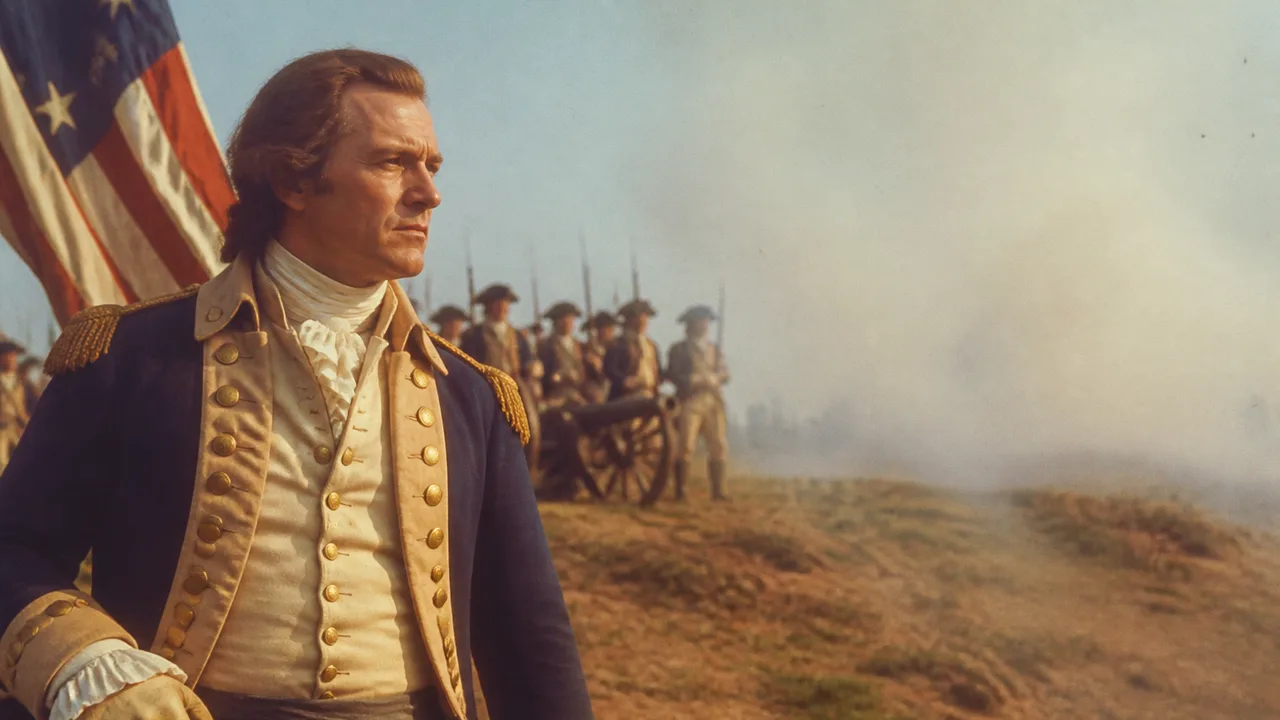
Photo: AI. Nikolai Brandt
There is a monument at the Saratoga National Historical Park that commemorates the most consequential military performance of the American Revolutionary War. It depicts a boot — just a boot, no name attached — in honor of the leg shattered on that battlefield in October 1777. The inscription reads: "in memory of the most brilliant soldier of the Continental Army who was desperately wounded on this spot, winning for his countrymen the decisive battle of the American Revolution and for himself the rank of major general."
The man who earned that tribute went on to betray the country he'd bled for. His name, of course, was Benedict Arnold. And the monument's studied anonymity tells you everything about the problem historians have never quite solved: how do you account for a man who was, in the same lifetime, genuinely indispensable and genuinely treasonous?
A new documentary from The People Profiles runs nearly an hour wrestling with that question, and it earns its runtime. This is a careful, well-researched biography that resists the temptation to flatten Arnold into either martyr or monster — a temptation that, it should be said, is considerable on both sides.
The Making of a Soldier
Arnold's path to the Continental Army was shaped less by ideology than by grievance, which is itself worth noting. Born in Norwich, Connecticut, in 1741, he came from a family that had seen prosperity collapse in real time. His father, a once-wealthy merchant, drank the family fortune into ruin and died with his reputation destroyed. Arnold, still a teenager, was left to rebuild from the foundation.
He did. By the early 1770s, he was a successful merchant and sea captain, addressing the inequities of British trade policy the way most Connecticut merchants did — by smuggling. When a sailor threatened to inform on him, Arnold and associates responded with a flogging. He was fined, not jailed, and rather than apologizing, he reframed the informer as the real villain. The pattern — perceived injustice met with disproportionate, self-righteous response — would repeat itself with consequences of an entirely different magnitude.
By 1774, Arnold was a prominent leader of New Haven's Sons of Liberty. When the first shots of the war were fired at Lexington and Concord in April 1775, he was already captain of the local militia. His response was immediate and characteristically aggressive: he threatened to storm a town meeting that refused to supply his men with weapons, then marched toward the fight.
The Soldier No One Wanted to Credit
What Arnold accomplished in the first three years of the war is, by any honest accounting, remarkable. He co-led the capture of Fort Ticonderoga in May 1775, led a grueling expedition through the Maine wilderness to besiege Quebec — where he was wounded in the leg — and then commanded the American fleet on Lake Champlain in 1776, buying the Continental Army the winter it needed to survive. The documentary makes the case, convincingly, that without Arnold's strategic deception at Valcour Island — he knew he couldn't win, bluffed aggressively to delay the British advance, and accepted tactical defeat to win strategic time — there may have been no Saratoga, and without Saratoga, no French alliance, and without France, no Yorktown.
Then came Saratoga itself. In September and October of 1777, Arnold was serving under General Horatio Gates, a commander whose relationship with Arnold had curdled into open hostility. Gates stripped Arnold of his command after the first battle at Freeman's Farm on September 19th — a fight that Arnold had largely directed without authorization, and which Gates refused to credit in his report to Congress.
When the decisive engagement came on October 7th, Arnold was technically without a command. He rode into the battle anyway. According to the documentary, he personally directed the assault that broke the British line, ordered the rifleman who mortally wounded British General Simon Fraser, and led the charge on the Breymann Redoubt before taking a musket ball in the same left leg wounded at Quebec. Gates's subsequent report to Congress credited him for the redoubt assault. It did not mention that Arnold had ordered the general attack.
Burgoyne surrendered ten days later. France entered the war. The Revolution survived.
Philadelphia and the Unraveling
Congress, which had repeatedly passed over Arnold for promotion and dismissed his seniority, hailed Gates as the hero of Saratoga. Arnold, convalescing with his left leg set in a wooden cast — the injury left the limb two inches shorter than his right — received his seniority elevation by private letter, with no public acknowledgment.
Washington appointed him military commandant of Philadelphia in 1778. It was, the documentary observes, the worst decision of his career.
Arnold in Philadelphia was a man of expensive tastes and legitimate resentments operating in an environment designed to produce exactly the kind of corruption his enemies were already accusing him of. Pay across the Continental Army was years in arrears. Arnold engaged in private business ventures to cover his expenses. None of it was illegal. Most of it was unseemly. Pennsylvania's Governor Joseph Reed made it his personal mission to destroy Arnold through a series of corruption charges.
Into this climate arrived Peggy Shippen — 18 years old, daughter of a loyalist judge, and previously acquainted with British intelligence officer Major John André during the British occupation of the city. Arnold married her in April 1779. The documentary notes, with appropriate care, that Peggy "may have influenced Arnold's future career trajectory." That hedge is honest; the historical record is genuinely ambiguous about the extent of her role.
What is not ambiguous is what followed. Arnold made contact with the British through an intermediary, negotiated terms with André, lobbied to take command of West Point, and spent the better part of 1780 planning to hand it over. The plot unraveled on September 23rd, when militia intercepted André attempting to return to British lines and found the incriminating papers in his stockings. André was hanged on October 2nd. Arnold, warned of the arrest minutes before Washington arrived for breakfast, escaped down the Hudson to New York.
According to Wikipedia's account of the episode — corroborated by the documentary — Washington's reaction when he finally read the recovered documents was as much personal as strategic. He reportedly said: "Arnold has betrayed me. Whom can we trust now?"
What the Boot Doesn't Say
The rest of Arnold's life has a grim, diminishing arc. He led British raids into Virginia and later into Connecticut, burning New London near his own hometown — a detail the documentary presents without editorial comment, which is the right call. It speaks for itself. After Cornwallis surrendered at Yorktown in October 1781, Arnold sailed to London, urged the British government to continue the war, and found that governments, like armies, have little use for turncoats once the crisis passes. He spent his remaining years trading in Canada and the Caribbean, captured once by the French who reportedly debated selling him back to the Americans. He died in London in 1801.
The documentary's framing — was he a brilliant soldier with legitimate grievances, or a vain man who put himself above the cause? — is a reasonable question, but it may be slightly the wrong one. Both things were true, and their coexistence is the actual subject worth examining.
The Continental Army's treatment of Arnold was genuinely disgraceful by any institutional standard. Repeated promotion denials, denied seniority, a public court-martial reprimand for a man who had bled twice for the cause — these were not minor slights. Armies that treat their best officers this way tend to lose wars. The American army was saved, in part, by the fact that Arnold's plot failed.
But grievance, however legitimate, does not constitute justification for treason. Arnold's raids against his former countrymen — particularly the burning of New London — were not the acts of a principled man settling accounts with a corrupt system. They were the acts of someone who had, at some point, crossed from disillusionment into something harder to name.
The Boot Memorial names that something by refusing to name the man. You can honor the wound and the bravery while declining to honor what came after. Whether that constitutes justice or evasion probably depends on what you think the purpose of history is.
More Like This
Douglas MacArthur and the People He Left Behind
MacArthur is remembered as a military legend. But what about the veterans he gassed, the soldiers he abandoned, and the Japanese citizens who built a new democracy?
FBI's Struggle Against Omega 7: A Tale of Terrorism and Intrigue
Explore the FBI's complex investigation of Omega 7, a Cuban exile terrorist group, amid community challenges and evolving tactics.
Sitting Bull: Warrior, Mystic, and Military Strategist
From Hunkpapa war chief to victor at Little Bighorn—the life of Sitting Bull reveals a leader whose complexity American history has rarely done justice.
Attila the Hun: Scourge of God or Economic Strategist?
Attila never sacked Rome—yet he's history's ultimate barbarian. The real story is stranger, and more familiar, than the legend.
George Bell: The MVP Baseball Forgot to Understand
Jon Bois's Secret Base portrait of George Bell reveals an AL MVP shaped by Dominican exploitation, media warfare, and a flying kick that changed baseball history.
Rommel's Gold: Nazi Plunder or Enduring Myth?
The story of Rommel's lost gold is part treasure hunt, part Holocaust history. What do we actually know—and what are we choosing to romanticize?

Ray Dalio's Framework for Tracking Empire Decline
Ray Dalio argues empires follow measurable, repeating cycles of rise and fall. His framework deserves scrutiny—and raises questions relevant to today's geopolitics.
April 1865: How the Civil War's End Was Decided
The History Channel's documentary on April 1865 examines how decisions made in a single month determined whether the Civil War's end would bring peace or prolonged guerrilla conflict.