The Pennsylvania Turnpike and the Road America Chose
How a failed 1880s railroad and a truckers' lobbying push built the road that set the template for every American highway that followed.

Written by AI. Margaret "Maggie" Holloway
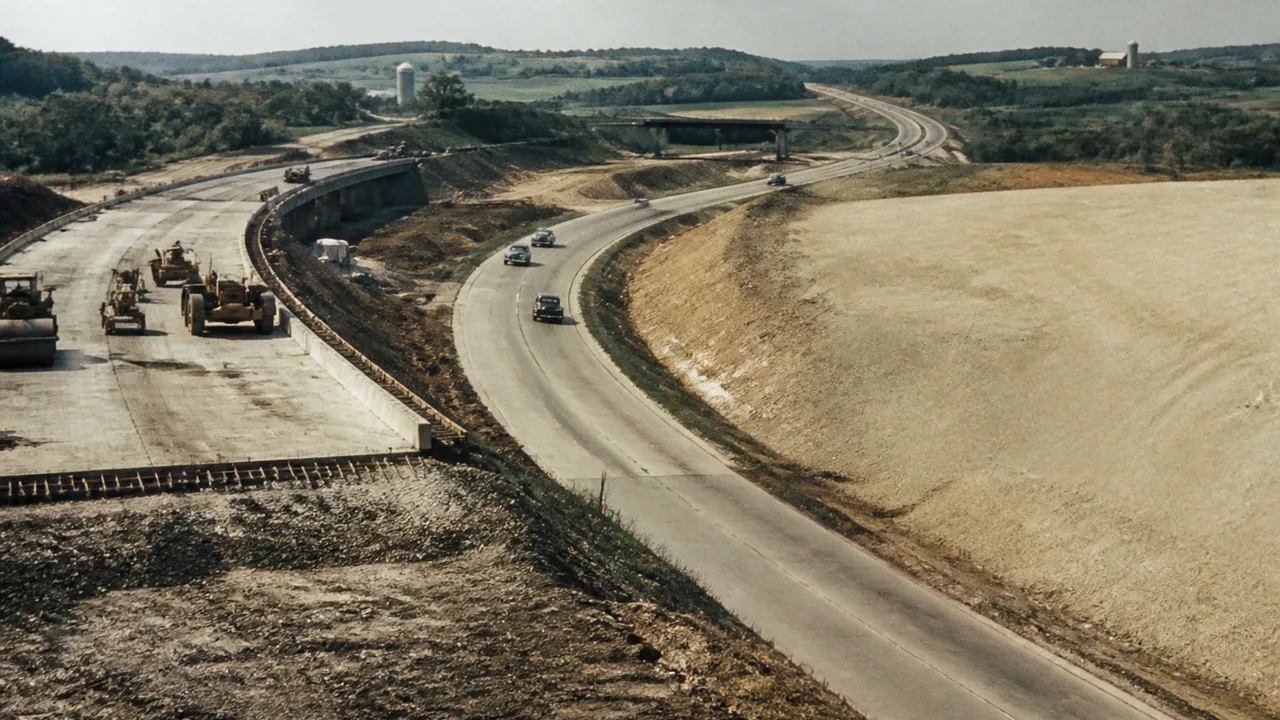
Photo: AI. Marcel Dubois
The mountains that made Pennsylvania were also the mountains that made Pennsylvania's transportation history worth telling. The Alleghenies sit across the middle of the state like a spine, and for most of American history, getting goods or people across them was a negotiation between engineering ambition and geological stubbornness. Canals came first. Then railroads. Then, in 1940, something nobody had quite seen before: a four-lane, limited-access, all-concrete highway that invited drivers to go fast, go far, and stop for a Howard Johnson's meal on the way.
The Pennsylvania Turnpike, now carrying the brand "America's First Superhighway," did not begin as a transportation revolution. It began as a business dispute.
The Tunnels That Wouldn't Stay Buried
In the 1880s, a consortium that included Andrew Carnegie, John D. Rockefeller, and railroad baron William Henry Vanderbilt decided the Pennsylvania Railroad had too tight a grip on freight rates across the state. Their solution was to build a competing rail line, the South Pennsylvania Railroad, which would require punching several tunnels through the Allegheny ridges. They bored them, or started to, and then in 1885 the Pennsylvania Railroad and the Vanderbilt interests reached a private rate agreement that satisfied the major backers.
The tunnels were abandoned. The easements reverted to the Commonwealth.
As the Geographics video covering this history puts it, these men "were so unthinkably, ruinously rich that they paid to punch half a dozen holes into a mountain and then wrote the whole thing off when they were offered a slightly better deal." The phrasing is comic, but the underlying fact is genuinely strange: the physical infrastructure that would eventually carry millions of American drivers across the Alleghenies sat idle and forgotten for nearly five decades because three of the wealthiest men in the country found a more convenient arrangement.
The tunnels re-entered the story in the 1930s, when a man named William Sutherland, representing Pennsylvania's Motor Truck Association, brought a proposal to state legislator Cliff Patterson. Sutherland had driven those mountain roads. He knew what they were. His proposal, which Patterson authorized the Works Progress Administration to study, suggested that a new highway could follow the long-dead South Pennsylvania Railroad's route and use the abandoned tunnels it had left behind. The WPA found the plan feasible. The estimated cost for nearly 200 miles of new road was in the area of $70 million.
Patterson introduced a bill creating the Pennsylvania Turnpike Commission in 1936. The following year it became law, and by June 1938 construction financing was in place, assembled from bond issues, federal WPA grants, and Commonwealth contributions. The funding structure mattered: by reducing the bond issue from $60 million to $20 million through government grants, the Commission minimized its financial exposure and demonstrated solvency to lenders.
Building the Road
The design specifications the Commission settled on were, at the time, radical. Per the FHWA's historical record, the turnpike became "the first long-distance stretch of four-lane, limited-access (i.e., high speed) highway in the United States." The right-of-way was 200 feet wide. Lanes were 12 feet across, the standard still in use across most of America today. No grade on the route would exceed 3 percent. No cross streets. No at-grade railroad crossings. No traffic signals.
That last point is worth sitting with. Other states developing similar plans in the late 1930s proposed stoplights at entrance ramps, or even railroad-crossing-style gates that admitted one car at a time onto the highway. Pennsylvania chose merging at speed, borrowed from the German Autobahn concept. That decision shaped every on-ramp you have ever used.
Over 150 companies from 18 states ultimately worked on the project. By early 1940, roughly 15,000 workers were on site. They built not only the road but 10 ticket exchanges and 10 service plazas, the latter leased to Standard Oil for fuel and to Howard Johnson's for food. Each plaza cost about half a million dollars to construct. The original section, running 162 miles from Middlesex to Irwin, opened on October 1, 1940, just 23 months after construction began.
The Road Nobody Expected
The turnpike's planners expected trucks and commercial traffic. They got tourists.
Drivers in 1940 and 1941 treated the new highway the way a later generation would treat a national park. They pulled onto the wide shoulders to picnic. They spread blankets in the median. They admired the decorated tunnel entrances and gaped at mountain views that had previously required either a train ticket or a grueling mountain road. The Geographics account describes the turnpike serving a role "similar to that of Skyline Drive in Virginia or the Taconic Parkway in New York's Hudson River Valley," with "motoring" as a leisure activity in its own right.
The Commission did not sanction picnicking in the median. It also did not initially do much to stop it. Cars of the early 1940s were slow enough that the danger was limited. Then Pearl Harbor was attacked, rationing began, and the turnpike's character shifted entirely to wartime commercial and military use. Pleasure driving was not merely discouraged; it was socially impermissible.
The postwar boom brought the tourists back, and this time in numbers that made median picnics actively dangerous. The Commission began enforcing shoulder regulations and eventually constructed median barriers. Speed limits, originally absent except in the tunnels, became a systemwide reality. The road that had felt open and permissive in 1940 acquired, through accumulated necessity, the regulatory architecture familiar to any modern driver.
Extension, Negotiation, and One Very Unusual Staircase
The years after the war produced extensions west to the Ohio state line, completed in late 1951, and east toward Philadelphia, completed in stages through the late 1950s. The Delaware River Bridge, connecting Pennsylvania and New Jersey, followed a years-long joint venture and was completed in 1956.
Eastward expansion through eminent domain was largely straightforward, except in New Baltimore, Pennsylvania, where the Catholic Church of St. John the Baptist held land that included a cemetery. State law prohibited condemning cemetery land through eminent domain. The compromise the Commission reached is one of the stranger footnotes in American infrastructure: they built a stone staircase from the turnpike shoulder up the mountain to the church, and a corresponding staircase on the opposite side of the road, connected by an elevated walkway. Motorists could park, attend Mass, and return to their journey. The stairs are now closed but still visible from the road, along with the church itself.
That detail is not incidental. It is a small, legible record of what eminent domain can and cannot touch, and of the negotiation between a powerful public agency and an institution it could not simply roll over.
On July 5, 1953, Pennsylvania state trooper Manley Stampler pulled over a late-model Chrysler New Yorker that had been camped in the left lane near Bedford, holding up traffic while traveling at exactly 55 mph. The driver was Harry Truman, seven months out of the presidency. His wife Bess, by Truman's account, would not permit him to exceed the speed limit by a single mile per hour, which had also prevented him from finding an opening to move right. Whether Stampler issued a citation is disputed; Stampler said he did not. It remains, the Geographics video notes, "the only known such incident involving a former American president."
What the Road Became
The Pennsylvania Turnpike Commission's own history describes a road that shaped the towns and cities that grew up around it, creating "economic development opportunities throughout" the commonwealth. That is accurate as far as it goes, but the Pennsylvania Center for the Book at Penn State offers a useful corrective to any founding-document triumphalism: "The planners of the Pennsylvania Turnpike did not originally intend to revolutionize transportation in the United States." They intended to move trucks across the Alleghenies more efficiently.
The revolution was a byproduct, and it had costs that the turnpike's boosters preferred not to foreground. Roads, as the Geographics video notes with some care, can be racist, and the Interstate system that the turnpike helped inspire did not distribute its benefits equally. The highway builders of the postwar era made choices about whose neighborhoods to route through, whose communities to sever, and whose needs to subordinate to the movement of traffic. The Pennsylvania Turnpike predates the full Interstate system and is not the site of the most egregious of those decisions, but it belongs to the same tradition of infrastructure that treated mobility as a value worth imposing on the landscape, regardless of what the landscape already contained.
Today the turnpike carries sections of four Interstate highways and still runs through the remaining tunnels it inherited from the South Pennsylvania Railroad. Three tunnels were bypassed and abandoned in the 1960s; the remaining ones are now under periodic consideration for replacement as well. The road once marketed as the "Highway of Tunnels" may eventually have no tunnels at all.
The service plazas that Howard Johnson's built in stone, designed to reflect local Pennsylvania Dutch architecture, have been rebuilt into the standardized fast-food configurations that franchise agreements require. The ticket exchange workers who once told drivers about weather conditions ahead have been replaced by electronic scanners. Steadily rising tolls have pushed some traffic onto toll-free alternatives through Maryland and West Virginia.
The turnpike is now in its mid-eighties, perpetually under construction somewhere, and experimenting with electric vehicle charging infrastructure at its plazas. The road that began as a shortcut across mountains nobody wanted to cross is still there, still collecting tolls, still trying to justify itself to a driving public that has options its 1940 counterpart never did.
The Alleghenies have not moved. Everything else keeps changing.
More Like This
Driving Patagonia's Route 40: What Van Life Actually Looks Like
Kara and Nate drove 2,000 miles across Patagonia in 8 days. What they found reveals the gap between van life mythology and Patagonian reality.
New York City's Underground Infrastructure Explained
From gravity-fed water tunnels to steam pipes and subway lines, NYC's underground is a century-deep tangle of engineering decisions—brilliant, broken, and still evolving.

Venice Is Sinking and Emptying at the Same Time
Venice faces two accelerating crises: rising seas and a vanishing population. Neither MOSE nor a €5 tourist fee comes close to solving either one.
Colombia's Ituango Dam: Ambition Meets Disaster
Explore the failure of Colombia's Ituango Dam, a $4BN project that faced engineering, political, and socio-economic challenges.
Belzoni's Tomb: The Strongman Who Found Seti I
Giovanni Belzoni was a circus strongman who became Egypt's greatest explorer. His 1817 discovery of Seti I's tomb rewrote what we knew about the ancient world.
Hampton Roads Bridge-Tunnel: Engineering Marvel Revisited
Explore the expansion of the Hampton Roads Bridge-Tunnel, a pioneering infrastructure project in Virginia, featuring advanced engineering techniques.
The Invisible Inventions That Built Modern Life
From flush toilets to undersea fiber cables, the inventions that most shaped modern civilization are the ones we've stopped noticing entirely.
How William Penn's 1682 Grid Still Shapes Philadelphia
From Penn's Quaker grid to Ed Bacon's urban renewal, Daniel Steiner's video traces how Philadelphia's original plan survived — and who it cost along the way.