Nikola Tesla and the Cost of Inventing Without a Business Plan
Tesla's AC motor and Tesla coil changed the world, but his finances never recovered. A look at the inventor's life, the Edison rivalry, and what he left behind.
Written by AI. Margaret "Maggie" Holloway
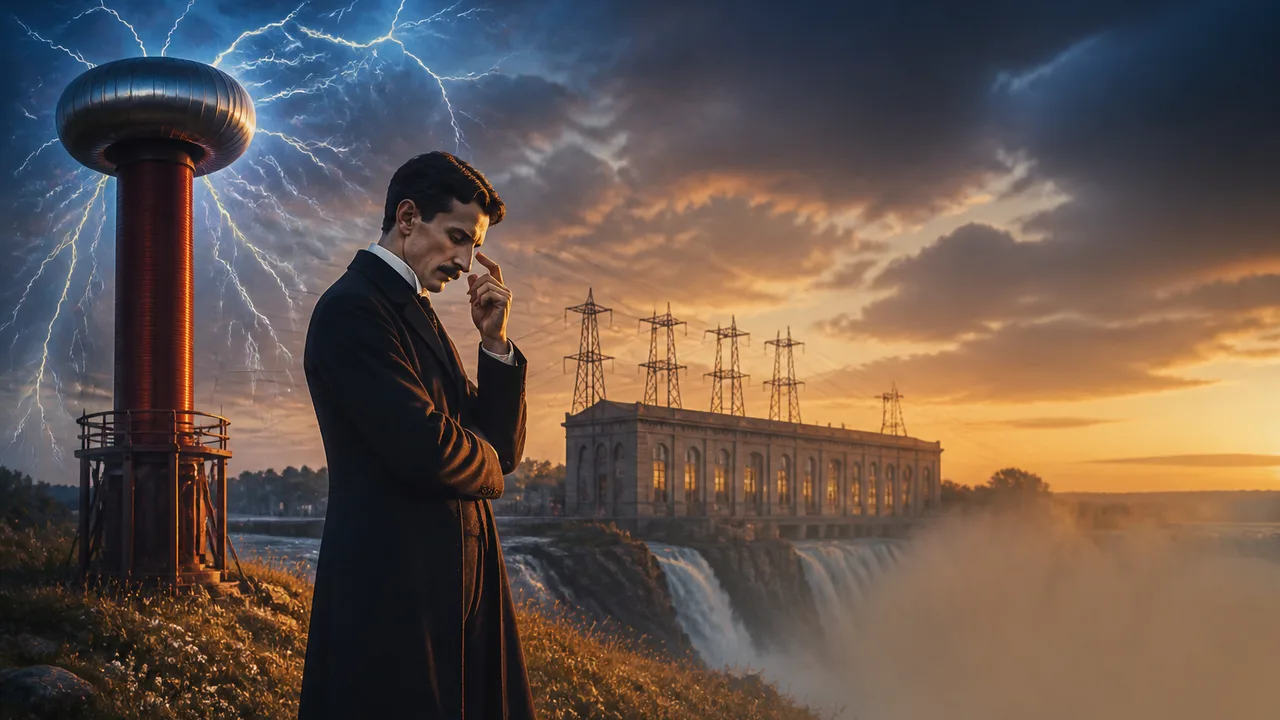
Photo: AI. Asha Kingsley
Nikola Tesla was born on July 10, 1856, in the village of Smiljan, in a corner of the Austrian Empire that sits in modern-day Croatia. According to Astronomy Magazine, his mother was in labor during a lightning storm, and the midwife took the flashes as a bad omen. Tesla's mother disagreed, proclaiming that he would be "a child of light." If you like your biographies with tidy openings, that one is hard to beat, and Biographics leans into it in their video on his life (youtube.com).
But the storm story is the embellishment. The rest of Tesla's life needs no embellishment, and it is more useful to read as a study in what happens when a first-rate technical mind meets a second-rate grasp of commerce. Every electrical system you touch today runs through decisions Tesla made and, just as often, through money he lost.
A Mind Trained to Breaking Point
Tesla credited his memory to his mother, who could recite entire epic poems and built mechanical gadgets for the household. His father was an Eastern Orthodox priest. The boy, for his part, claimed to see flashes of light before ideas arrived, visions the Biographics account connects to a darker memory: at age five, Tesla watched his older brother Dane die in a horse-riding accident.
The school record is strange. At the higher real gymnasium, teachers accused him of cheating because he performed integral calculus in his head. He finished in three years instead of four. At the Austrian Polytechnic, he worked from 3 a.m. to 11 p.m., holidays included, and passed twice the required exams in his first year. His body and the scholarship both gave out in year two. He gambled, lost his tuition, skipped his finals, never graduated, fled to Maribor to draw drafts, and was eventually hauled home after being arrested over a residence permit. His family pooled money to send him to Prague; he arrived too late to enroll.
So the man who redesigned the modern electrical grid held no degree. That fact does not appear in many admiring school assemblies.
The Induction Motor, Sketched in Dirt
In 1881, working for the central telephone company in Budapest, Tesla went for a walk in the park with a friend and suddenly saw the design of an induction motor. He picked up a stick and drew it in the dirt. He built a prototype, but European investors showed little interest.
The move that mattered was to New York. Tesla had joined the Continental Edison Company in Paris, and in 1884 he was recruited to work directly for Thomas Edison. Tesla's own account of Edison is a small masterpiece of backhanded portraiture: "his existence was made up of alternate periods of work and sleep in the laboratory... he lived in utter disregard of the most elementary rules of Hygiene." Edison, in other words, was Tesla with worse habits and better instincts for publicity.
The partnership lasted six months. The story Tesla told involves a $50,000 bonus offered for redesigning certain machines, which Tesla completed and was then refused, with Edison reportedly telling him, "Tesla, you don't understand our American humor." It is still unclear, as the Biographics video concedes, whether the AC/DC disagreement or the refused bonus drove the split; the record is thin and both men had reasons to shape it. What is not unclear is what came next: Tesla dug ditches for two dollars a day. "My high education in various branches of science, mechanics and literature seemed to me like a mockery," he said of that period.
What Westinghouse Bought
Here is the structural fact of Tesla's career: his ideas became historically decisive exactly when someone else handled the money. In 1887, according to biography.com, he found funding for the Tesla Electric Company and filed several AC-related patents by year's end. Then he published a paper, "A New System of Alternating Current Motors and Transformers," and George Westinghouse read it. Westinghouse licensed Tesla's induction motor patents, as Britannica notes, buying the rights to his system of AC dynamos, transformers, and motors, and hired him as a consultant in Pittsburgh.
The timing mattered. Edison was waging a public campaign claiming AC was unsafe, while Westinghouse, his company under financial strain, needed a proven system. The 1893 Columbian Exposition in Chicago, lit by Westinghouse with Tesla demonstrating AC to the public, and the Niagara Falls hydroelectric plant, which sent power to Buffalo based on Tesla's design, settled the argument about how America would be electrified. history.com puts it plainly: Tesla invented the first AC motor and developed AC generation and transmission technology, and was famous and respected for it.
The Tesla coil, patented in 1891, pushed further into wireless transmission, and descendants of the design still turn up in radio and television circuitry.
Marconi, Morgan, and the Tower
Then the pattern reversed. Tesla wanted to transmit power and messages wirelessly and persuaded J. Pierpont Morgan to put up $150,000 for a transmission tower. Marconi got there first; Morgan and other investors pulled their money; Tesla abandoned the project in 1906, mortgaged the property, and watched the tower go to foreclosure and demolition in 1917. He sued Marconi, arguing his ideas had been taken. Along the way he ran up hotel bills at the Waldorf-Astoria, spending roughly $20,000, nearly half a million today, in a short stay.
This is where the popular narrative of the lone visionary betrayed by a philistine world starts to wobble. Morgan invested once, in wireless messaging, which looked like a business. Tesla's larger dream, wireless power, had no answer to the obvious investor question: how do you bill for it? Marconi's system, however derivative, had a commercial model. Tesla, for all his brilliance, largely did not, and the Biographics account makes that the through-line of his failures, from the pulled backers of 1886 to Wardenclyffe.
A Difficult Man, Honestly Drawn
The video does not flatter its subject, and neither should we. Tesla claimed to sleep two hours a night, refused marriage ("I do not think you can name many great inventions that have been made by married men"), and used eighteen napkins per meal after his brush with cholera in 1873 left him germaphobic for life. His 1924 comments on women, in which he mourned the passing of the "soft voiced gentle women of my reverent worship" and complained that modern women made themselves "as much as possible like man," have aged about as well as you would expect a pedestal to age.
And then there is the pigeon. Tesla fed thousands of New York's birds and loved one white female in particular. "I loved that pigeon as man loves women," he said, "and as long as I had her there was purpose to my life." When she was injured, he built a device to heal her wing and leg. It is the most human detail in the whole record, and also the saddest.
What the Record Actually Shows
A maid found Tesla's body in his New York hotel room in January 1943, behind a Do Not Disturb sign that had hung for 48 hours. He died of coronary thrombosis at 86, having invented well into his seventies.
The honest reading of his life sits between the two available caricatures. He was no fool whom capitalism failed; he made shrewd choices, allied with Westinghouse at the right moment, and cashed licensing checks that kept his lab running for years. He was also no pure businessman-done-wrong; he mortgaged his future repeatedly, alienated funders, and pursued projects he could not pay for. history.com notes that, unlike Edison, he never translated his inventions into long-term financial success.
Infrastructure remembers. Walk past a hydroelectric plant, charge anything at a wall socket, and you are handling Tesla's design decisions. The man himself died broke in a hotel room.
More Like This
Venice Is Sinking and Emptying at the Same Time
Venice faces two accelerating crises: rising seas and a vanishing population. Neither MOSE nor a €5 tourist fee comes close to solving either one.
Colombia's Ituango Dam: Ambition Meets Disaster
Explore the failure of Colombia's Ituango Dam, a $4BN project that faced engineering, political, and socio-economic challenges.
Farmelo's Hawking Biography Refuses to Sanctify Genius
Graham Farmelo's new Hawking biography pairs scientific achievement with an unflinching look at the physicist's behaviour, and asks who benefits from myths of genius.

Spark Plugs and the Knowledge We Forgot to Keep
Angela Collier's video about a 1960 Popular Science article is really about how technology quietly erases knowledge — and what fills the void.
How Panasonic Lost Its Place in the Consumer Market
Panasonic still generates over $50 billion in annual revenue — but almost none of it comes from the products that made it a household name. Here's how that happened.
The War of the Currents: AC vs DC History
The War of the Currents was won on physics, not propaganda. A look at how Edison, Westinghouse, and Tesla shaped the electrical grid we still live with today.
Savannah's Urban Grid: A Utopia Built on Slavery
Savannah, Georgia was designed as an egalitarian utopia in 1733. What it became reveals how idealism and slavery shaped one of America's most walkable cities.
Ten Engineering Projects That Remade the World
From the Panama Canal to the International Space Station, ten engineering feats that didn't just solve problems — they rewrote what was thought possible.