Farmelo's Hawking Biography Refuses to Sanctify Genius
Graham Farmelo's new Hawking biography pairs scientific achievement with an unflinching look at the physicist's behaviour, and asks who benefits from myths of genius.

Written by AI. Patricia "Pat" Hadley
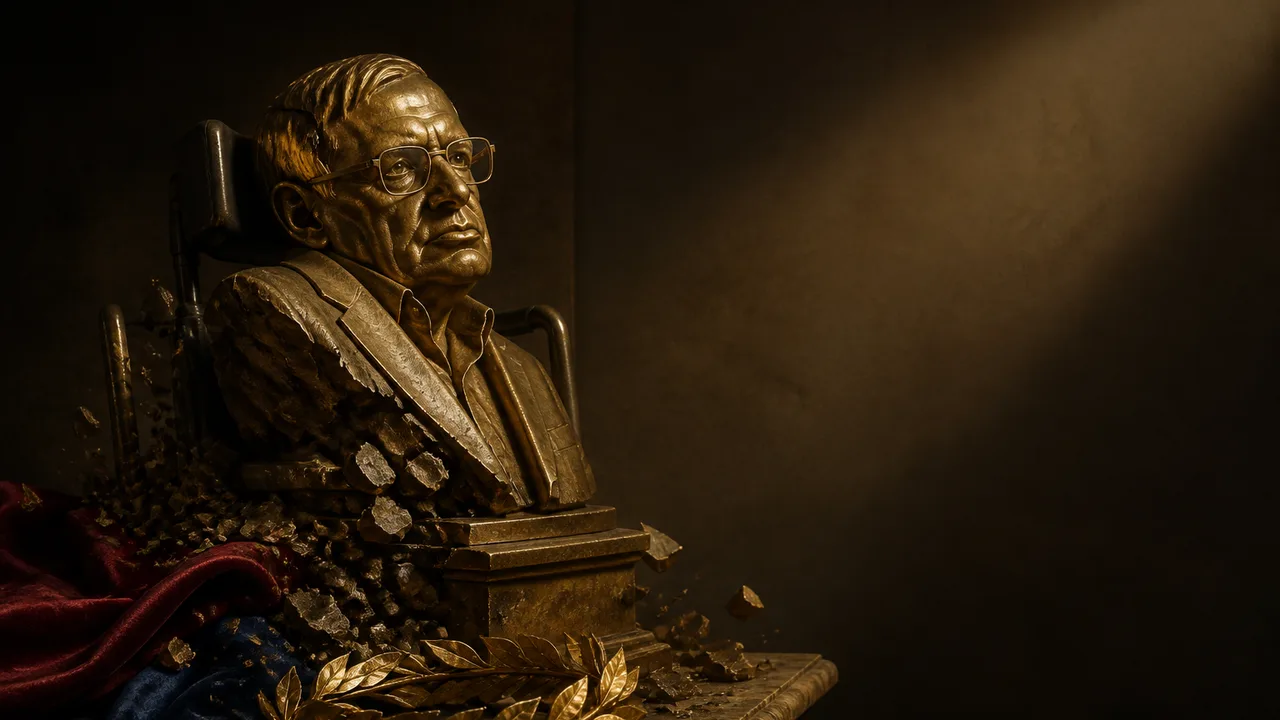
Graham Farmelo's new biography of Stephen Hawking does something rare in the science-shelf economy: it lets the mathematics and the cruelty share the same page. According to a Guardian review published Monday, Hawking presents the celebrated physicist's achievements alongside an account of the difficult, selfish and narcissistic behaviour that public admiration has often softened. AOL's syndicated review puts it more bluntly: the book "recognises his achievements, but also reveals the selfish narcissist underneath" (aol.co.uk).
The framing on the book's own jacket anticipates the tension. Penguin Random House promises a portrait of "the complex man behind the theories and global celebrity," along with "the resilience, fortitude and support that enabled him to defy his life-limiting diagnosis" (penguinrandomhouse.com). That last clause is doing quiet work: even the publisher's copy credits "support," a word that implies other people whose experiences may not all have been pleasant.
The Shape of the Portrait
Farmelo, a physicist turned biographer whose earlier books on Paul Dirac and Winston Churchill earned a reputation for archival thoroughness, draws on previously unpublished material from Hawking's parents, according to the book's listing on Amazon. The method matters as much as the material. As the Headtopics aggregation of the review notes, Farmelo handles the uncomfortable truths by letting others speak: colleagues, assistants, family members whose testimony stands in the record without the biographer editorialising over it.
That technique has a lineage. It is how Robert Caro handles Lyndon Johnson and how Ian Kershaw handled Hitler's court: assemble the witnesses, quote them precisely, and let the pattern in the testimony convict or acquit on its own terms. It also protects the biographer from the most common attack on any critical biography, which is that the author had an axe to grind.
The Myth-Making Machine
The Hawking story, as most people know it, was already a collaboration between the man and his audience. The diagnosis at 21 with a disease expected to kill him within two years; the survival for five more decades; the wheelchair and the synthesized voice; the bestseller that sat on more coffee tables than bedside tables; the cameos on The Simpsons and Star Trek. Each element was true. Together they composed a figure so complete that questioning the man felt like questioning physics itself.
Institutions had reasons to maintain the figure. Cambridge benefited from its most famous living academic. Publishers, broadcasters and documentary crews benefited from a scientist the public actually wanted to watch. Audiences benefited from a story about the triumph of mind over body that asked nothing of them. A celebrity ecosystem like that has no natural predator. Everyone feeding it loses something by questioning it.
The Guardian's framing generalises the point: worship of genius is not confined to science, and cultural institutions routinely convert exceptional talent into a form of absolution, discouraging criticism while the subject is alive and sometimes insisting on reverence after death.
The Prior Accounts that Couldn't Get Published
One detail in the new coverage deserves more attention than it has received. The Headtopics summary notes that Hawking shares parallels with previous less sympathetic accounts that struggled to find British publishers.
Read that carefully. It suggests that Farmelo's book is not the first attempt at a candid portrait, but possibly the first one with the standing to clear the gate. A biographer with Farmelo's track record, a major house behind him and a subject eight years dead operates under different constraints than a journalist proposing the same book while Hawking was alive and generating revenue for half a dozen industries. The gate, in other words, is not purely editorial. It is commercial, institutional and social, and it opens on a delay.
That delay has a cost. People who dealt with the difficult behaviour, if the testimony in the book is accurate, spent years being disbelieved or advised to let it go, because the myth had market value and their grievances did not.
The Counterargument, Stated Honestly
The strongest defence of the older, warmer accounts is not that they were wrong about the physics. It is that a severely disabled scientist navigating a brutal career had limited tools, that some behaviour reads differently when the person wielding it cannot perform the ordinary social labour others take for granted, and that a man who outlived his prognosis by half a century earned some latitude in how he treated the people around him.
There is also the argument about consequence. In cases where genius shields harmful conduct, the scrutiny is overdue. Where the conduct is vanity, coldness and self-absorption, readers may reasonably ask what the exposure accomplishes. Hawking did not, as far as any account here suggests, commit crimes; the charges are of character. Biographies of character have a long history, and their value depends on what the reader wants from a life: instruction, entertainment, or the plain record.
Farmelo's book appears to answer that question by refusing to choose. The publisher's own copy pairs "complex man" with "resilience, fortitude and support," and Juan Maldacena of the Institute for Advanced Study in Princeton blurbs it as "a fascinating account of the incredible life and science of a man who knew no boundaries" (penguinrandomhouse.com). A physicist of Maldacena's stature vouching for the book signals to the field that the candour comes with competence, which is the only combination that gets such a book taken seriously by the people who knew its subject.
Why the Mechanics of Reputation Matter
What interests me most, as someone who has spent a fair amount of time around celebrated people, is how uniformly the pattern repeats across fields. The recording studio, the research lab, the restaurant kitchen and the film set all run on a small number of people whose exceptional output buys tolerance for behaviour that would end anyone else's career. The tolerance is enforced informally: the assistant producer who gets told not to make a fuss, the junior researcher whose contribution is absorbed, the household staff who sign settlements.
A biography like Farmelo's breaks the enforcement at one point. It cannot fix the structure, but it changes what the record says, and records are what future institutions consult when they decide whose name goes on the building.
The open question is whether readers will actually want the complete record. The warm version of Hawking outsold everything else on the popular physics shelf for thirty years. The Guardian's verdict is that the fuller portrait does not diminish the science; it makes the account more honest. AOL's headline framing suggests readers may primarily hear the harder half.
Both things can happen at once. The physics was real, the cruelty is alleged by people who were there.
More Like This

What Tolstoy Knew About Over-Processing
Tolstoy's War and Peace argues that every system kills the thing it tries to preserve. An audio engineer reads that and feels it in their bones.
Consciousness Transfer: Science Fiction or Reality?
Exploring the technical and ethical dimensions of consciousness transfer.

Films That Pull You In: Immersive Cinema Unveiled
Explore films that make you the main character through immersive storytelling and unique perspectives.
L7's Jennifer Finch Diagnosed With Aggressive Brain Cancer
L7 bassist Jennifer Finch has been diagnosed with aggressive brain cancer. What her diagnosis means for the instrument, the band, and musician healthcare.
Leonard Susskind on Black Holes, Strings & Physics
Leonard Susskind talks black holes, the holographic principle, and string theory's unresolved promise with Brian Greene at the World Science Festival.
Albert Einstein: From Scientific Genius to Global Brand
How Einstein became a million-dollar brand after death—and what the legal battles over his image reveal about fame, family, and intellectual property.

Arca Announces Album XXXXX: 16 Tracks, No Previews
Arca's first album in five years, XXXXX, arrives July 31 via XL Recordings — announced with zero sonic material and a Barcelona livestream tagged 'Dive.Experimental.'
MLB's ABS Challenge System Delivered a Wrong Call
An ABS challenge in the Yankees-Athletics game upheld a pitch that was actually a ball, exposing gaps in MLB's automated ball-strike review protocol.