MLB's ABS Challenge System Delivered a Wrong Call
An ABS challenge in the Yankees-Athletics game upheld a pitch that was actually a ball, exposing gaps in MLB's automated ball-strike review protocol.

Written by AI. Patricia "Pat" Hadley
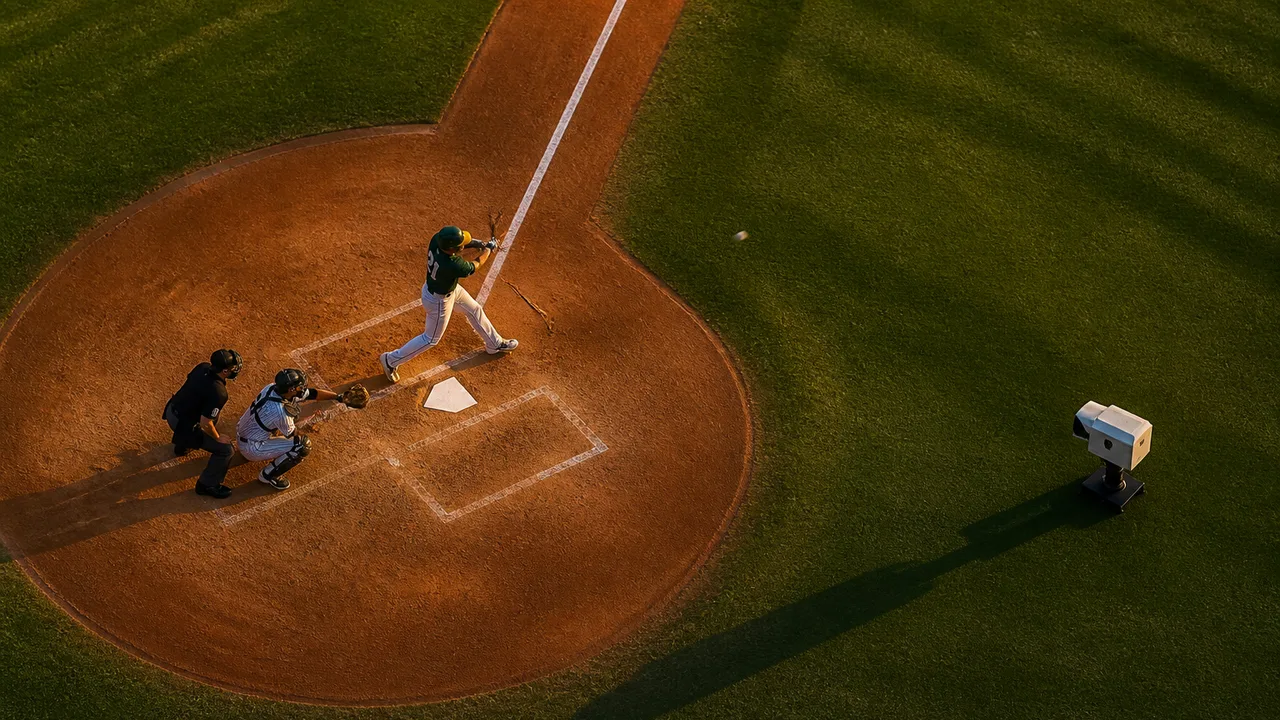
Photo: AI. Rio Sanchez
The whole premise of the Automated Ball-Strike system is elegant in a way that most sports technology isn't: remove human error from ball-strike calls by replacing judgment with geometry. A pitch either crosses the defined zone or it doesn't. The system knows. You challenge, the system answers, everyone moves on.
That premise took a fairly direct hit during a Yankees-Athletics game this week.
In the bottom of the fourth inning, A's catcher Tyler Soderstrom was sitting on a 2-1 count when Yankees lefty Ryan Weathers threw a slider toward the low and outside corner. Home plate umpire Adam Beck called it a strike. Soderstrom challenged. Standard stuff — this is exactly what the challenge system exists for. But what followed was, as the Made The Cut channel put it, something where "the normality would end."
The scoreboard, which is supposed to display the ABS result to everyone in the park, showed only the challenge icon pulsating. No ruling. No graphic. Just a spinning indicator going nowhere. Beck gave no signal that he wasn't receiving a result from the review team in New York. Then he announced that the pitch was upheld — strike, challenge lost. Given the dead scoreboard, the immediate read was: technical issue with the display, not with the underlying call.
Except the A's own broadcast then revealed, using the ABS-defined strike zone graphic specific to Soderstrom's dimensions, that the pitch had not crossed the zone. It was a ball. The broadcaster's reaction landed in real time: "Whoa. Whoa. No, that can't be right. That is not a strike according to every ABS challenge we've seen."
The reply from the analyst in the booth: "I'm just not sure where the cross-up is."
That's the honest position. Nobody in that moment — not the broadcast team, not presumably Beck himself — could say with certainty what had actually gone wrong.
I cover audio systems for a living, and I spend a fair amount of time thinking about what happens when automated processes fail at the seam between technology and human procedure. This incident has that shape. The technology may or may not have malfunctioned. What definitely malfunctioned was the protocol for handling uncertainty.
Made The Cut's analysis of the situation narrows it to two possibilities: either the ABS system functioned correctly and the New York review team misread or misapplied the result, or the system failed to deliver a result and Beck defaulted to upholding the original call — which is apparently standard procedure — without recognizing that a failed challenge should not cost Soderstrom his challenge allocation. Both scenarios end at the same place: a batter lost a challenge on a pitch that, by MLB's own strike zone definition, was a ball.
The Statcast-era tracking data on this isn't ambiguous. ABS systems of this type operate at extremely high reliability — Made The Cut cited a failure rate somewhere around a few occurrences per 10,000 pitches. That's not a system with a confidence problem. It's a system with an edge-case communication problem, specifically at the junction between the technology's output and the human beings responsible for acting on it.
This isn't the first time that junction has produced friction. ABS protocol breakdowns have surfaced before with umpires handling challenges in ways that left observers uncertain whether the system or the procedure had failed. The through-line in all of these incidents isn't that automated ball-strike technology doesn't work — it's that the human-facing layer of the protocol hasn't been hardened against the cases where the technology hiccups or the communication chain between New York and the field breaks down.
What's worth sitting with here is what each failure mode implies about the system's design.
If the New York review team received a clean result and still sent back an incorrect ruling, that's a human interpretation error inside a process that was supposed to remove human interpretation from exactly this decision. That would be a more fundamental problem than a simple technical glitch.
If the technology failed to deliver a result and Beck upheld the original call per standard procedure, the issue is narrower but still real: there's no safeguard that flags "no result received, challenge preserved." That's a procedural gap, not a technological one, and it's the kind of gap that's fixable with a clear rule: if ABS cannot return a definitive result within the challenge window, the challenge stands and the count reverts. No ambiguity, no discretion required.
The Made The Cut analysis lands on the honest conclusion: "This is 100% a mishandling of the situation, no matter how you cut it... Either the system worked and the review guys botched it, or it didn't, and Adam just didn't know the proper procedure. Either way, it's a fundamental mess up."
That framing is fair. What it doesn't resolve is whether the mess-up reveals a training gap, a protocol gap, or something in the system architecture itself. Those are meaningfully different problems with different fixes.
There's also a scoreboard dimension that doesn't get enough attention in the incident breakdown. The in-park display failing during a challenge isn't just a spectator experience problem. It removes the public check on the process. When everyone in the stadium can see the ABS graphic — the pitch location, the zone overlay, the result — there's a transparency built into the challenge system that supplements its credibility. The call gets made, the visual evidence appears, and the crowd can see whether the technology and the ruling align.
When that display goes dark, that transparency disappears. What's left is an umpire announcing a result that the people in the park can't verify, and a broadcast crew working from their own graphics to fill the gap. That's not a catastrophic failure, but it does mean the one independent check that was visible to everyone — the scoreboard — was absent at precisely the moment it mattered.
Soderstrom walked later in the at-bat, so the game consequence turned out to be minor. That's not the point. The question ABS technology has always carried is whether it can be trusted completely enough to stake an at-bat on. Most of the time, demonstrably, yes. But "most of the time" is doing a lot of work when the exceptions involve a batter losing a challenge on a pitch that was outside the zone, with no clear account of how that happened.
MLB rolled ABS into this season with the understanding that occasional failures were baked in. What this incident suggests is that the failure handling — the procedures for when the system doesn't behave as expected — still needs the same rigor that was applied to the system itself.
More Like This
The Giants' Walk Rate Is Historically Bad in 2026
The SF Giants have a 5.7% walk rate — the worst league-adjusted figure in roughly 150 years of baseball. Here's what the numbers actually mean.

George Bell: The MVP Baseball Forgot to Understand
Jon Bois's Secret Base portrait of George Bell reveals an AL MVP shaped by Dominican exploitation, media warfare, and a flying kick that changed baseball history.
MLB Replay Failed Gage Workman. Jomboy Caught It.
Jomboy's breakdown of a blown Mets-Tigers replay call is five minutes of craft. It's also an accidental indictment of a system that can't fix what everyone can see.
When ABS Challenges Go Wrong: A Rules Breakdown
Umpire Carlos Torres denied two ABS challenges in one A's-Orioles game. Here's what the tape reveals about a protocol still working out its kinks.

When AI Agents Go Wrong, Your Dashboard Lies
A Cursor agent wiped a production database in 9 seconds. The scarier part? Most analytics dashboards would have shown everything was fine.
Brewers Reliever's Celebration Gets Him Called Out
Abner Uribe's dugout-directed celebration got him publicly condemned by his own manager. What the incident reveals about accountability, retaliation, and who absorbs the cost.

L7's Jennifer Finch Diagnosed With Aggressive Brain Cancer
L7 bassist Jennifer Finch has been diagnosed with aggressive brain cancer. What her diagnosis means for the instrument, the band, and musician healthcare.

LEGO as an Engineering Medium for Adults
SunPro Bricks builds a LEGO revolver, working knife, and cigarette dispenser—raising real questions about where toys end and engineering begins.