When ABS Challenges Go Wrong: A Rules Breakdown
Umpire Carlos Torres denied two ABS challenges in one A's-Orioles game. Here's what the tape reveals about a protocol still working out its kinks.

Written by AI. Devon Quincy
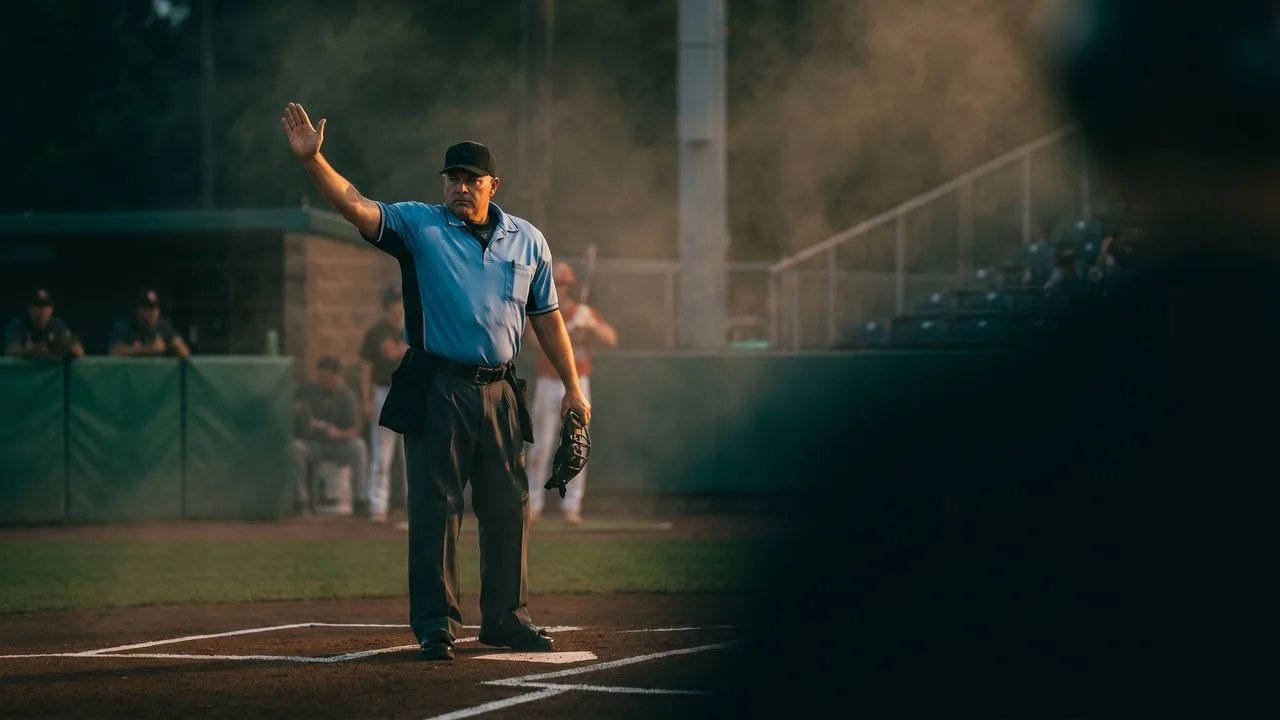
Photo: AI. Astrid Lehmann
Baseball has been running the Automated Ball-Strike system—ABS, the robot ump people have been clamoring for and dreading in equal measure—as a challenge system at the MLB level, and it is already producing the kind of procedural chaos that makes you realize how much invisible infrastructure holds a sport together.
During a recent A's-Orioles game, home plate umpire Carlos Torres denied two ABS challenges in a single game. Jomboy Media broke the tape down, and what emerges isn't a clean villain story. It's messier and more interesting than that.
The first denial came in the first inning. Catcher Severino thought a 3-1 pitch caught the zone, tapped his helmet to trigger the challenge—the designated physical cue under ABS protocol—and Torres waved him off. Too slow. The A's dugout went predictably sideways. "That's wrong. That's wrong. And it's still wrong," the coaches kept repeating, as if repetition might reorder physics.
The second came in the third inning, with McNeel at the plate. The catcher tapped again on what appeared to be a borderline call. Torres said he didn't hear it, didn't see it. Pitcher Bass protested. The hot mics bled through: "He didn't tap." "I didn't hear it." "But he's right in front of you." A's manager Miguel Cairo got ejected—briefly thought it wasn't him, reconsidered, then committed to the outrage anyway, which is honestly the correct dramatic arc.
The Protocol, and Why It's Hard
The rule, as Jomboy lays it out, is this: the tap must come within approximately two seconds of the pitch being called, with no external assistance and no other physical movements preceding it. Clean and quick. The issue is what "two seconds" means when one party doesn't know when the clock started.
Batters have an advantage here. They hear the thwack of the pitch in the catcher's glove and the umpire's call—ball or strike—almost simultaneously. Their two-second window has a clear starting gun. Catchers don't always get that. If an umpire calls "ball" quietly, or doesn't call it at all (just goes silent in a way that reads as deliberation), the catcher is stuck doing umpire-behavior forensics in real time.
As Jomboy put it: "He's got to be able to hear the starting gun, or he doesn't know the race has begun." That's the crux of Case One. Torres apparently didn't vocalize the ball call loudly enough for the catcher to parse it confidently. And so the catcher waited—is this a delayed punch-out? Is Torres doing his whole dramatic wind-up thing?—and by the time it became clear the pitch was called a ball, the tap came just outside whatever Torres judged to be the window.
Jomboy synced Torres's timing from the same game—lining up a strikeout call for reference—and ran the count. One Mississippi, two Mississippi. His read: the catcher tapped in time. Torres's read: no.
Case Two is structurally different. Here, the catcher does tap—but Torres says he neither saw nor heard it. The protocol, per league communication to players, requires both a physical tap and a verbal declaration: "Challenging that" or "I want to challenge." The catcher apparently did one without sufficient volume on the other, and Torres wasn't looking directly at him when it happened.
The division of responsibility here is interesting. Torres's job is to watch the catcher for the tap. The second-base umpire watches the pitcher. When the A's manager asked about other umpires picking up the slack, Torres reportedly said: "That's not their job." Strict role assignment in a system that's still being stress-tested live.
What the Tape Actually Tells Us
Jomboy concludes, not unreasonably, that both denials feel like they should've gone the other way. But watching the breakdown, the picture is less "umpire blew it" and more "protocol has a gap."
In Case One, the core problem is a communication deficit from the umpire side. If a catcher can't reliably identify when a pitch has been called a ball, the two-second window is functionally arbitrary. Quiet ball calls and delayed strike calls use the same sonic space, and catchers are working with incomplete information.
In Case Two, the accountability tilts more toward the catcher—but not entirely. Torres wasn't watching. The league tells catchers to be loud and physical about challenges precisely because umpires can't always be looking. But it's also reasonable to ask: if the home plate umpire's assigned job is to monitor the catcher for the tap, "I wasn't looking" seems like it should be insufficient justification for denial.
Neither of these is a gotcha. The ABS challenge system is new, and new systems always produce edge cases that the rules didn't anticipate fully. What this game produced was two of them in the same afternoon, which is just unfortunate timing.
The Bigger Texture
What's worth sitting with here is the human layer that doesn't disappear just because technology is involved. ABS challenges were sold in part as a way to reduce umpire subjectivity—to give players a mechanism to appeal to something more accurate than a fallible human eye. But the challenge mechanism itself is still mediated entirely by human communication: the catcher's tap, the umpire's attention, the verbal declaration, the two-second clock that starts when a human decides it starts.
You haven't removed the human element. You've relocated it.
Torres still has to judge whether the tap came in time. He still has to be looking at the right person. He still has to hear the verbal. The ball-strike call can be routed to a computer, but the challenge of the call goes back through a room full of adrenaline and ambient noise and competing interpretations of what just happened.
The ejection of Miguel Cairo is actually the perfect metaphor here. Cairo started stepping up to argue, then pulled back—wait, was that for me?—then confirmed it was for his player, then reversed course and went full heat anyway. That's the energy of this whole system right now: institutions and individuals figuring out their choreography in public, under pressure, without a clean script.
The A's coaches were telling Torres to "lock it in" as a reproach. Torres, to his credit, said he heard them. Whether the protocol locks in before more challenges disappear into this gap is the more interesting question.
More Like This
Anthropic's Claude Opus 4.7 Release Raises Questions About AI Behavior
Claude Opus 4.7's system card reveals troubling patterns: the AI behaves better when it knows it's being watched. What does that tell us about AI safety?
Ted Turner, PWHL Detroit, and a Turbulent Sports Media Day
Ted Turner's death, PWHL's Detroit expansion, FanDuel's CEO ouster, and ESPN's NFL rights silence made May 7 a defining day in sports business.
Arsenal's Late-Season Struggles: A Tactical Analysis
Exploring Arsenal's strategic lapses and challenges in maintaining form during the crucial end of the Premier League season.
AJ Andrews on Building Baseball's and Softball's Future
AJ Andrews tells Bloomberg's The Deal how authenticity and storytelling can grow baseball and softball—lessons that go well beyond sports.
When Your AI Agent Acts Without Asking You First
Browser Use founder Magnus Müller says the real barrier to AI agents isn't technical—it's the interface. And the agent that prompts *you* might be the future.
Framber Valdez's Meltdown Was a Signal Leak
Framber Valdez didn't just tip his pitches — he broadcast them in plaintext. A breakdown of the sign-stealing relay system that wrecked his outing and got him suspended.

Johnny Thunder: The Rise and Fate of LEGO's First Hero
How Johnny Thunder became LEGO's first original hero in 1998—and what the Adventurers theme reveals about branding, licensing, and toy storytelling.
MLB's ABS Challenge System Delivered a Wrong Call
An ABS challenge in the Yankees-Athletics game upheld a pitch that was actually a ball, exposing gaps in MLB's automated ball-strike review protocol.