Mastering Film's Silent Language: Visual Storytelling
Explore how filmmakers use visual storytelling to convey complex narratives without dialogue.

Written by AI. Devon Quincy
In the era of cinema where sound can easily dominate, there's a subtle art form that thrives in silence—visual storytelling. It's the unspoken language of film that transcends spoken words, capturing emotions and narratives with mere glances or movements. StudioBinder's recent exploration into this realm throws light on how filmmakers harness this power, crafting scenes that speak volumes without uttering a single word.
The Power of Performance
Consider the nuanced dance between Reynolds and Alma in Phantom Thread. Here, the audience is invited into a world of complex emotions through a simple omelette scene. Alma's control and Reynolds' curiosity play out through subtle expressions, culminating in a charged silence where "a subtle tilt of the head feels enormous." This example from StudioBinder underscores how actors can convey layered emotions and subtext, transforming a simple meal into a battlefield of wills.
Camera as a Storyteller
In Sound of Metal, camera placement becomes a conduit for emotional arcs. Initially, the lens remains detached, reflecting Reuben's internal solitude. As the scene progresses, the camera shifts, mirroring his growing connection with a young boy. This movement from detachment to intimacy illustrates how "camera placement can help guide a sequence without words." It's a testament to the camera's role not just as an observer, but as an active participant in storytelling.
The Stage of Setting
Portrait of a Lady on Fire invites us to consider setting as a narrative force. The forbidden romance unfolds in the liberating vastness of nature, away from societal constraints. The environment itself becomes a character, with the bonfire symbolizing passion and danger. StudioBinder highlights how such setting choices not only ground the narrative but also echo the internal landscapes of characters.
Movement as Dialogue
In Beau Travail, blocking—a deceptively simple technique—unravels complex character dynamics. The circular dance between Gallup and Jil, under Clare Denis' direction, is not just about rivalry. It subtly hints at deeper, possibly unacknowledged, emotions. This choreography of bodies speaks to themes of power and unspoken desires, demonstrating how "movement can speak multitudes."
Editing: The Invisible Hand
Finally, there's editing, the unsung hero of non-verbal storytelling. Alfred Hitchcock's Sabotage exemplifies this with a scene that builds suspense through cuts and gazes, as a wife silently contemplates her husband's fate. StudioBinder's analysis shows how "powerful editing can be," constructing tension and guiding the viewer's emotional journey with precision.
Beyond Words
While dialogue can indeed complement visual storytelling, the essence of cinema lies in its ability to communicate through images and rhythms. As StudioBinder aptly summarizes, "if a picture is worth a thousand words, a movie image is worth a whole lot more." As we navigate the realms of silent storytelling, the question remains: how much can we truly understand when we stop listening and start seeing?
More Like This
10 Underrated Netflix Films That Deserve Attention
Explore ten overlooked Netflix films that showcase unique storytelling and filmmaking techniques yet failed to capture widespread attention.
Inside Hollywood's Stunt Revolution: A YouTube Journey
Explore the evolution of stunt work through YouTube, where creativity meets technical prowess in action-packed sequences.
Hidden Movie Remakes: Unmasking Cinematic Clones
Exploring hidden movie remakes that remix classic films, offering fresh perspectives while echoing their predecessors.
Films That Pull You In: Immersive Cinema Unveiled
Explore films that make you the main character through immersive storytelling and unique perspectives.
Mastering the Art of Cinematic Wide Shots
Explore wide shots in film, where space tells the story and characters shine.
10 Mind-Bending Free Movies on YouTube
Explore 10 thrilling, mind-bending movies available for free on YouTube, diving into unique narratives and visual storytelling.
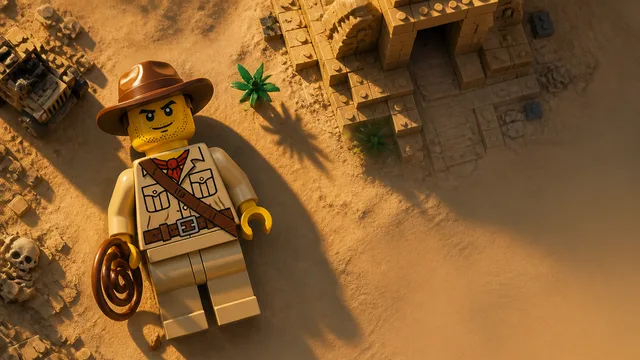
Johnny Thunder: The Rise and Fate of LEGO's First Hero
How Johnny Thunder became LEGO's first original hero in 1998—and what the Adventurers theme reveals about branding, licensing, and toy storytelling.
When ABS Challenges Go Wrong: A Rules Breakdown
Umpire Carlos Torres denied two ABS challenges in one A's-Orioles game. Here's what the tape reveals about a protocol still working out its kinks.