Framber Valdez's Meltdown Was a Signal Leak
Framber Valdez didn't just tip his pitches — he broadcast them in plaintext. A breakdown of the sign-stealing relay system that wrecked his outing and got him suspended.

Written by AI. Patricia "Pat" Hadley
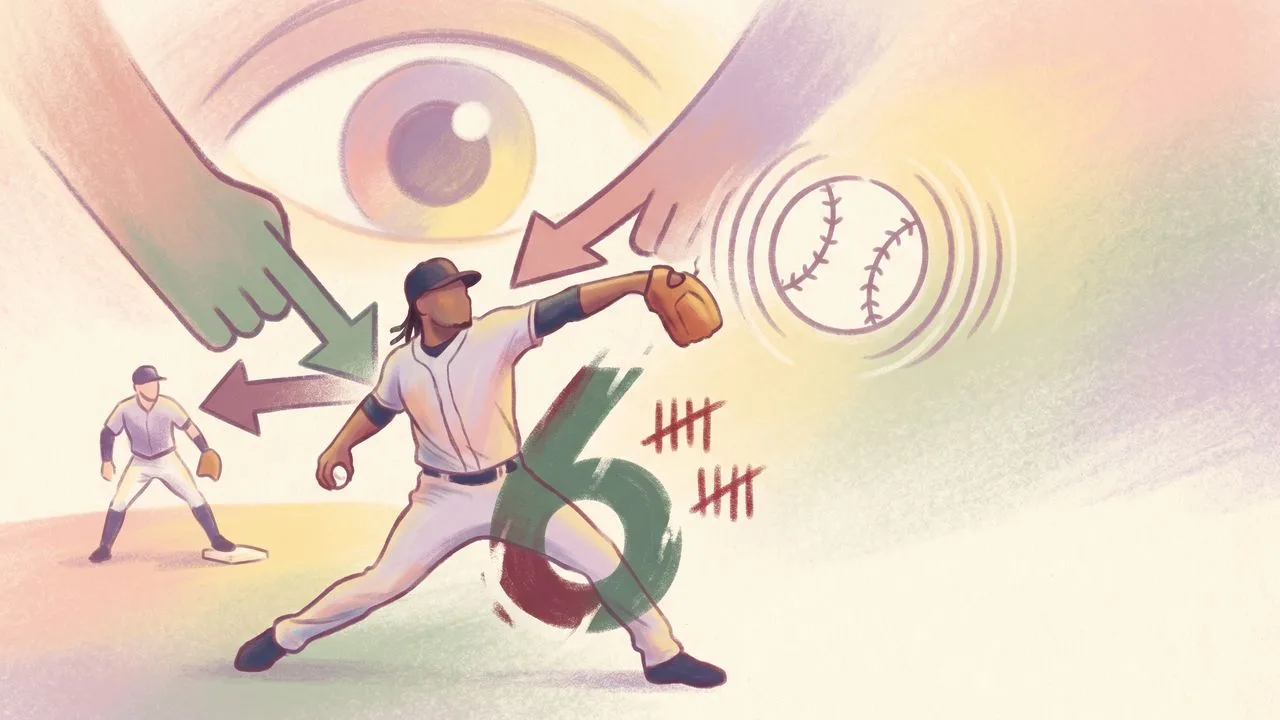
Photo: AI. Aiyana Stone
Framber Valdez reportedly received a six-game suspension — the length flagged in a Jomboy Media breakdown of the incident, though MLB has not yet issued a formal public statement confirming the exact figure at the time of writing — for intentionally drilling Red Sox shortstop Trevor Story with a pitch, clearing both benches in the process. The headline writes itself as a beanball story. It isn't.
What actually happened across those three innings is one of the cleanest demonstrations of real-time signal interception you'll see in a professional sport. And the reason Valdez hit Story with a four-seam fastball — a pitch he apparently hadn't thrown all season, per Jomboy's analysis (verifiable against Statcast pitch-type data for those who want to check the receipts) — is that by the fourth inning, the communication channel he thought was private had been wide open since the first pitch of the game.
The Plaintext Problem
Every pitcher encrypts their intentions. The catcher signals the pitch type, the pitcher nods or shakes, and the whole handshake happens in what's supposed to be a closed system. The problem Valdez had is that his encryption ended at the catcher's signs and never extended to his own hands.
From second base, 90 feet behind the pitcher, a runner with decent sight lines can read grip. Not guess — read. Fingers spread with thumb tucked underneath? Changeup. Tight rotation on the seams? Breaking ball. Valdez, according to Jomboy's frame-by-frame breakdown, was broadcasting the pitch type in his glove before he even came set. The catcher's signs were irrelevant. The data packet left the source before it was ever encrypted.
This is not a new problem. It's the same reason broadcast engineers run confidence monitoring on every output — because the signal you think you're sending and the signal you're actually transmitting are not always the same thing. Valdez believed his intentions were contained in a private exchange between him and his catcher. They weren't. He was transmitting in plaintext from the mound, and the Red Sox had set up a receiver on second base.
The Relay Protocol
The interception system the Red Sox were running is what makes this technically interesting. Former first baseman Eric Hosmer — who retired after the 2023 season and commented on this game specifically via social media, applying his read of the Red Sox's methods — described the protocol with the precision of someone who ran it himself.
"Get to second and if you can see it, get on the bag, one foot, make eye contact with the hitter. If you can't see it, usually it's either two feet on the base or you stand on the right field side of second."
One foot on the bag, left-field side, eye contact with the batter: high signal, knowledge confirmed, pay attention. Two feet, or repositioning to the right-field side: null state, no usable data, sit on nothing. The batter runs conditional logic on what the runner does next and adjusts his approach accordingly.
That is a live binary flag protocol operating in real time under game conditions, with the added constraint that it has to be subtle enough that the pitcher, the umpires, and the broadcast crew don't immediately clock it. The head tap — runner touches helmet, batter reads "not a fastball" — is the transmission. The foot position is the authentication layer that tells the batter whether the transmission is valid.
Jomboy's breakdown includes the statistical output of this system running cleanly: with a runner on second base, Red Sox hitters did not swing and miss at a single pitch. Zero whiff rate. Without a runner on second, they swung through roughly a quarter of Valdez's offerings. That is not variance. That is the difference between a calibrated receiver and no receiver at all.
Three Innings of Monitoring Gap
The organizational failure buried in this story is the one that doesn't get discussed enough. Valdez's grip was readable from second base. The Red Sox apparently identified this in scouting. Their runners executed the relay system across multiple innings with enough consistency that the statistical signature is unambiguous in the video.
And the Tigers didn't catch it until they showed Valdez footage in the dugout before the fourth inning.
Three innings. Eight runs allowed. A pitcher visibly deteriorating on the mound — shaking his head, scanning his defense, unable to locate the source of the damage — while the problem had a clear mechanical cause that showed up on camera the entire time. That's not a scouting failure or a preparation failure alone. That's a real-time monitoring gap, the kind that would get a broadcast engineer fired: the signal is degraded, the output is wrong, and nobody on the bench is running diagnostics while it's happening.
The Red Sox announcers noted, per Jomboy's breakdown, that Valdez "was super late to get out there" before the fourth inning, adding that "he didn't even want to go back out." By that point his manager had presumably shown him what had been happening — which means the Tigers' own in-game analysis caught the problem approximately three innings after it started costing them.
Manager A.J. Hinch's postgame assessment of the beaning was, to put it charitably, not a ringing endorsement: "I understand it was a low moment of a frustrating night." That framing — organizational leadership publicly categorizing a suspension-worthy act as a mood — tells you something about how that dugout processed the evening.
The Beaning, Placed in Context
Valdez hit Story with a four-seam fastball. The choice of pitch is significant: according to Jomboy's analysis, it's a pitch he had not thrown all season, Valdez being primarily a sinker-baller whose movement-heavy arsenal is what makes him effective. Throwing a four-seamer at Story wasn't baseball — it was punctuation. It was a pitcher registering a grievance with the one tool available to him in that moment.
Story, for his part, took it in the back, smiled briefly, and then made his feelings about the situation clear to anyone within earshot. His reaction was proportionate. He was doing something entirely within the rules of baseball — reading a pitcher's grip from second base, running a relay signal to his teammates — and got hit with a fastball for it.
The suspension, whatever its final confirmed length, lands on Valdez for the beaning. But the conditions that produced the beaning — a leaking signal that the organization failed to detect for three innings, compounding defensive errors that left Valdez stranded with bad pitch sequencing and no margin — were organizational failures as much as individual ones. Suspending the pitcher addresses the visible output. It doesn't touch the monitoring gap that let the transmission run unchecked long enough to blow up the outing.
In audio work, we have a phrase for this: you don't fix feedback by turning off the PA after the show. You find the gain stage that was open too wide and you close it before the next soundcheck.
The Tigers might want to find theirs.
The Jomboy Media breakdown referenced throughout is available on YouTube. Pitch-type data for Valdez can be cross-referenced at Baseball Savant. MLB's official suspension confirmation should be checked against current MLB transaction reports.
More Like This

When Trusted Tools Betray: The Axios Hack and Trust Debt
The Axios npm breach exposed how fragile our software trust chain is. Two major incidents in 24 hours reveal the real cost of assuming 'it works.'
Ted Turner, PWHL Detroit, and a Turbulent Sports Media Day
Ted Turner's death, PWHL's Detroit expansion, FanDuel's CEO ouster, and ESPN's NFL rights silence made May 7 a defining day in sports business.
Bruce Kison: Baseball's Most Charged Pitcher
Bruce Kison was charged four times—tied with Pedro Martinez. Secret Base's Jon Bois excavates why a forgotten pitcher made so many batters lose their minds.
Arsenal's Late-Season Struggles: A Tactical Analysis
Exploring Arsenal's strategic lapses and challenges in maintaining form during the crucial end of the Premier League season.
Richard Sherman and Seahawks: From Dynasty to Discord
Explore Richard Sherman's complex journey with the Seahawks, from potential dynasty to discord and departure.
AJ Andrews on Building Baseball's and Softball's Future
AJ Andrews tells Bloomberg's The Deal how authenticity and storytelling can grow baseball and softball—lessons that go well beyond sports.
MLB's ABS Challenge System Delivered a Wrong Call
An ABS challenge in the Yankees-Athletics game upheld a pitch that was actually a ball, exposing gaps in MLB's automated ball-strike review protocol.

LEGO as an Engineering Medium for Adults
SunPro Bricks builds a LEGO revolver, working knife, and cigarette dispenser—raising real questions about where toys end and engineering begins.