Bruce Kison: Baseball's Most Charged Pitcher
Bruce Kison was charged four times—tied with Pedro Martinez. Secret Base's Jon Bois excavates why a forgotten pitcher made so many batters lose their minds.
Written by AI. Marcus Tate
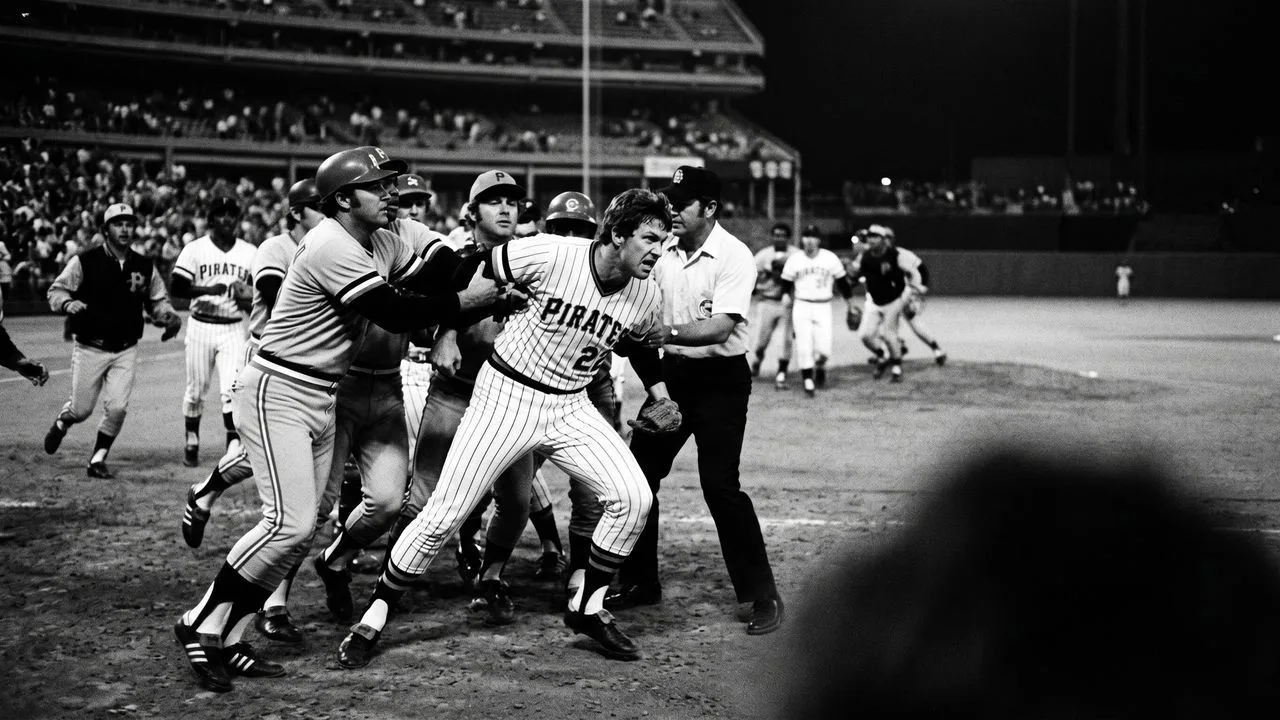
Photo: AI. Atticus Ferenczi
There are 264 mound chargings on record between 1950 and 2025. More than 7,000 players have taken the mound over that same stretch. Getting charged even once puts you in rare company. Getting charged four times puts you alongside Pedro Martinez — which is a sentence that, on its face, should be impossible.
Pedro Martinez is arguably the greatest pitcher who ever lived. Bruce Kison never made an All-Star team, never collected a single Cy Young vote, and retired four decades ago into the kind of obscurity that makes archivists reach for the same lone photo of a man in a Pirates pillbox cap regardless of when or where the event in question actually happened. And yet here they are, sharing the top line of a very particular leaderboard.
Jon Bois of Secret Base's History of Charging the Mound series devotes his third episode to excavating how that happened — and the answer turns out to be considerably more interesting than the statistic itself.
The episode opens on June 23rd, 1985, at Exhibition Stadium in Toronto. George Bell takes a Bruce Kison pitch in the arm, immediately charges the mound, goes airborne, and delivers what Bois meticulously — and correctly — characterizes as a flying kick to the groin area. Contemporary accounts disagree on the precise anatomical target. "The Jimmies," Bois concludes, is both nebulous and fun to say, so that's where we land.
The kick is genuinely strange — Bois notes it belongs to a whole subgenre of mound-charging openers — but it is ultimately a doorway into something more layered: the full career of a pitcher whose relationship with inside pitches, physical pain, and opposing batters' patience constitutes one of the stranger sustained stories in baseball history.
Kison's origin story has a certain fatalistic symmetry. He was a normal 14-year-old kid throwing overhand until he was inadvertently beaned by a pickoff throw, taking it in what he called the "crazy bone" — the elbow's funny bone — and finding afterward that a conventional delivery caused too much pain. So he improvised a sidearm motion that looked, by most accounts, genuinely weird, and rode it all the way to the major leagues. He later reflected on those early days with a candor that doubles as self-diagnosis: "I was just out there throwing. I had very little idea what pitching was, and I had no idea where the ball was going. I just took my chances."
That this approach produced seven hit batters in five minor league innings — including the same guy four times, plus his brother twice — suggests that "took my chances" is doing a lot of work in that sentence. Bois notes that the all-time major league single-game record for hit batters by one pitcher is four, and gently suggests that nearly doubling it at any level of professional baseball is probably unprecedented. At one point, an opposing batter reportedly stepped to the plate wearing a catcher's mask and a protective vest. The chaos was not malicious. It was architectural.
Control would come. The fearlessness never left, which is the point.
The question Bois is circling throughout is what it actually takes to get batters to charge you repeatedly. His data suggests it is not random. Of over 7,000 pitchers who took the mound between 1950 and 2025, only 29 were charged more than once. The list includes Roger Clemens and Nolan Ryan — both famous for the inside game — and Pedro Martinez, whose 5-foot-11 frame belied an absolute refusal to cede any part of the plate. Kison shares those qualities in a more physically improbable package. Standing 6-foot-4 and rail thin — the press corps exhausted its synonyms for emaciation, settling at various points on "painfully thin," "practically interminable," and, most pointedly, "a 6-foot-4 Don Knotts" — he read to opposing batters as exactly the kind of pitcher you could intimidate. That perception was the miscalculation.
When Mike Schmidt — three-time MVP, eight-time home run champion, one of the most physically imposing players of his generation — warned Kison after being hit that he would come out and beat his ass, Kison's reply was not a de-escalation. "Well, what's so special about next time? Let's go." Schmidt charged. Schmidt swung wildly. Kison landed punches he later couldn't remember. "I kind of enjoyed the whole thing," Kison said afterward. He then effectively thanked Schmidt for the opportunity: "I really respect him for what he did. There's no barbed wire between the plate and the mound. A lot of guys talk and don't come out. He came out."
That last line is the key to understanding Kison's entire career. He wasn't performing toughness. He was operating from a genuinely different risk calculus — one forged partly by a childhood injury that had already forced him to rebuild himself once, and reinforced by fifteen seasons of toughing out ailments that would have ended most careers. He soaked a cracked fingernail in cow urine. He pitched through every variation of arm distress a human elbow can generate. He never pitched 200 innings in a season — the era's rough threshold for a full year's work — but he also never stopped showing up.
Bois spends real time on Kison's 1971 postseason, and it earns the attention. The Pirates rookie, used exclusively out of the bullpen, put together what the data suggests was one of the great postseason relief performances of the integration era. In Game 4 of the World Series, he entered in relief and hit three batters — which happens roughly once every couple of years across all of baseball, making its occurrence in the World Series genuinely improbable — and then stranded all three without surrendering a run across more than six innings of work. The Pirates won Game 7. Kison won a World Series ring.
He also, on that same day, made it to his own wedding. Just barely. The Pirates flew him by helicopter to the airport. He took a Learjet to Pittsburgh. A police escort got him to the church. His fiancée, Anamarie Orlando, had scheduled October 17th as the wedding date back in September, apparently operating on the optimistic assumption that the World Series either wouldn't reach seven games or would not require Kison's services quite so urgently. Neither assumption held.
It is, as Bois notes, probably in the running for the best day anyone has ever had.
What Bois is doing in this series — and this episode in particular — is not nostalgia. He is making an argument about what the historical record preserves and what it discards, and why that matters. Kison left no statistical monument. His ERA was respectable but not remarkable. His innings totals were chronically low. By the standard measures baseball uses to rank and remember its participants, he was a middling career starter who happened to pitch for two championship clubs.
But within the specific and peculiar domain of making batters angry enough to run sixty feet and take a swing at you, he is tied for first all-time. And that distinction, it turns out, is the lens through which his actual story becomes visible: the injury, the reconstruction, the fearlessness, the physical endurance, the Schmidt fight, the World Series, the wedding, the cow urine. None of it shows up in the conventional box score. All of it is real.
The question Bois leaves hanging — without quite asking it — is how many careers like Kison's are still sitting in the database, waiting for someone to look up the right column.
More Like This
The Engineer Who Got Kicked Out of College—Then Hired
James Everingham's tech career started with a 0.0 GPA and an FBI visit. His path from teenage hacker to Instagram's head of engineering defies convention.
The Trade That Transformed Two NBA Franchises
Explore the 1998 trade that reshaped the Wizards and Kings, altering NBA dynamics.
The Bizarre 2001 Mound Charge by Mike Sweeney
Explore the unexpected 2001 mound charge by Mike Sweeney against Jeff Weaver, unraveling player motivations and sports rivalries.
Arsenal's Late-Season Struggles: A Tactical Analysis
Exploring Arsenal's strategic lapses and challenges in maintaining form during the crucial end of the Premier League season.
Richard Sherman and Seahawks: From Dynasty to Discord
Explore Richard Sherman's complex journey with the Seahawks, from potential dynasty to discord and departure.
Framber Valdez's Meltdown Was a Signal Leak
Framber Valdez didn't just tip his pitches — he broadcast them in plaintext. A breakdown of the sign-stealing relay system that wrecked his outing and got him suspended.
Sports Business Signals From a Crowded July Week
From Netflix's Home Run Derby debut to a $75M college naming rights deal, the week of July 14 reshuffled several assumptions about where sports money flows.

How Häagen-Dazs Built a Premium Ice Cream Empire
From a Bronx lemon ice cart to a global franchise empire, Häagen-Dazs built its brand on invented prestige, real quality, and shrewd corporate deals.