Brewers Reliever's Celebration Gets Him Called Out
Abner Uribe's dugout-directed celebration got him publicly condemned by his own manager. What the incident reveals about accountability, retaliation, and who absorbs the cost.

Written by AI. Patricia "Pat" Hadley
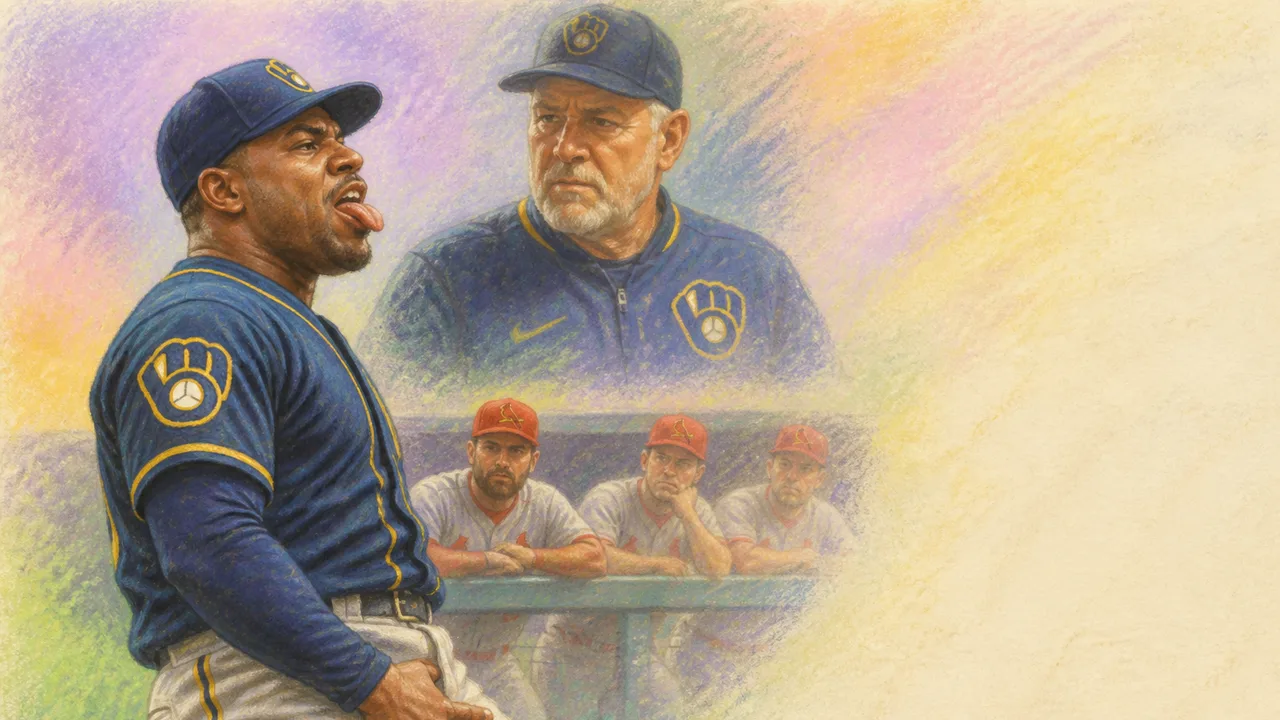
Photo: AI. Aiyana Stone
There's a version of this story where a reliever gets emotional after a big strikeout, his manager sets him straight, everybody moves on. That version ended when the cameras caught all of it, Uribe gave his postgame comments through an interpreter, and Yelich's "it's been handled" landed slightly differently than intended.
What Abner Uribe actually did in the eighth inning against St. Louis — three consecutive air humps directed specifically at the Cardinals dugout after striking out a batter on a slider — sits in a gray zone worth examining carefully. The Brewers were ahead by a comfortable margin. The out was real, a full-count strikeout with two runners on, but it wasn't a save situation or a series-deciding moment. The gesture wasn't ambiguous. Uribe didn't celebrate in the general direction of the sky or pump his fist toward his own dugout. He oriented the celebration at the opposing bench.
The context that makes that distinction important: there's a long-running and genuinely contested debate in baseball about whether players are allowed to show emotion. Bat flips, mound-fist-pumps, screaming strikeouts — the culture has shifted substantially in the last decade, and the shift is largely healthy. Expressiveness isn't disrespect. Directing it at the other team's dugout is a different mechanism entirely, because it moves the celebration from I'm excited to I'm taunting you, and those produce different downstream events.
Brewers manager Pat Murphy didn't hedge on where this one landed:
"Yeah, that's unacceptable. Yeah, it's just unacceptable. I don't know what got over him. I mean, he's been an emotional guy, but that kind of thing — that's just not how we do things and I was embarrassed by it. He's been so great for us in so many ways, but that's unacceptable."
That's a manager speaking on record, using the word "unacceptable" four times in under a minute, not softening anything with "we'll address it internally" or "I'll talk to him." Murphy closed the loop publicly. Whatever he said to Uribe privately, the organizational position was broadcast before Uribe's own comments were.
Christian Yelich, per MLB reporter Adam McCalvy, said postgame that the matter "had been handled" — and when pressed on whether that meant internally or also via communication with the Cardinals, said both. That framing suggested the Brewers had reached across to address it directly with St. Louis.
Then came Uribe's comments, which contradicted that framing in a specific and revealing way. He apologized to his organization. He did not apologize to the Cardinals. Asked to explain why, he offered context: Cardinals manager Oliver Marmol had allegedly been making gestures toward the Brewers dugout indicating that batters would be hit, and there had been a separate incident during batting practice that day, the details of which remain unverified. Uribe said he had his teammates' backs.
The strongest version of Uribe's position is this: if you believe the Cardinals were signaling intent to retaliate against Brewers hitters before Uribe even took the mound, then his celebration reads less as spontaneous disrespect and more as a response to a provocation that wasn't publicly documented. Players operate with information the broadcast doesn't capture. The code of conduct that governs beanballs and dugout-to-dugout friction is largely invisible to everyone outside the field level.
The problem with that argument, structural rather than moral, is that the return path is asymmetric. Uribe is a reliever. He doesn't bat. If his provocation produces retaliatory hit-by-pitches in game three of this series, those pitches land on someone else's body — specifically the Brewers' position players and starting pitcher. Uribe initiated a signal he cannot receive back. The teammates he described protecting are the ones who will absorb the cost of his response. That asymmetry doesn't make his anger invalid; it makes the expression of it, in that form and on that stage, a decision with uneven consequences for the people he said he was defending.
Murphy's public condemnation reads differently in this light. "He can't tolerate that for his teammates" — the emphasis isn't on optics or sportsmanship as an abstraction. It's on the practical downstream effect on the other 25 guys.
What Yelich's "it's been handled" comment introduced was a factual discrepancy. If the Brewers had communicated with the Cardinals and Uribe was part of that resolution, you'd expect Uribe's comments to align with that framing. They didn't. Either "both" referred to a resolution Uribe wasn't party to, or Yelich's read of the situation was more optimistic than accurate. Yelich is a veteran leader and presumably chose his words carefully — but the gap between his characterization and Uribe's is the most unresolved element of this story, and it's worth noting that neither version is definitively wrong based on available information.
What's not unresolved: the celebration happened on a live broadcast in front of everyone. The Brewers' institutional response — Murphy's public rebuke, followed immediately by Uribe's explanation-that-isn't-quite-an-apology — played out in full view of both fanbases, the Cardinals organization, and whatever arbiters of baseball culture are paying attention. Public actions produce public records. The organizational signal Murphy sent was clear; Uribe's counter-signal introduced interference into what Murphy tried to resolve cleanly.
The mechanism that makes all of this stickier than a simple "player did something dumb, manager corrected him" narrative is that Uribe's stated reasoning — protecting teammates from a provocation they may have genuinely experienced — is the kind of reasoning that earns respect in a clubhouse regardless of its tactical wisdom. He may have been wrong about method. He may not have been wrong about motive. Those two things coexist, and they don't cancel each other out.
Uribe can apologize to his organization. He cannot recall the broadcast.
More Like This
Ted Turner, PWHL Detroit, and a Turbulent Sports Media Day
Ted Turner's death, PWHL's Detroit expansion, FanDuel's CEO ouster, and ESPN's NFL rights silence made May 7 a defining day in sports business.
Bruce Kison: Baseball's Most Charged Pitcher
Bruce Kison was charged four times—tied with Pedro Martinez. Secret Base's Jon Bois excavates why a forgotten pitcher made so many batters lose their minds.
The Giants' Walk Rate Is Historically Bad in 2026
The SF Giants have a 5.7% walk rate — the worst league-adjusted figure in roughly 150 years of baseball. Here's what the numbers actually mean.
MLB Replay Failed Gage Workman. Jomboy Caught It.
Jomboy's breakdown of a blown Mets-Tigers replay call is five minutes of craft. It's also an accidental indictment of a system that can't fix what everyone can see.
When ABS Challenges Go Wrong: A Rules Breakdown
Umpire Carlos Torres denied two ABS challenges in one A's-Orioles game. Here's what the tape reveals about a protocol still working out its kinks.
Anthropic's DMCA Mess: What Happens When 8,100 Repos Go Down
Developer Theo got DMCA'd by Anthropic for changing one word in a markdown file. The story reveals how DMCA enforcement can go catastrophically wrong.

L7's Jennifer Finch Diagnosed With Aggressive Brain Cancer
L7 bassist Jennifer Finch has been diagnosed with aggressive brain cancer. What her diagnosis means for the instrument, the band, and musician healthcare.
Jacob Misiorowski's May 2025 Sets MLB Pitching Records
Jacob Misiorowski posted three historically unprecedented pitching metrics in May 2025, raising serious Cy Young questions about the Milwaukee right-hander.