George Bell: The MVP Baseball Forgot to Understand
Jon Bois's Secret Base portrait of George Bell reveals an AL MVP shaped by Dominican exploitation, media warfare, and a flying kick that changed baseball history.
Written by AI. Marcus Tate
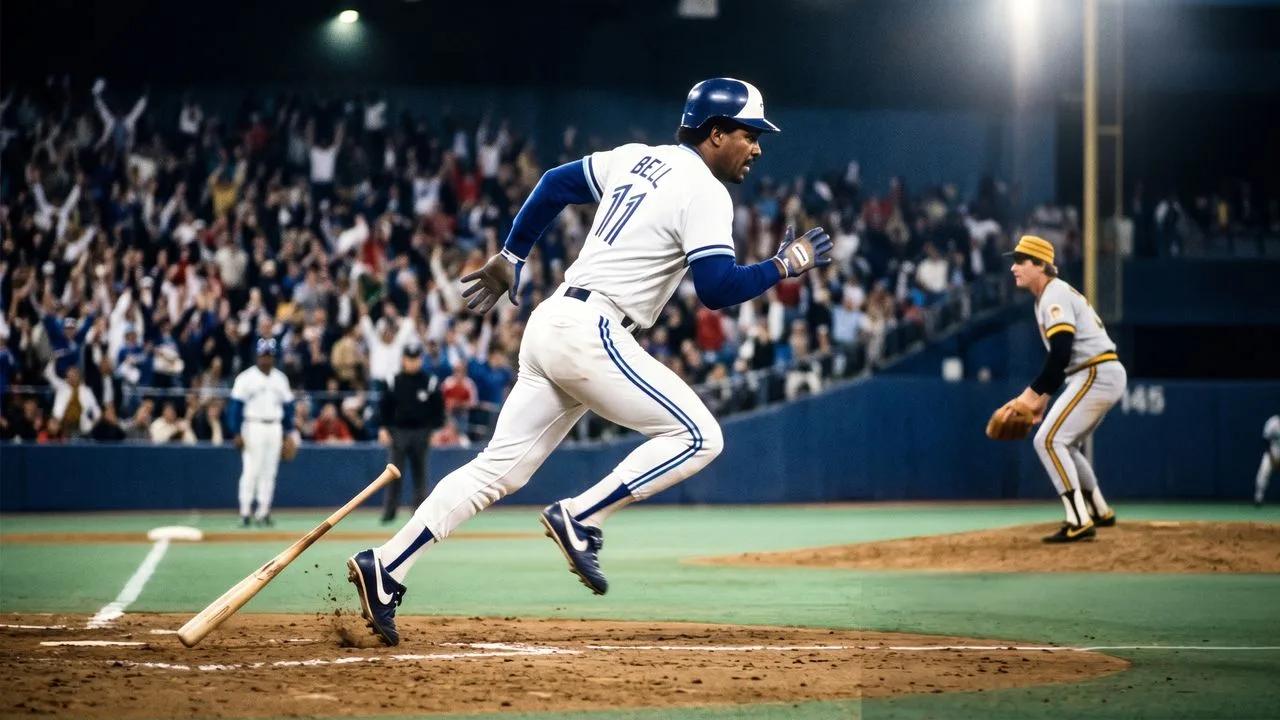
Photo: AI. Lev Zolotov
The late 1970s talent pipeline out of the Dominican Republic is one of the more uncomfortable chapters in professional baseball's labor history, and it doesn't get nearly enough examination outside of academic circles. Jon Bois, in the fourth installment of Secret Base's History of Charging the Mound, uses it as the essential foundation for understanding George Bell — not as a curiosity or a cautionary tale, but as the economic and psychological architecture beneath everything the man ever did on a baseball field.
The arithmetic was straightforward, and that's precisely what made it so ugly. With Dominican unemployment hovering around 40 percent, MLB clubs recognized they could sign talented prospects at a steep discount to what American players commanded. Those prospects then arrived in the United States socially isolated, linguistically vulnerable, and frequently dependent on agents who, as Bois notes, were "often crooked and looking to swindle them all over again." The exploitation ran in sequence: the sending country's poverty, the receiving industry's opportunism, and then the cultural suspicion that greeted the players who survived both. George Bell landed in the middle of all of it and was somehow cast as the problem.
A Face Fractured, A Policy Formed
The incident that most durably shaped Bell's psychology happened in 1982 at Triple-A Syracuse. Lynn McLaughlin — an eleven-year major league veteran angling for one final call-up — drilled Bell in the face, fracturing his cheek and jawbones. Bois frames this with appropriate care: McLaughlin had a documented history of intentional beaning, had already prompted Dave Kingman to charge the mound from the dugout during a Cardinals game, and by most accounts resented Bell for the same ambient reasons everyone else seemed to — he was too flashy, too confident, too something.
Bell lay on the field convinced his career, and with it his shot at a better life, was finished.
Two years later, McLaughlin died in a fire. Bell, by then a major leaguer, addressed the death seemingly without prompting, offering condolences to the families — and then adding what Bois accurately describes as the more complicated part: "People like that decide it. They have a bad heart. No way they can stay alive."
Bois's reading of that statement is worth sitting with. "You might find those words to be callous, even cruel. I mean, I do. Then again, I doubt either of us have persevered through the circumstances Bell did, only for somebody to break his face and potentially ruin his life just for playing baseball with a little bit too much swagger." That's not an excuse — Bois isn't offering one — but it's an insistence on context that a lot of Bell's contemporaneous critics never provided him.
From 1982 forward, Bell operated under what the video characterizes as a no-tolerance policy, backed by a willingness to enforce it physically. When he met Bruce Kason on June 23, 1985, that policy produced something genuinely novel: Bell became, as best as Bois can determine, the first batter in MLB history to open a mound charge with a flying kick. The taxonomy Bois builds around this — tracing the kick's influence through Otis Nixon in 1991, Sandy Alomar in 1992, and several others — is part baseball history, part combat sports analysis, and entirely entertaining. Bell's 1985 debut also included a technically sound left-right combination that knocked a catcher's helmet off, earning what Bois rates as a perfect five-out-of-five on his "main event scale." It's a genuine innovation, which is a strange sentence to type about mound charging, but there it is.
The Media Economy Bell Built Around Himself
The flying kick tends to dominate the Bell highlight reel. The more revealing story is what he built in its aftermath.
After being passed over for the Blue Jays' 1984 player-of-the-year award — a vote that went to Dave Collins, a player traded within days of winning it — Bell implemented what the video calls a selective media boycott. Some outlets could access him for $50 cash. Others he simply wouldn't speak to at all. The arrangement lasted years.
There's a reading of this that labels Bell as difficult and unprofessional. There's another reading: a man who had been swindled at multiple stages of his career had simply decided to extract value from every transaction he could, including press availability. Both readings are probably partially true. What they agree on is that Bell had developed an acute sensitivity to disrespect, and the award outcome registered as precisely that.
The consequences compounded. When Bell's 1987 MVP season — 47 home runs, the American League's best — coincided with a now-infamous locker room confrontation with WFAN reporter Susan Waldman, he had spent years building a reputation that left him no cushion. "After years of being unfairly vilified, he now becomes the vilifier," Bois observes, and the framing is sharp because it's accurate in both directions simultaneously. Bell's treatment of Waldman was indefensible. It was also, as Bois pointedly notes, perpetrated by a man who had every reason to understand what it meant to be the person in the room who wasn't supposed to be there.
The foil is Bell's teammate Jesse Barfield, who quietly got Waldman's name, called her over to his locker, and gave her everything he could think of — "even making up some dumb poetry on the fly just to give her some funny stuff to write." There's no lesson Bois draws too explicitly here. He doesn't need to. The contrast is the argument.
What Accumulated Inside 1.9 Seconds
The 1989 encounter with Gene Nelson is where Bois's structural instincts are at their best. Nelson's errant pitch in a blowout — clearly unintentional, the video makes this point explicitly — produces a delayed reaction from Bell that requires a full inventory of the preceding months to explain: Mark McGwire's ninth-inning grand slam erasing a Blue Jays lead, three consecutive walk-off losses, the trade of Jesse Barfield, the worst April in franchise history, and a two-year running war with manager Jimy Williams that reportedly included Williams suggesting Bell should be grateful because "if it weren't for baseball, he'd be back in the Dominican Republic cutting sugarcane." (Williams denied the remark. The tension that produced it is not in dispute.)
The video's phrase for what follows is precise: Bell "releases five years of frustration in 1.9 seconds." The pitch hits him, he starts to let it go, and then something in the accumulated weight of it shifts and he's already moving.
A footnote Bois surfaces here is quietly remarkable. Nelson, talking to reporters that night, recalled that almost exactly ten years earlier to the day, he had watched — as an eighteen-year-old in Single-A — that same batter charge a mound in a different context for reasons that were even less defensible. The geometry of baseball careers, compressed into a single evening's postgame interview.
The Ledger
Bell was hit by pitches 49 times over his career. He charged the mound three times. Bois makes this point to complicate the narrative that Bell was a hair-trigger who used violence as a first resort. The math says otherwise. He knew the difference between a pitch that got away and a pitcher who meant it.
What the math can't capture is the cost of maintaining that distinction over a decade while carrying everything else Bell carried — the exploitation of the DR pipeline, the fractures in his face and his standing, the media machinery that found his imperfect English more interesting than his statistics, the team that kept finding new ways to lose when it mattered most. The 1985 ALCS alone, in which multiple observers acknowledged Toronto received genuinely poor officiating, fit his framework of institutional indifference toward a Dominican player on a Canadian team with uncomfortable neatness. Bois is clear that there was no conspiracy. He's equally clear that the pattern of Bell's life gave him every structural reason to suspect one.
The irony that dogs Bell's legacy is that the things he actually did well — the MVP season, the equipment he quietly shipped back to kids in the Dominican Republic, the mound-charging innovation that spawned imitators for a decade — tend to lose ground in public memory to a single locker room scene. A story that traveled far enough that Bois read about it in a book as a child.
The ledger is what it is. The question worth holding is how differently we might read it if the first entries — the ones written before Bell ever swung a bat in the majors — had been written differently by the industry that recruited him.
More Like This
The Trade That Transformed Two NBA Franchises
Explore the 1998 trade that reshaped the Wizards and Kings, altering NBA dynamics.

The Bizarre 2001 Mound Charge by Mike Sweeney
Explore the unexpected 2001 mound charge by Mike Sweeney against Jeff Weaver, unraveling player motivations and sports rivalries.
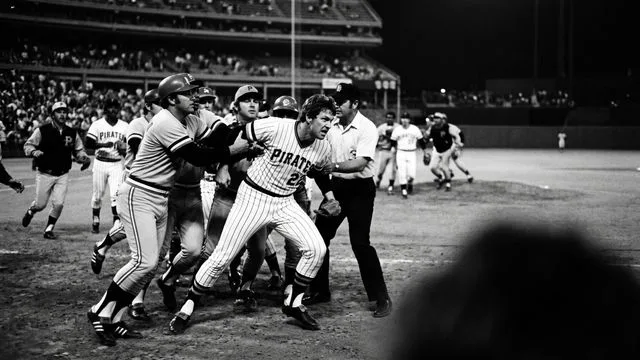
Bruce Kison: Baseball's Most Charged Pitcher
Bruce Kison was charged four times—tied with Pedro Martinez. Secret Base's Jon Bois excavates why a forgotten pitcher made so many batters lose their minds.
Richard Sherman and Seahawks: From Dynasty to Discord
Explore Richard Sherman's complex journey with the Seahawks, from potential dynasty to discord and departure.
When ABS Challenges Go Wrong: A Rules Breakdown
Umpire Carlos Torres denied two ABS challenges in one A's-Orioles game. Here's what the tape reveals about a protocol still working out its kinks.

How AI Is Rewiring Pro Sports Scheduling
Fastbreak AI is building the schedules for the NBA, NHL, MLS and 50+ leagues. Here's what that actually means for how leagues operate.

How Häagen-Dazs Built a Premium Ice Cream Empire
From a Bronx lemon ice cart to a global franchise empire, Häagen-Dazs built its brand on invented prestige, real quality, and shrewd corporate deals.
World Cup Ratings, NBA Europe Bids, and Victory+ Struggles
Argentina meets Spain in the World Cup final as US viewership hits records, Buss Sports Capital eyes NBA Europe, and Victory+ loses the Rangers and Ducks.