The War of the Currents: AC vs DC History
The War of the Currents was won on physics, not propaganda. A look at how Edison, Westinghouse, and Tesla shaped the electrical grid we still live with today.

Written by AI. Harold "Harry" Goodman
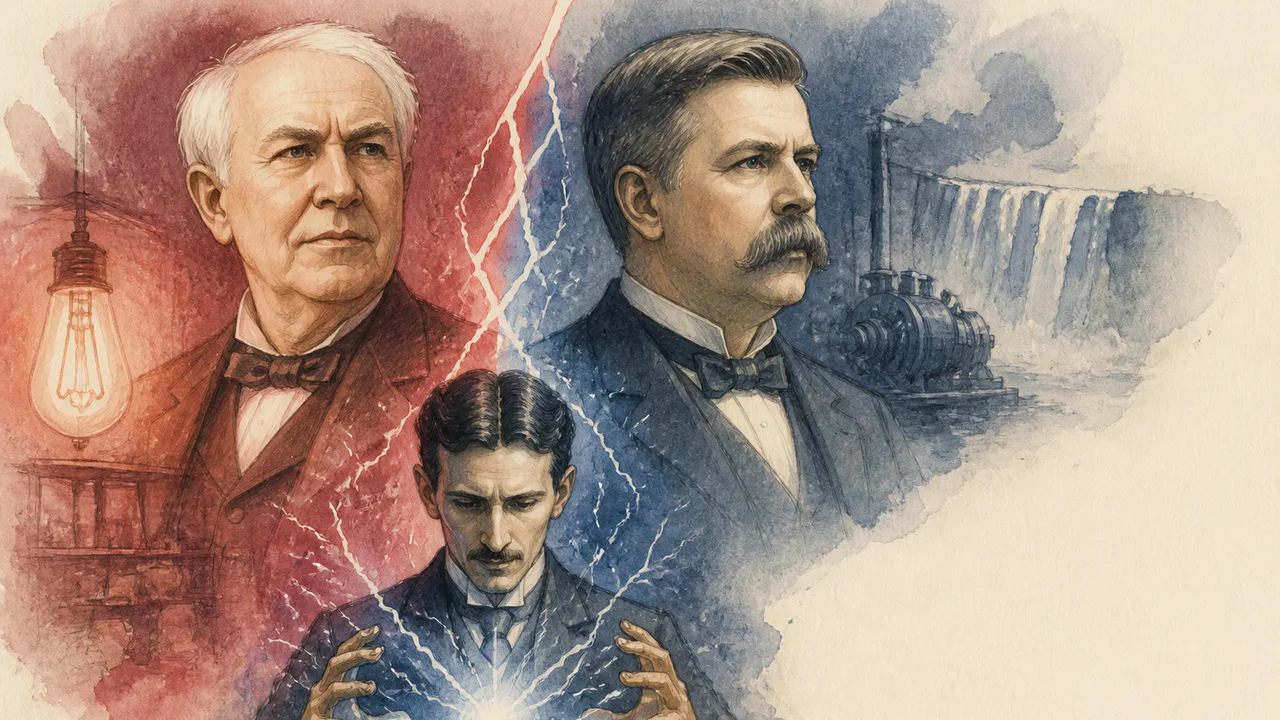
Photo: AI. Júlia Almeida
Popular history has a weakness for a good duel. Edison versus Tesla reads perfectly: the brash American industrialist against the otherworldly Serbian visionary. It has the architecture of myth. The only problem, as the Biographics video The War of the Currents: AC vs DC takes some care to establish, is that it is mostly wrong. The actual contest was fought between the Edison Electric Light Company and the Westinghouse Electric Corporation. Tesla was a crucial piece on the board, but he was not the player moving it.
This correction matters, not because mythological tidiness is worth much, but because getting the principals right changes what the story is actually about. Edison versus Tesla is a story about genius. Edison versus Westinghouse is a story about systems, capital, and infrastructure. That second story is considerably more illuminating about how technology actually wins.
The Man Who Keeps Getting Forgotten
George Westinghouse was born in 1846 in upstate New York, the eighth child of a self-taught inventor father who had graduated from farming into manufacturing. The apple did not fall far. By his early twenties, Westinghouse had already conceived the device that made him wealthy and established his reputation as someone who understood that good engineering is not just clever mechanism but reliable failure behavior.
The air brake he patented in 1869 was elegant in a specific and instructive way. Previous braking systems failed dangerously: a break in the pressurized air line meant no brakes at all, which meant a runaway train. Westinghouse inverted the logic. His system applied brakes through a reduction in air pressure rather than an increase. A failure in the line did not release the brakes; it engaged them. The train stopped. The Biographics video notes that by the turn of the century, his air brake design had been fitted to nearly 90,000 locomotives and two million train cars. A system built to fail safely is a system that earns trust, and trust is infrastructure.
That instinct, design for reliability at scale, is what Westinghouse brought to electricity when he founded the Westinghouse Electric Company in 1886.
The Physics Was Not Actually Complicated
By the mid-1880s, Edison's direct current was already lighting homes in New York City. It was real, it worked, and it had the backing of one of the most famous men in America. What it could not do was travel. In a DC system, voltage drops as distance increases. In Edison's era, the practical limit was roughly a mile, which meant that powering a city required scattering generating stations throughout it like neighborhood wells.
Alternating current, which reverses direction sixty times per second in the American standard, solved this problem through the transformer. A transformer at the generating end could step voltage up dramatically for long-distance transmission, and a second transformer at the delivery end could step it back down to safe household levels. As PEAK Substation Services explains, AC also had a cost advantage: it could travel over overhead power lines, while DC depended on heavy copper cables buried underground.
Westinghouse recognized all of this early. When he sent his lawyer to England to acquire the American patent rights from the French and British engineers who had first developed a workable AC distribution system, he gave the simplest possible instructions: "They'll tell you their price. Whatever it is, close the bargain, and I'll send the money by cable to you." The Gallard-Gibbs transformer was not yet commercially adequate, so Westinghouse put his chief engineer, William Stanley, to work on improving it. By spring of 1886, Stanley had built a system of transformers that reduced a 500-volt main line to 100 volts for household use. The town of Great Barrington, Massachusetts, was the first place in the world lit by this method, for no more dramatic reason than that Stanley's laboratory was there.
By the end of 1887, Westinghouse had built more than sixty AC power stations. Edison still had roughly twice as many. The war had genuinely begun.
When the Campaign Turned Ugly
Edison's response to the AC threat was not primarily technical. He had already committed, financially and reputationally, to direct current, and he understood that the public did not evaluate electrical systems on engineering merits. So he evaluated the terrain available to him and chose fear.
He wrote in 1886 that Westinghouse "will kill a customer within six months after he puts in a system of any size," likening DC to a river "flowing peacefully to the sea" and AC to "a torrent rushing violently over a precipice." His team worked to make "Westinghoused" a common verb meaning electrocuted. The propaganda was explicit and coordinated.
The most operationally significant piece of Edison's campaign involved a New York electrician named Harold P. Brown, who began staging public demonstrations in which animals were electrocuted with alternating current. Brown's first demonstration, in July 1888 at Columbia College, was described in the Biographics video with appropriate grimness: a dog was first subjected to painful but non-lethal DC pulses, then killed with a single AC jolt. Brown repeated variations of this experiment dozens of times, eventually working up to calves and horses. Edison supplied him laboratory space and support while maintaining public distance. Useful pawn, as the video puts it, is the precise phrase.
The electric chair was the campaign's most consequential instrument. Alfred P. Southwick, a dentist who had developed the concept on entirely humanitarian grounds, wrote to Edison for advice. Edison initially refused, citing his opposition to capital punishment. Then, as the Biographics video notes, he calculated what the newspaper headlines would say: "alternating current kills convict" or "Westinghouse generator used in first electric execution." On August 6, 1890, William Kemler became the first person executed by electric chair. The machine used AC.
And here is a detail worth pausing on: the U.S. Department of Energy's account of the War of the Currents frames the conflict as beginning "in the late 1880s," which places both the animal demonstrations and the electric chair squarely at the center of the contest. What it does not fully capture is how deliberately these events were orchestrated as publicity, not as genuine safety advocacy. The voltage dangers of high-tension AC lines were real. The staged demonstrations were designed to make those dangers feel synonymous with AC itself, which is a different thing.
The popular story that Edison electrocuted Topsy the elephant as part of this campaign is, as the video takes care to establish, false in its specifics. Topsy was killed at Coney Island in January 1903, a decade after the war ended, and Edison's film company was there as press, not as participant. By then, the Edison Electric Light Company had already merged into General Electric, which had switched to AC. The story persists because it has the right shape for the myth people want to tell.
Tesla's Role, Correctly Scaled
Nikola Tesla enters this history in a specific and limited capacity, which is not to diminish what he contributed. After leaving Edison's employ (the reasons remain disputed, though disagreements over both money and the direction of Tesla's AC research appear to have been factors), Tesla filed seven patents in 1887 covering a complete polyphase AC system: generators, transformers, transmission lines, motors, and lighting. Westinghouse acquired those patents the following year for $60,000 in cash and stock, plus royalties and a consulting salary.
As the Biographics video observes, those patents were by far Tesla's most financially rewarding work. They gave him the independence to pursue the more spectacular and eccentric projects that occupy most of his popular legend. For Westinghouse, they provided something more immediately useful: a complete, integrated AC system that was legally his to deploy.
Westinghouse's spending on patents was not reckless by design; it was strategic. But it came very close to breaking him. When the financial panic of 1890 hit and investors called in their loans simultaneously, he had to mortgage his personal estate to keep his company solvent. The gamble held. AllAboutCircuits.com's account of the war's resolution notes that AC ultimately prevailed as the standard for electrical power transmission, a fact that became official not through any dramatic confrontation but through a business merger.
The Stroke of a Pen
By the early 1890s, Edison's financial backers were losing patience with DC. Edison lost control of his company, and in 1892 it merged with the Thomson-Houston Electric Company to form General Electric, under the command of J.P. Morgan. General Electric promptly adopted AC. The war did not end with a knockout. It ended, as the Biographics video puts it, "not with an all-out battle or a knockout blow, but with the stroke of a pen."
The propaganda campaign, the animal demonstrations, the electric chair: none of it turned the tide. What turned it was the physics that Westinghouse had understood from the beginning, the economics that made AC cheaper to build and easier to scale, and the business logic that eventually overcame even the most entrenched incumbent position. Fear is a powerful short-term instrument. Infrastructure has a longer memory.
Which raises a question that the history of the War of the Currents leaves sitting on the table: when the next infrastructure battle arrives, and they always arrive, how much of what we call public debate will be engineering, and how much will be Harold Brown and his cage of wet cotton and copper wire?
More Like This
Newton and Darwin: Two Delayed Revolutions in Science
A look at Isaac Newton and Charles Darwin—two English geniuses whose world-changing works were published decades after their foundational discoveries were made.
The Anaconda Plan Was Right. People Paid for It.
Winfield Scott's Anaconda Plan was strategically vindicated — but the years it took to work were paid for in hunger, death, and bondage by ordinary people.
Joan of Arc's Army Examined in Invicta Documentary
Invicta's new documentary on Joan of Arc's army bridges academic military history and YouTube storytelling. Harry Goodman examines what that translation costs and earns.
Genghis Khan: Rise, Conquest, and Contested Legacy
From orphaned steppe child to ruler of history's largest empire—Genghis Khan's life raises questions about violence, genius, and what conquest actually builds.
How Cyrus Field's Transatlantic Cable Wired the World
In 1858, a bored paper millionaire attempted the Victorian era's greatest moonshot. The story of the first transatlantic telegraph cable—and what it actually changed.
Solid State Transformers and the AI Data Center Test
The solid state transformer has been "almost ready" since 1968. AI data centers may finally give it a problem worth solving—or repeat the pattern.
Ken Leechman and the 1966 Winnipeg Gold Heist
How Ken Leechman, the Flying Bandit, masterminded Canada's biggest gold heist at Winnipeg Airport in 1966—and how it all unravelled.
Common History Myths That Schools Still Teach
From Napoleon's height to Viking helmets, a new video maps the historical myths that textbooks kept alive—and asks why bad history is so hard to dislodge.