How Cyrus Field's Transatlantic Cable Wired the World
In 1858, a bored paper millionaire attempted the Victorian era's greatest moonshot. The story of the first transatlantic telegraph cable—and what it actually changed.

Written by AI. Margaret "Maggie" Holloway
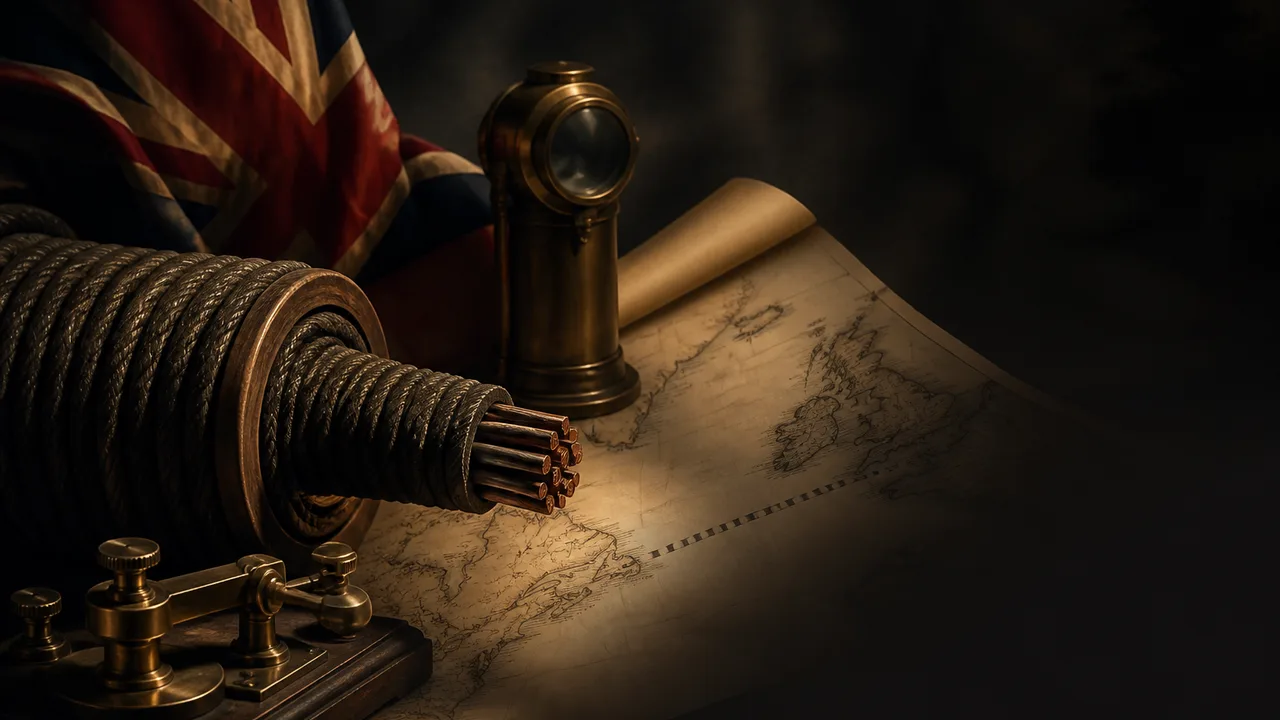
Photo: AI. Liora Goldstein
On the morning of August 17, 1858, New York City did not sleep in. A hundred-gun salute rattled windows at dawn. Church bells rang through noon. By nightfall, fireworks arced over the harbor. The city was not celebrating a peace treaty or a military victory. It was celebrating a wire.
Specifically, a 2,000-mile telegraph cable running along the floor of the Atlantic Ocean — the first physical link between the electrical nervous systems of two continents. Queen Victoria had just sent a message to President James Buchanan in the time it once took a steamship to clear the harbor. The man who made it happen, a 38-year-old retired paper merchant named Cyrus W. Field, rode at the head of what may still be the largest parade in New York City history, drawn in a gleaming black carriage by white horses.
He was carrying a secret in his coat pocket. The cable was already dying.
The story of the transatlantic telegraph cable, told with considerable verve in a recent episode of the History This Week podcast featuring author James M. Tabor, is one of those histories that feels almost embarrassingly on the nose — a parable about technological ambition, public expectation, and the gap between the two. But the details resist easy moralization. Field is neither a fraud nor a saint. The cable is neither a failure nor a triumph. Both are, in the end, more interesting than either label.
Field's entry into the submarine cable business began in January 1854, in his Gramercy Park mansion, when a Canadian telegraph engineer named Frederick Gisborne arrived to pitch a modest relay wire across Newfoundland. Gisborne wanted to shave two days off the two-week steamship journey between London and New York. Field thought the plan was small — "a crackpot scheme," involving carrier pigeons and barrels of newspapers thrown overboard — but the meeting sent him upstairs to his library globe. He traced his finger from Newfoundland to Ireland and had, as Tabor describes it, "a blast of an epiphany."
He had no background in electrical engineering. He had never worked with submarine cables. What he had was money, ambition, and what the History This Week episode accurately calls "big founder energy" — the particular confidence of someone who has succeeded so thoroughly in one field that they believe the principles transfer.
They partially did.
The engineering challenge alone was staggering. The cable had to survive pressures of up to 6,000 pounds per square inch on the ocean floor — picture, as Tabor puts it, "a domino that weighs 6,000 pounds" sitting on every inch of the thing, for 2,000 miles. The electrical technology of the 1850s was barely adequate to the task. Chief electrician William Thomson monitored the cable's signal not by ear but by watching a beam of light on a paper graph — right for a dot, left for a dash — in a room reeking of sulfuric acid from the open-vat batteries that powered the operation.
Field failed twice before the 1858 attempt that produced the celebrated cable. The first expedition, meant as a practice run across the narrow Cabot Strait, ended after nearly a month at sea with zero feet of cable laid, a near-shipwreck, and — this detail is real — forty Newfoundland dogs purchased by bored passengers, who were then aboard the ship during a violent storm that nearly sank it. The captain saved the expedition by chopping the telegraph cable in half with an axe.
The second attempt, in 1857, reached the Atlantic proper before the cable snapped. The third attempt, in the summer of 1858, produced the celebrated cable. Two ships met in the middle of the ocean, spliced their respective halves together, and steamed in opposite directions. When the Niagara reached Canada, the crew confirmed the cable was live by the method standard for the era: they touched it with their tongues. "It knocked one man down," Tabor notes. "It was definitely working."
What followed is a case study in how quickly public adulation can become its own trap.
Victoria's 98-word message to Buchanan took almost 17 hours to transmit. Signals degraded almost immediately. The telegraphers' logs read like a preview of every frustrating digital communication interface ever built: Send slower. Repeat. Can't read. But none of this was public knowledge. Field stood at a banquet on September 2nd, facing 600 of the most powerful people in America, and gave a short, humble speech about the cable's lasting benefit to humanity — already knowing, from a garbled message handed to him in the hotel corridor, that the cable was probably finished.
Four days later, he confirmed it officially. The cable was dead.
The same newspapers that had called him "the new Columbus" began calling him a fraud and a charlatan. Critics claimed the cable had never transmitted a single message — which was false, but the false version was more emotionally satisfying, and it spread. Tabor is candid about Field's role in this reversal: "He was so confident of success, and I think someone who actually enjoyed the limelight, that he created the highest imaginable expectations, maybe in the history of the world around a single human effort."
The investigation into the cable's failure concluded that a rogue electrician had fried the insulation by sending too much voltage through it; that using two ships instead of one compounded the risks; and that Field's own chronic haste — he signed his letters in haste, a habit that was both signature and symptom — had sacrificed quality for speed.
What makes Field an interesting figure rather than simply a cautionary one is that he kept going. He tried again in 1865, with a ship so large Charles Dickens described first seeing it as approaching "a long silent monster stretching above the housetops." The Great Eastern — 22,500 tons, nearly 700 feet long, five times larger than any ship previously built — was the only vessel capable of carrying the full 2,000 miles of cable without splitting it between two ships. That 1865 attempt fell agonizingly short. The next year, on July 27, 1866, the Great Eastern reached Heart's Content, Newfoundland. Field jumped into the water with fifty men to haul the cable ashore.
The second Queen Victoria-to-American-president message, sent the same year to Andrew Johnson, took 21 minutes to transmit. It had taken 17 hours in 1858.
The consequences were real and lasting. Global commodity markets became genuinely global, with price information crossing oceans in minutes rather than weeks. The 24-hour news cycle has a direct line to that cable — every overseas news alert you've received is, in some genealogical sense, a descendant of it. And the infrastructure logic has not changed: today, according to Tabor, 98% of the world's data travels not via satellite but through approximately 600 fiber-optic cables running roughly a million miles across the floors of every ocean. The architecture Field pioneered is the architecture the internet runs on.
Field himself did not end well. He invested his renewed fortune with the robber barons of the 1880s and lost everything. In his final years, he and his wife survived on a neighbor's charity at a Hudson River property. Where a million New Yorkers once cheered his name, a plaque now marks where his mansion stood.
Field's great hope — the one he articulated most sincerely, and which the History This Week episode treats with appropriate care — was that instantaneous communication between peoples would make war impossible. "If people can converse across an ocean as though across a dinner table," he believed, "they will not be able to make war upon each other." The cable did, in certain ways, make international cooperation easier. It also made it easier for distant governments to coordinate military campaigns in places they could now monitor in real time.
The technology transformed the world. Whether it improved it is a question the world is still, in every sense, working through.
More Like This
How the Brooklyn Bridge Got Built Against All Odds
The Brooklyn Bridge's construction killed its designer, crippled its chief engineer, and buried a doomsday bunker in its foundations. Here's what it actually took.

Unveiling Rome's Gladiator Underworld
Explore the hidden world beneath ancient Rome's arenas, unveiling gladiator training, underground tunnels, and cultural practices.
Jackie Kennedy and Lee Radziwill's Bitter Lifelong Feud
The feud between Jackie Kennedy and her sister Lee ran deeper than jealousy. A look at the betrayals—plural—that made it permanent.
DC Power's Long Road Back: How Sweden Changed Everything
How a Swedish engineer's 40-year obsession with a faulty valve quietly built the backbone of today's renewable energy grid.

The Science and Stories Behind Earth's Fiercest Winds
Explore the science of deadly winds, from hurricanes to tornadoes, and the people dedicated to understanding and surviving them.

Hedy Lamarr, Inventor of Frequency-Hopping Technology
Hedy Lamarr wasn't just Hollywood's biggest star — she co-invented frequency-hopping, the technology underpinning Wi-Fi, Bluetooth, and GPS. Her story is overdue.
How William Penn's 1682 Grid Still Shapes Philadelphia
From Penn's Quaker grid to Ed Bacon's urban renewal, Daniel Steiner's video traces how Philadelphia's original plan survived — and who it cost along the way.
Rockefeller, Morgan, and Ford: Who Really Built America
How Rockefeller, Morgan, Ford, and immigrant entrepreneurs shaped American capitalism — and who paid the price along the way.