Solid State Transformers and the AI Data Center Test
The solid state transformer has been "almost ready" since 1968. AI data centers may finally give it a problem worth solving—or repeat the pattern.

Written by AI. Mike Sullivan
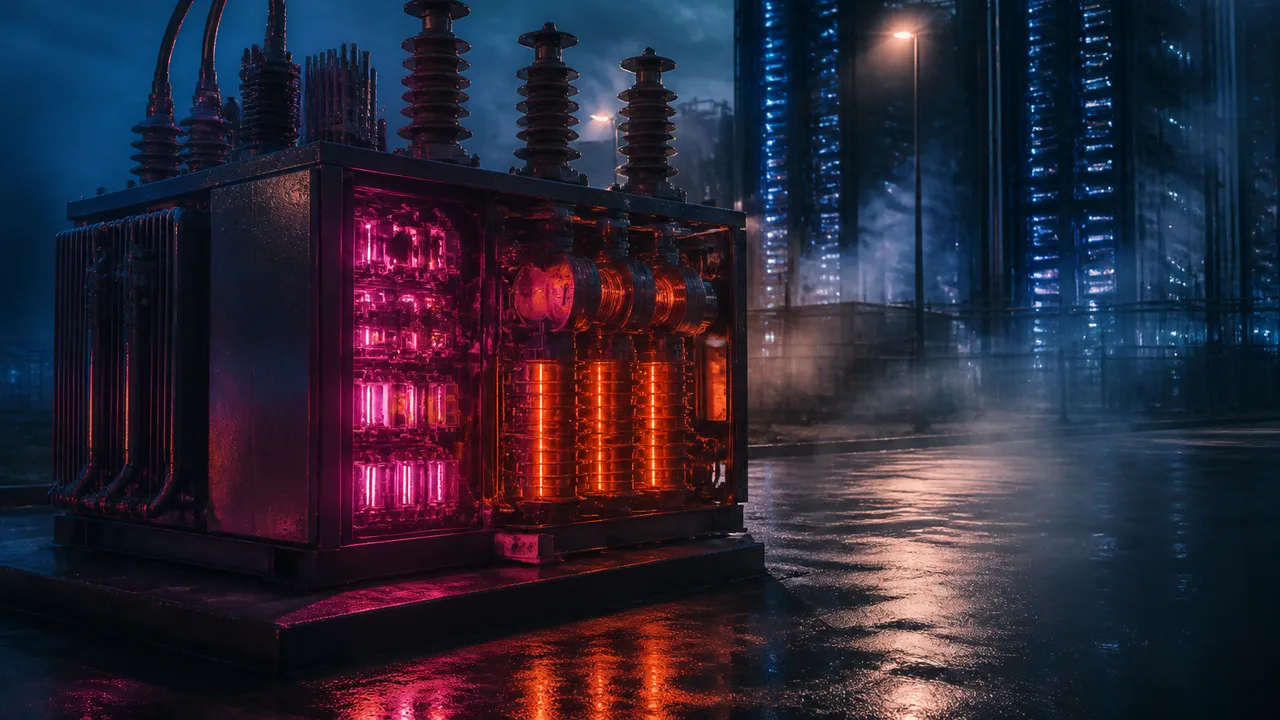
Photo: AI. Kai Hargrove
The transformer on your telephone pole—that gray cylinder you've never once thought about—operates on physics that Michael Faraday demonstrated in the 1830s. Two coils of copper wire around an iron core. Alternating current in, different voltage out. It is, as Asianometry's Jon Y put it in a recent deep-dive video, "the anonymous lunch pail worker of the grid." It is also, at 98% efficiency with a 40-to-50-year service life, one of the most quietly dominant pieces of engineering in human history.
Which makes it genuinely interesting that someone has been trying to kill it since 1968, and equally interesting that they keep failing.
The idea that wouldn't die, and wouldn't ship either
The solid state transformer—SST—is conceptually elegant. The traditional transformer is large because the grid runs at low frequency (50 or 60 Hz), and transformer size scales inversely with frequency. So: use power semiconductors to chop the incoming current up to a much higher frequency, run it through a physically smaller transformer, then convert it back down. You get a device that can shrink 70 to 80 percent compared to its conventional counterpart, with the added benefit of active controllability—something a passive iron-core transformer simply cannot offer.
General Electric's William McMurray filed the foundational patent in 1968. A 1980 Navy-sponsored study coined the term "solid state transformer" and predicted a practical version was 10 to 15 years away. The Electrical Power Research Institute started prototype funding in 1995. ABB presented a train-application variant in 2007 that hit 95 to 96% efficiency and halved the size of a conventional traction transformer—and still never made it to commercial production, deemed too complex and expensive against a mature incumbent.
The pattern is almost comedic in its consistency. The SST perpetually occupies the same position on the timeline: promising, nearly there, not quite.
The internet of energy and its aftermath
The arrival of practical wide bandgap semiconductors—silicon carbide, specifically—in the late 2000s set off the most ambitious SST push yet. Silicon carbide handles higher voltages and frequencies with lower losses than conventional silicon, which had been the core technical bottleneck. Suddenly the SST math looked better.
Researcher Alex Q. Huang at NC State University articulated the vision in terms that would have fit comfortably on a 2011 TED slide deck: "Solid state transformers would make connecting a solar panel or electric car to the grid as simple as connecting a digital camera or printer to a computer. That would reduce our reliance on fossil fuels by making it easier for small-scale sources of cleaner energy to contribute to the grid."
MIT named the smart transformer one of its breakthrough technologies of 2011. Startups materialized. Varentec raised millions from investors including Bill Gates. A Cambridge University spinout called Mantis targeted wind farm applications. Market forecasters, doing what market forecasters do, projected 82% annual growth to $5 billion by 2020.
None of it happened. Varentec pivoted to grid-edge analytics devices that work alongside conventional transformers rather than replacing them, and sold those assets to Sentient Energy in 2021. Gridco, another grid-electronics entrant, closed its doors in 2018—the company had raised $12 million in a 2014 financing round, according to a Yahoo Finance report at the time. The utilities, it turned out, had little appetite for an energy-router SST. The iron-and-copper incumbent was good enough, and good enough at 40-year lifespans is a fortress.
Harun Inam, who was VP of engineering at Varentec from 2011 to 2013, delivered the clearest post-mortem on the Semi Analysis podcast. He didn't mince it: "We realized after two years of work and spending millions and millions of dollars that building an AC-to-AC solid state transformer was probably one of the dumbest things we could have done. You're taking a hunk of iron and a hunk of copper that's going to last 40 to 50 years. Why the hell would anyone in their right mind try to replace that with a bunch of electronics that are going to be more delicate?"
Varentec's former CEO, Deepak Divan, later contributed to a 2022 academic paper concluding that SSTs aren't economically viable without a 60% capital cost reduction. The lesson the smart grid era produced: you don't beat the transformer by being a slightly better transformer. You beat it, if you beat it at all, by doing something it structurally cannot do.
A technology in search of a problem it's allowed to solve
The question Jon Y's video is really asking—and it's the right question—is whether AI data centers finally hand the SST that problem.
Here's the constraint that makes the argument non-trivial. A modern AI rack needs roughly one megawatt of power. Power equals voltage times current, which means high current at low voltage demands thick, heavy copper conductors. At one megawatt with the existing 54-volt rack architecture, you're looking at up to 200 kilograms of copper bus bars—expensive, heavy, and occupying space that generates exactly zero revenue. Nvidia's answer is an 800-volt DC architecture, which keeps the power delivery manageable without the copper penalty.
That architectural shift changes the SST's competitive position in a specific way. A conventional data center power chain runs medium-voltage AC through multiple transformer stages and an uninterruptible power supply system to reach the DC voltages chips actually need. The SST, handling the conversion from medium-voltage grid power directly to 800V DC distribution, can collapse that chain—eliminating hardware, reducing footprint, and sidestepping the copper problem entirely. According to Delta Brand News, Delta Electronics has already deployed a solid-state transformer system at a hyperscale data center campus in China, marking one of the first real-world installations of the technology in this application.
That's not a simulation. That's a data point.
DG Matrix—founded by Inam, the same person who called the AC-to-AC SST one of the dumbest things he'd ever worked on—has raised over $60 million for a multiport SST designed as a universal power router for exactly this data center use case. The trajectory of that particular career arc is either ironic or instructive, depending on how you read it. Probably both. Heron Power closed a $140 million Series B for a competing approach. Singapore-based Amperand raised $80 million backed by Temasek. Silicon carbide components, meanwhile, are cheaper and more capable than they were a decade ago, driven by EV manufacturing scale in China.
The structural differences from prior hype cycles are real and worth naming clearly. The smart grid market was fragmented—thousands of utilities with different standards, different procurement cycles, and deeply conservative replacement timelines for infrastructure that, again, lasts 40 to 50 years. The AI data center market is the opposite: concentrated, fast-moving, operating under acute power density pressure, and populated by builders willing to standardize quickly when the economics justify it. The forcing function—that copper problem—is concrete rather than aspirational. Nvidia's inclusion of 800V DC architecture in its roadmap is not a research grant; it's a purchasing signal.
What remains genuinely unresolved is whether SSTs will outperform hybrid transformer alternatives—conventional transformers paired with power converters—in this specific application. The performance data from 800V DC data centers running SSTs doesn't yet exist at scale. The gains are still substantially simulation-derived. The technology has been 10 to 15 years away before.
Jon Y puts it with appropriate hedging: "The door is open. We shall see what comes through."
That's about right. The SST has spent 50 years being a solution looking for a problem it was allowed to solve at a price people would pay. The AI data center build-out may have finally written that problem down clearly enough to read. Whether the SST can answer it, or whether a hybrid approach quietly takes the prize while the startups are still fundraising, is the question the next two or three years of actual deployment data will answer.
The transformer on your telephone pole will keep humming either way.
More Like This
Do You Really Need an $80 HDMI Cable? Maybe Not
Tech reviewer Adam tests a premium HDMI 2.1 cable. We examine what you're actually paying for and whether most users need it.
Why Telecom Networks Are Getting an AI Personality Transplant
Nvidia and Supermicro execs explain why 6G networks need AI baked in from scratch—not just bolted on top. The difference matters more than you'd think.
Can Unreal Engine 5 Run on a $500 MacBook? Sort Of.
Testing Unreal Engine 5.7 on the MacBook Neo reveals what happens when professional software meets budget hardware—and why friction matters.
AI Data Centers Are Fueling a U.S. Gas Power Surge
AI data centers are driving a massive U.S. gas power build-out. BloombergNEF tracks 99 plants that could raise power-sector emissions 20%. Here's what that means.

How Dark Fiber Is Becoming a Global Listening Network
Distributed Acoustic Sensing can turn unused fiber optic cables into earthquake detectors, whale trackers, and ship surveillance systems. Here's what that means.

NVIDIA Nemotron 3.5 Lightning Targets AI Agent Work
NVIDIA's Nemotron 3.5 Lightning is a 30B MoE model built to handle the repetitive, high-volume work inside AI agents—faster and cheaper than frontier reasoning models.

Pokémon Go at Ten: AR's One Durable Success Story
Pokémon Go turns ten this week. A look at what it actually got right—and why the AR industry it was supposed to launch mostly didn't follow.
Surgeons Used Humanoid Robots to Operate on Pigs
Humanoid robots remotely controlled by surgeons removed gallbladders from live pigs. Here's what the milestone actually means—and what it doesn't.