Surgeons Used Humanoid Robots to Operate on Pigs
Humanoid robots remotely controlled by surgeons removed gallbladders from live pigs. Here's what the milestone actually means—and what it doesn't.

Written by AI. Mike Sullivan
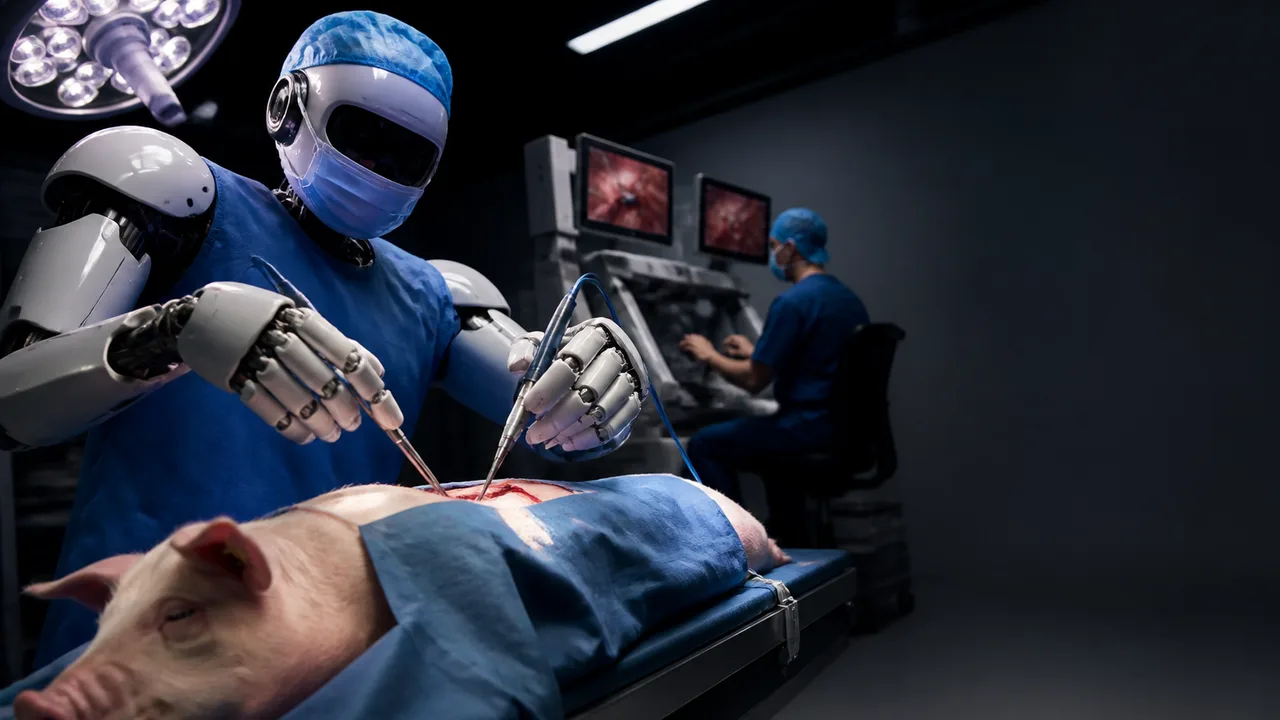
When I was a kid watching RoboCop 2, the operating-table scene was nightmare fuel precisely because a machine was doing something to a human body without the human having much say in the matter. That's the cultural image we carry into headlines like this week's: humanoid robots perform surgery on live animals. Your brain fills in the rest. Beeping machines, cold metal hands, nobody asking if you'd like a blanket.
So let's be specific about what actually happened, because the specifics are both less cinematic and more interesting than the mental movie.
According to Ars Technica, teleoperated humanoid robots completed two minimally invasive surgeries—laparoscopic gallbladder removals—on live pigs, in a preclinical trial published in the journal Nature. Ground.news notes the operative word: these were not autonomous machines making independent clinical decisions. Skilled human surgeons remotely controlled the robots' movements throughout. The robots were the hands. The surgeons were still the surgeons.
That distinction matters enormously, and it's the one that gets lost in the headline scramble.
Not a Robot Surgeon. A Robot Hand.
The da Vinci Surgical System—FDA-cleared in 2000, back when ER was still must-see Thursday television—already proved that surgeons could operate through a robotic interface with results comparable to or better than direct manual technique. Da Vinci is a purpose-built surgical robot: purpose-designed arms, purpose-designed instruments, purpose-designed console. It works. Hospitals use it constantly. It also requires purpose-built infrastructure that can run well into seven figures, which is a polite way of saying that if you're in a rural hospital or a developing-nation clinic, you're probably not getting one.
That's the gap this new research is gesturing toward. Humanoid robots—machines designed to move the way human bodies move—are already being manufactured for general-purpose use in warehouses, factories, and research environments. The bet here is that if a surgeon can teleoperate a humanoid robot the same way they'd operate a da Vinci system, you've potentially decoupled surgical expertise from surgical geography. A specialist in Boston could, in principle, operate on a patient in rural Montana, or in a field hospital, or somewhere that couldn't support the infrastructure costs of a dedicated surgical suite.
That's not science fiction. That's a plausible engineering roadmap. And it's genuinely different from what came before.
The Two Tracks, and Why They Keep Getting Confused
Surgical robotics has been running on two parallel tracks for a while now, and they keep getting conflated in coverage.
Track one is teleoperation: a human expert controls a robotic system remotely, with the robot extending the surgeon's reach and precision. That's what happened in the pig study. That's what da Vinci does. The human is in the loop, making every decision, with the robot as a very sophisticated prosthetic.
Track two is autonomy: the robot makes surgical decisions without real-time human direction. Johns Hopkins' STAR robot—documented by the Johns Hopkins Hub—has demonstrated autonomous laparoscopic surgery on a pig without human assistance, results published in Science Robotics. That's a different and considerably more fraught frontier.
Most of the public anxiety about robot surgery—the "what happens when it goes rogue" question—applies to track two. The humanoid teleoperation study is firmly track one. The robot cannot go rogue on porcine digestive systems; it does exactly what the surgeon's hands tell it to do.
The coverage tends to blur these tracks because "robot surgery" is a cleaner phrase than "teleoperated humanoid robotic interface for minimally invasive laparoscopic procedures." Fair enough. But the blur creates misplaced fear about the first thing and potentially misplaced comfort about the second.
Here's the Part That Makes Me Want to Ask Inconvenient Questions
Every time a new technology layer gets added to medicine, the industry asks: who gets trained, and on what?
Surgeons currently develop their skill through years of direct, tactile, hands-in-the-patient practice. Residencies exist partly because there is no substitute for doing the thing, in the room, with your hands, on actual tissue, with someone senior watching over your shoulder. The feedback loop is physical and immediate. You feel resistance. You correct in real time. You build the kind of muscle memory that doesn't come from a simulator.
This is where I start to sound like someone who's watched the tech industry promise "this changes everything about how we train people" approximately once per decade since the CD-ROM era. Remember when e-learning was going to replace universities? When MOOCs were going to democratize expertise? When VR training was going to close the skills gap in manufacturing? Some of that landed. A lot of it didn't, particularly in fields where physical intuition is load-bearing.
If surgeons are training on humanoid robotic interfaces rather than direct laparoscopic technique, what skill are they actually building? Is it fungible? Does a surgeon who's expert at telepresence robotics develop the same underlying surgical judgment as one who's spent years with hands in a cavity? I don't know. Neither does the field yet. The preclinical trial shows the robots can be operated successfully—it doesn't answer what successful operation does to the development of the operator.
That's a real question, not a rhetorical speed bump. The answer could be fine. The answer could matter a lot. Right now the honest answer is: we're going to find out.
The Regulatory Clock Problem
Medical device regulation operates on a different timescale than venture-backed hardware development. The FDA's 510(k) pathway—the main route for getting surgical devices to market—was designed in an era when the devices being reviewed were, largely, iterative improvements on existing tools. Stents. Pacemakers. Upgraded laparoscopes.
Teleoperated humanoid surgical robots don't fit cleanly into that lineage. They're general-purpose hardware performing specialized clinical functions, controlled by humans in potentially different physical locations, operating on patients who may be thousands of miles from the decision-maker. The liability questions alone would make a healthcare attorney's eyes light up with a mixture of professional excitement and genuine concern.
The history of medical technology is essentially a loop: innovation arrives, clinical enthusiasm outpaces the regulatory framework, the framework scrambles to catch up, occasionally something goes badly wrong in the gap, and the framework tightens. We saw it with direct-to-consumer genetic testing. We saw it with early AI diagnostic tools. We saw it with telehealth credentialing during the pandemic—where necessity forced regulatory flexibility that the system then had to figure out how to formalize afterward.
The question isn't whether the regulatory conversation should happen. It's whether it starts now, before humanoid surgical systems are in widespread clinical trials, or later—which in practice means after the first high-profile adverse event.
What This Actually Is
A preclinical trial in a journal. Two surgeries. Pigs. Proof of concept for a technology pathway that could, with substantial additional development, regulatory navigation, and clinical validation, eventually expand access to surgical expertise in underserved settings.
That's worth reporting. It's worth taking seriously. Koolerai.com frames it as a significant milestone in technology integration, and on the narrow question of whether humanoid robots can be operated precisely enough to perform minimally invasive surgery—they can. That's new information.
It's not the dawn of autonomous robotic surgeons. It's not the end of surgical residency programs. It's not a solution to rural healthcare access—not yet, not without the infrastructure, the credentialing frameworks, the latency problems that anyone who's ever experienced lag on a video call knows will be non-trivial when the stakes are someone's gallbladder.
And it's not nothing. Two surgeries. Pigs. Published in Nature. The da Vinci system was also, once, a preclinical proof of concept that most people assumed would never reach an operating room.
The part that makes me genuinely curious—not skeptical, just curious—is whether the humanoid form factor turns out to matter. General-purpose robots are cheaper and more widely manufacturable than purpose-built surgical systems. If the teleoperation capability is portable across platforms, the infrastructure calculus for global surgical access changes. That's the version of this story that would actually be different from what came before.
We're nowhere near knowing if that's the version we're in.
More Like This

Do You Really Need an $80 HDMI Cable? Maybe Not
Tech reviewer Adam tests a premium HDMI 2.1 cable. We examine what you're actually paying for and whether most users need it.

When Agents Generate Their Own UI: The Three Flavors Explained
CopilotKit's Tyler Slaton maps the spectrum of generative UI—from pixel-perfect control to agents writing raw HTML. Each approach makes different tradeoffs.

Can Unreal Engine 5 Run on a $500 MacBook? Sort Of.
Testing Unreal Engine 5.7 on the MacBook Neo reveals what happens when professional software meets budget hardware—and why friction matters.
Midjourney Medical's Ultrasonic Body Scanner, Explained
Midjourney founder David Holz wants to reinvent medical imaging with ultrasonic full-body scans. Here's what the technology promises—and where physics pushes back.

UBTech's Humanoid Robot Pushes Into Home and Border
UBTech's UWorld U1 humanoid aims to replicate human faces, voices, and emotions. Here's what the launch actually shows — and what it quietly sidesteps.
Brain-Computer Interfaces Are Coming. Who Can Afford Them?
Brain chips can restore movement to paralyzed patients. But at $50,000 a surgery, the real question isn't who wins the tech race — it's who gets left out.

Pokémon Go at Ten: AR's One Durable Success Story
Pokémon Go turns ten this week. A look at what it actually got right—and why the AR industry it was supposed to launch mostly didn't follow.

U.S. PhD Admissions Fall 15%: A Threat to Science
PhD admissions at top U.S. research universities dropped 15% this fall. Here's what that means for the science pipeline—and why it's harder to fix than it looks.