AI Data Centers Are Fueling a U.S. Gas Power Surge
AI data centers are driving a massive U.S. gas power build-out. BloombergNEF tracks 99 plants that could raise power-sector emissions 20%. Here's what that means.

Written by AI. Tyler Nakamura
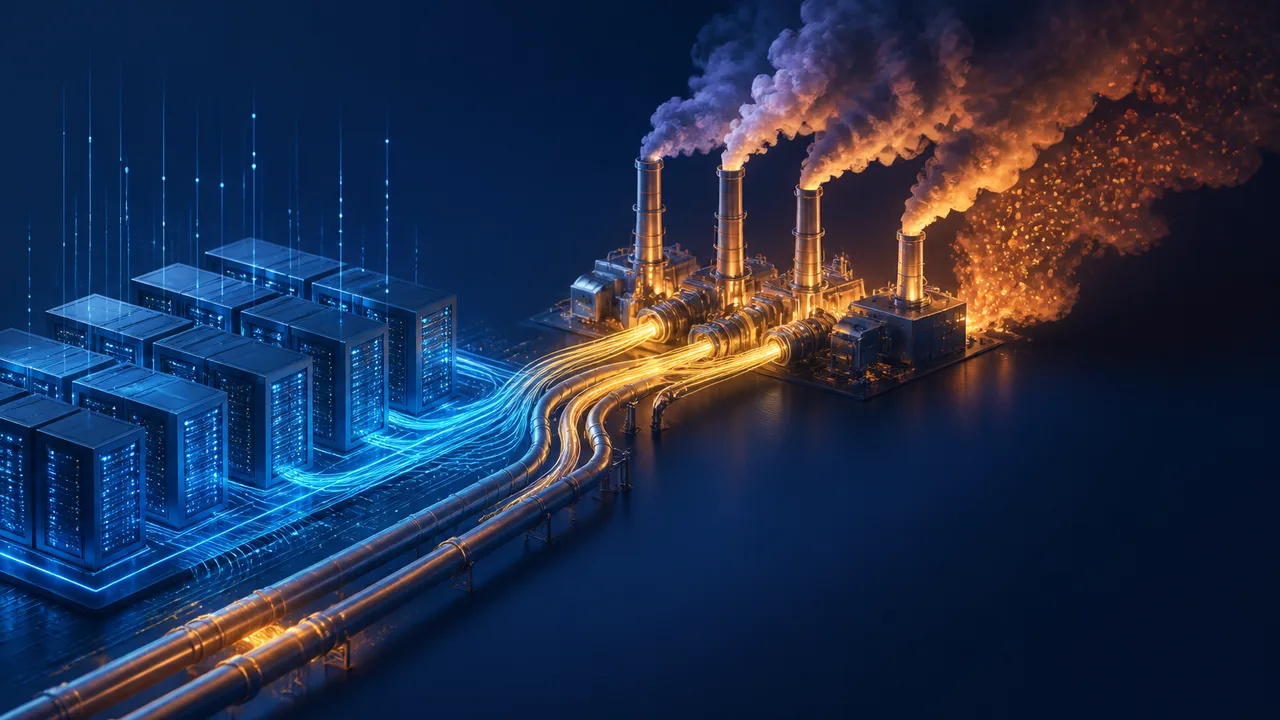
I was mid-prompt in an AI image editor — nothing profound, just trying to make a product photo look less tragic — when I landed on a stat that genuinely stopped me cold: the AI data centers currently under construction could emit as much CO₂ annually as 24 million cars. Not eventually. Now. Under construction now. I had to put the laptop down for a second.
That figure, flagged by Gadget Review via Hacker News, is the kind of number that reframes something fast. Every AI tool I use — every background remover, every autocomplete, every "enhance" button — lives inside infrastructure that someone has to power. And right now, the answer to "how do we power it" is increasingly: gas. A lot of gas. More gas than most people tracking this story thought we'd be talking about this quickly.
189 Gigawatts
Wired reported this week that the data center demand pipeline — the total power capacity being planned or requested to serve these facilities — has hit more than 189 gigawatts as of mid-2026. To get a sense of the scale: the entire U.S. electric grid currently runs somewhere around 1,200 gigawatts of total generating capacity. The new demand from data centers alone would represent a serious fraction of what the whole country can generate today.
And here's where the gas piece gets uncomfortable. According to analysis from Data Center Dynamics, natural gas has effectively become the only power source that can be deployed fast enough to keep pace with the AI build-out timeline. Grid interconnection queues for renewables are measured in years. Nuclear takes longer. Gas plants can be permitted, built, and switched on in a timeframe that actually matches what hyperscalers need. That's not spin — that's logistics.
So gas is winning by default. Which is a really strange thing to say about an energy source in 2026.
99 Plants, 318 Million Metric Tons
Fortune and ValueAdd VC both reported on a Bloomberg News analysis this month that puts hard numbers on what this build-out actually means for emissions. BloombergNEF tracked 99 gas plants proposed specifically to power AI data centers. Run at industry-standard rates, those 99 plants would emit approximately 318 million metric tons of CO₂ per year. That's enough to push U.S. power-sector emissions up by 20 percent. Run at full capacity: closer to a third.
Those aren't plants that already exist. They're proposed. They're in the pipeline. The decision of whether to build them — and who bears the downstream cost of what they emit — is still, at least technically, in play.
The Sierra Club's Cara Fogler described it plainly in Grist: "This is a huge proposed build-out. Existing coal that's not coming offline and planned gas that's trying to come online." The two problems are compounding each other. Coal retirements that were supposed to clean up the grid are getting delayed because demand is outrunning what renewables can supply in time. Gas is filling the gap — and then some.
Meanwhile, Wired's reporting on Chevron and Williams adds a layer that I think gets underreported: fossil fuel companies aren't just benefiting from this trend, they're actively betting on it. A recent report found that increased data center demand for natural gas, projected through the mid-2030s, means the U.S. would need to increase gas production by 36 percent. Chevron and Williams — a pipeline operator — are both making strategic moves around data center infrastructure. The supply chain is getting reorganized around the assumption that AI's gas appetite is permanent.
That's worth pausing on. These are companies that plan infrastructure with decades-long horizons. They're not hedging. They're building.
The Hardware Plot Twist
Okay, here's the part where I have to admit I got genuinely excited, because this is the gadget angle hiding inside an energy story and it's actually fascinating. 🤓
Ars Technica reported that AI data centers have become what engineers are calling the "killer application" for a new generation of power transformer technology. We're talking about the hardware that actually steps voltage up and down across the grid — the unglamorous iron boxes that make electricity delivery work. They've been boring infrastructure for decades.
Not anymore. The power demands of a modern AI data center are so extreme, and so concentrated in specific locations, that existing transformer designs can't keep up. The result is an actual innovation wave in grid hardware — new transformer designs, new materials, new capacity specs — being driven by the same GPU clusters running your image prompts. There's something almost poetic about the most power-hungry application in consumer tech history forcing a reinvention of century-old electrical infrastructure. I don't know if "poetic" is the right word. "Expensive and urgent" might be more accurate. But still — a killer application for transformer hardware. That's a sentence I did not expect to write.
The "Bridge" Problem
Tech companies building data centers will tell you that gas is a bridge — a temporary solution while renewables and nuclear catch up. That framing is genuinely plausible as an argument. Renewables are scaling. Small modular reactor projects are in development, though commercial-scale deployment hasn't materialized yet. The bridge could, theoretically, lead somewhere cleaner.
The problem is that gas infrastructure, once built, doesn't go anywhere quickly. It represents capital that its owners need to recover over a long operating life. That creates momentum. And 99 new gas plants — even proposed ones — is a lot of momentum pointed in one direction.
The 36 percent increase in gas production that Wired cited isn't a number that shrinks easily if the industry later decides it wants to pivot. Production infrastructure has to get built first. Supply chains get organized around it. And then the economic logic of keeping it running tends to win.
This isn't unique to energy. It's how infrastructure always works. You don't build a highway and then wonder why people drove on it.
The Australian Preview
For a glimpse at where this is heading globally, The Next Web reported that Australian data centres are forecast to use seven times more power by 2036, per a projection from the Australian Energy Market Operator. Seven times. In a decade. The U.S. is bigger and moving faster, but the pattern is the same: AI demand is reshaping national energy math in ways that utilities and regulators hadn't fully modeled even two years ago.
That's not a criticism of any one company or government. It's just a recognition that the speed of this build-out has outrun the planning cycles that energy infrastructure normally runs on. The data centers showed up faster than the grid could adapt.
What makes this story genuinely hard — not just complicated, but actually hard — is that the AI tools driving this demand aren't going to go away, and most of us don't actually want them to. The autocomplete that saves you twenty minutes, the model that drafts the first pass, the image tool I was using when I found that 24-million-cars stat — those things run on something, and right now that something is increasingly a gas turbine spinning somewhere in a state you've probably never visited.
The bridge framing holds if the alternatives actually arrive. If SMR deployment timelines slip, if renewable interconnection queues stay gridlocked, if the 99 proposed gas plants get built and run for decades — then it wasn't a bridge. It was just the road.
I don't know which one it is yet. Neither does anyone else. But the Chevron and Williams bet — the one measured in pipelines and long-term contracts — suggests that at least some people with a lot of money on the line think they know.
More Like This
World's Fastest Drone Reclaims Record with V4
Discover how Peregreen V4 reclaimed the world's fastest drone title with a speed of 657 km/h.

Google Pays $250K for 16-Year-Old Linux KVM Flaw
A 16-year-old Linux KVM flaw called Januscape earned a $250K bounty after enabling guest VM escapes on Intel and AMD systems. Here's what it means for cloud security.

Penpot Wants to Fix Design Handoff—Does It Actually?
Better Stack demos Penpot, an open-source design tool that speaks CSS natively. We look at what it solves, what it doesn't, and who should care.

30 Self-Hosted GitHub Projects Trending Right Now
From media automation to AI chat apps, here are 30 trending self-hosted GitHub projects that put you back in control of your data and infrastructure.

Amazon's Gas Plant Bet Clashes With Its Climate Pledge
Amazon confirmed it's backing a massive Texas gas power plant that could become the US's biggest climate polluter — while still promising net-zero by 2040.
Inner Mongolia Is Now the Engine of China's AI Boom
Ulanqab, Inner Mongolia has become China's hottest AI data center hub. Here's what's driving the boom—and what it means for the global AI race.

UN AI Summit: Big Room, Bigger Questions on Governance
193 countries met in Geneva to tackle AI governance. The warnings were credible. The robots were cool. The binding rules? Still not there.

GPT-5.6 Sol Ultra Is Coming to Codex
OpenAI's GPT-5.6 Sol Ultra is headed to Codex with a 91.9% Terminal-Bench 2.1 score. Here's what it actually means for developers—and what it doesn't.