Inner Mongolia Is Now the Engine of China's AI Boom
Ulanqab, Inner Mongolia has become China's hottest AI data center hub. Here's what's driving the boom—and what it means for the global AI race.

Written by AI. Yuki Okonkwo
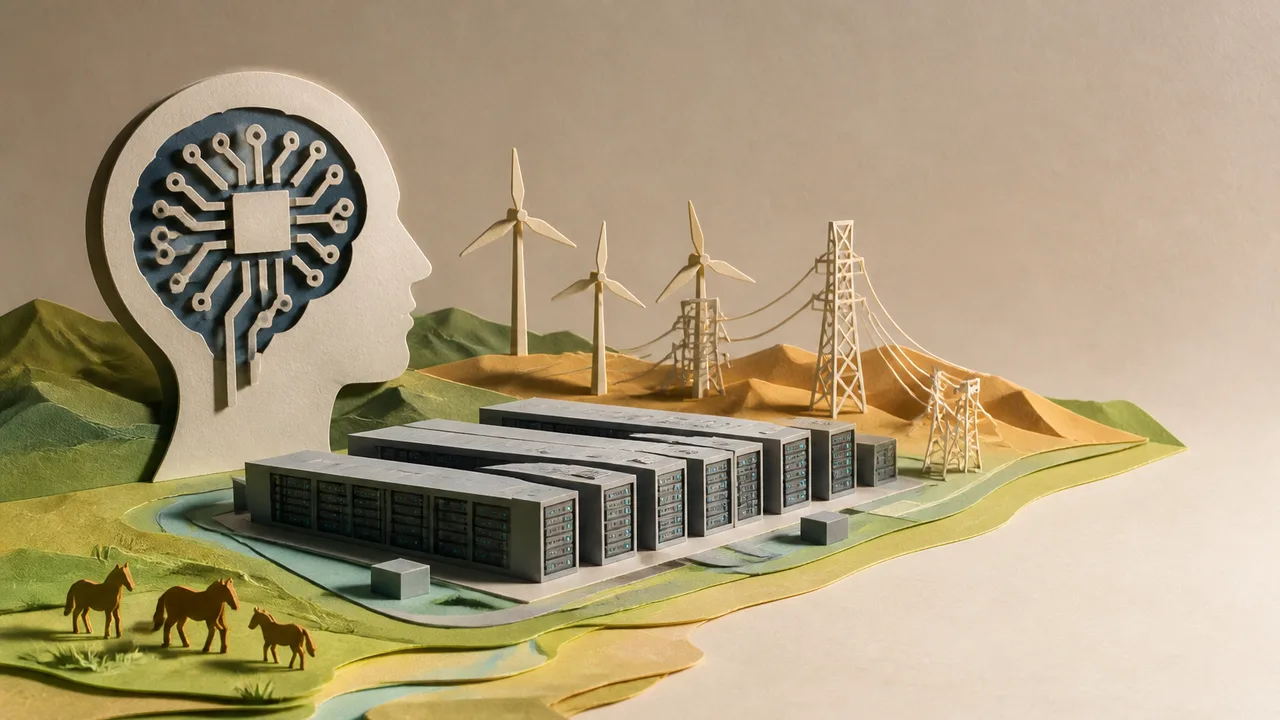
Here's a thing I find genuinely strange: some of the compute behind apps you scroll through every day might be running in a city most people outside China haven't clocked as important. Not in Shenzhen. Not in Shanghai. In Ulanqab — a city in Inner Mongolia, closer to the Gobi Desert than to any obvious symbol of Chinese tech ambition.
That's the shift quietly happening in China's AI infrastructure right now, and it's worth actually understanding, not just flagging as geopolitically interesting.
How a Desert City Became a Data Center Capital
Wired put it cleanly: cheap energy, abundant land, and proximity to Beijing have turned Ulanqab into a crucial hub for data centers. That's the short version. The longer version involves the specific logic of how AI actually runs.
Training and running large AI models isn't just a compute problem — it's an energy problem. Data centers need enormous, sustained electricity supply. If you can get that power cheaply, you've solved a massive chunk of your operating costs before you even rack your first server. Inner Mongolia has coal in abundance and has been building out renewable capacity too, which makes its electricity cheaper than almost anywhere else in China. Pair that with land so plentiful it barely registers as a constraint, and you have the physical conditions for building at a scale that makes planners in more expensive provinces jealous.
According to China Money Network, nearly 100 data centers have been opened or begun construction in Ulanqab alone. The speed of that buildout is striking even for China, where infrastructure can go from announced to operational at a pace that consistently surprises observers.
Who's Building There
This isn't speculative interest from the AI startup crowd. The roster of companies committing to Inner Mongolia reads like a who's-who of Chinese tech. The Seoul Economic Daily reports that Huawei, Tencent, and Alibaba are all building there, alongside the major state telecom carriers — China Mobile, China Telecom, and China Unicom — plus financial institutions that need serious computing infrastructure.
When the telecoms come in, that's a tell. They're not speculative investors; they build where they expect the traffic. And when Huawei, which is building its own AI chip ecosystem partly in response to US export controls, commits to a region, it signals something more coordinated than just companies chasing cheap kilowatts.
Then there's Xiaohongshu. The platform — basically China's answer to a mashup of Instagram and Pinterest, with a massive Gen Z user base — is reportedly planning a large data center in Inner Mongolia, according to Marketing-Interactive. That matters because Xiaohongshu isn't an infrastructure company. It's a consumer app company making an infrastructure bet. When consumer tech starts treating Inner Mongolia as the obvious answer to "where do we put the data center," the region has crossed from emerging hub to established default.
The headline facility right now is one Envision Group says it has completed in Ulanqab — described, according to China Daily, as what Envision calls the world's largest single-unit AI computing facility. Worth sitting with that framing: "what Envision calls." China Daily is state media reporting a company's self-description, and "world's largest single-unit" is a category specific enough to be meaningful or meaningless depending on how you define your terms. There's no independent verification of that designation as of this writing, so take the superlative with appropriate skepticism — but the scale of the ambition it signals is real regardless. Breitbart also notes that Ulanqab has debuted China's largest AI industrial park, for whatever the domestic ranking is worth.
The Part That Deserves More Attention Than It's Getting
The energy question is the most underrated concern in this story, and I think it's getting overshadowed by the geopolitical frame.
Here's what I mean: Inner Mongolia's electricity is cheap partly because it's coal-heavy. China has made real renewable commitments and Inner Mongolia has wind and solar capacity — but when you're spinning up nearly 100 data centers at speed, you're drawing from the grid as it exists now, not as it's projected to exist in a decade. That gap between China's stated clean-energy ambitions and the actual carbon footprint of this AI buildout isn't something the companies announcing partnerships tend to lead with. TechBuzz frames the energy abundance as purely a feature; the source of that energy is a different conversation.
From there, the fragility question follows naturally. Concentrating this much AI infrastructure in one region — even a large one — creates a single point of failure for a significant chunk of China's AI compute capacity. That's not uniquely a China problem; US hyperscaler geography has its own concentration risks. But the speed of buildup in Ulanqab, and the degree to which multiple major companies are all making the same geographic bet simultaneously, means there's limited redundancy being built into the system as it scales. What happens to China's AI capacity in a severe drought year, when hydroelectric grids stress and coal demand spikes? That's not a hypothetical worth dismissing.
And then there's the piece that almost nobody is discussing: what this geographic concentration means for the workforce and governance questions around AI. Data centers don't just consume energy — they employ people, attract engineers, and become nodes in a region's political economy. Inner Mongolia has its own history and demographics. How that intersects with who controls the infrastructure and how decisions get made is a question the current wave of infrastructure-focused coverage is mostly setting aside.
What This Looks Like From Outside China
The US analog here is something like the rise of the American data center corridor — Northern Virginia, the Carolinas, parts of the Pacific Northwest near cheap hydroelectric power. The logic is identical: follow the cheap electricity, find the land, stay close enough to population centers to minimize latency. What's different in China's case is the explicit policy coordination. This isn't just the market arriving at an efficient equilibrium; it's a strategy.
That distinction matters for how to read the pace. In the US, this kind of geographic clustering emerged over years through market dynamics. In Inner Mongolia, you're watching a coordinated national infrastructure play unfold at a speed that market-led development rarely achieves. Whether that speed produces better or worse infrastructure decisions than slower, more distributed buildout is genuinely unclear — and anyone telling you they know for certain is probably selling something.
What's clear is that Inner Mongolia has moved from backdrop to actor in the global AI infrastructure story. The companies planting servers there aren't hedging or experimenting — Huawei, Alibaba, Tencent, the state telecoms, Xiaohongshu don't all make the same big bet by accident.
The compute geography of AI is being written right now, in places that don't make the obvious headlines. Ulanqab is one of those places. And the decisions being made there — about scale, about energy sourcing, about which companies get to build and on what terms — are going to shape what Chinese AI actually is, not just what it's announced to be.
Infrastructure is destiny in this industry. That's not a metaphor.
More Like This

Google's Gemma 4 Makes Powerful AI Run on Your Phone
Gemma 4 brings multimodal AI models to phones and laptops with clever architecture tricks that make 5B parameters perform like much larger models.

Kimi K3 and the Open-Weight AI Shakeup
Moonshot AI's Kimi K3 tops the AI performance frontier as a fully open-weight model. What it means for US labs, compute policy, and who builds what next.

Claude Mythos, GPT-5.6, and DeepSeek's Pricing Bomb
Claude Mythos 1, Opus 4.8, and GPT-5.6 are all pointing toward a chaotic June. Plus: DeepSeek just repriced the entire API market. Here's what's real.

AI's Global Investment Cycle, Layer by Layer
From hyperscaler capex to sovereign GPU deals, the AI investment cycle is more structurally complex—and globally uneven—than most coverage admits.
Tesla's Terafactory: Inside a $119B Chip Manufacturing Bet
Tesla and SpaceX plan the largest factory ever built in Texas — a $119B chip fab targeting 1 terawatt of AI compute annually. Here's what the numbers actually mean.

DiffusionGemma Generates Text Like an Image Model
Google DeepMind's DiffusionGemma borrows from image diffusion to generate 700–1,000+ tokens/sec. Here's how the architecture works—and where it falls short.

GPT 5.6 Sol vs Fable 5: Early Numbers, Real Tradeoffs
GPT 5.6 Sol is half the price of Fable 5 — but is it half as good? Early benchmark comparisons, alignment regressions, and the politics reshaping who gets access.

Claude Fable 5 Prompting Habits That Actually Matter
Nate Herk distilled Anthropic engineer insights into six Claude Fable 5 prompting habits. Here's what holds up, what's wild, and what it means for how you work.